

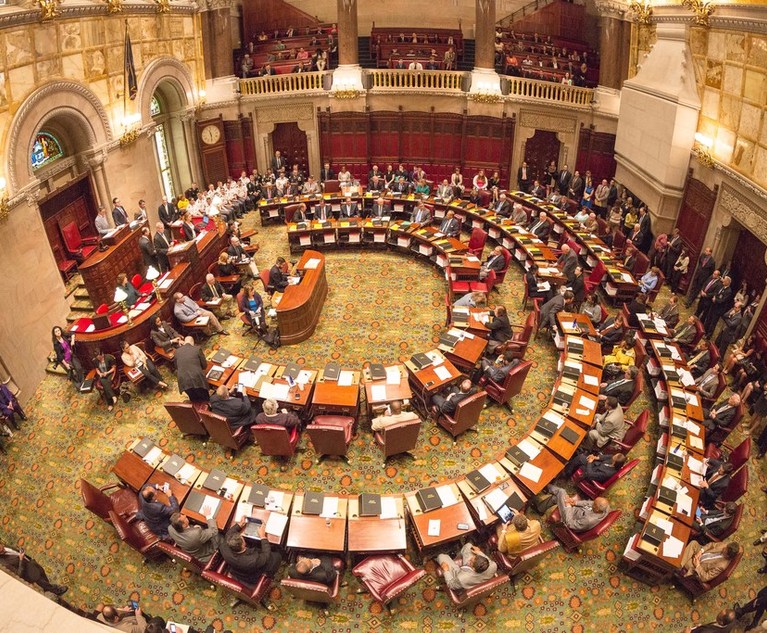
 New York state Senate chamber.
Predicting economic consequences that it says would be damaging to the state, a good-government group has launched a publicity effort to veto a bill that would align New York with most other U.S. states in permitting the families of wrongful death victims to recover compensation for their emotional anguish.
The Lawsuit Reform Alliance of New York launched an ad campaign on Thursday against S74A, which was sponsored by state Sen. Brad Hoylman, D-Manhattan, and approved by lawmakers earlier this year.
The bill, known as the Grieving Families Act, would amend provisions of New York's estates, powers and trusts law relative to payment of damages in wrongful death lawsuits.
Compensation for emotional anguish is not available to families under New York law.
The nonpartisan alliance, whose mission is to reduce lawsuit abuse in New York, said the bill would skyrocket insurance premiums, because it would radically expand the types of damages recoverable in wrongful death lawsuits.
It cited an analysis from global actuarial firm Milliman Inc., which found that enactment of the bill would increase insurance costs by more than $2 billion.
The analysis said medical professional liability insurance costs would balloon by as much as 45%.
"This is a difficult economic environment for everyone," said Lev Ginsburg, counsel to The Business Council of New York State. "We should be focused on good public policy that reduces costs, combats inflation, and eases the burden on our economy. Unfortunately, this bill would do just the opposite and drastically increase insurance premiums for businesses of all sizes. That means higher prices for consumers and when it comes to health care, double-digit increases for years to come."
The alliance said New York already leads the nation in medical liability lawsuit payouts, which totaled more than $430 million in 2021, and the Empire State remains among the worst-ranked states for providers to practice, a deterrent to doctors from opening practices here.
"Our local governments, doctors and hospitals, and our friends and neighbors can't afford one more cost hike in these difficult economic times," said Tom Stebbins, executive director of the Lawsuit Reform Alliance of New York. "If signed into law, this bill will drain municipal budgets, increase household expenses as we battle record inflation, and devastate New York's already strained health care system, disproportionately harming the medical professionals and hospitals that serve our communities."
Hoylman, who chairs the Senate's Judiciary committee, continued to defend the bill.
"Forty-seven other states have similar laws, and yet business and the medical industry continue to prosper in those states," the lawmaker said. "For example, in 2010, Illinois removed their statutory caps on noneconomic wrongful death damages and there has been no appreciable increase in insurance premiums attributable to the change. The bottom line is that we can't put profit ahead of valuing a life. Other states don't. New York shouldn't either."
The bill is en route to Gov. Kathy Hochul's desk, and global law firm DLA Piper said she is expected to sign it.
An article co-written by attorney Christopher Michael Gismondi of DLA Piper's New York City office said the amendment is part of a trend in state law to expand the damages available to surviving family members asserting claims for the loss of a loved one.
Advocates for the bill include the New York State Trial Lawyers Association, which says it would bring New York law into the 21st century, and recognize that families who lose a loved one due to another's negligence deserve to hold the killer accountable.