

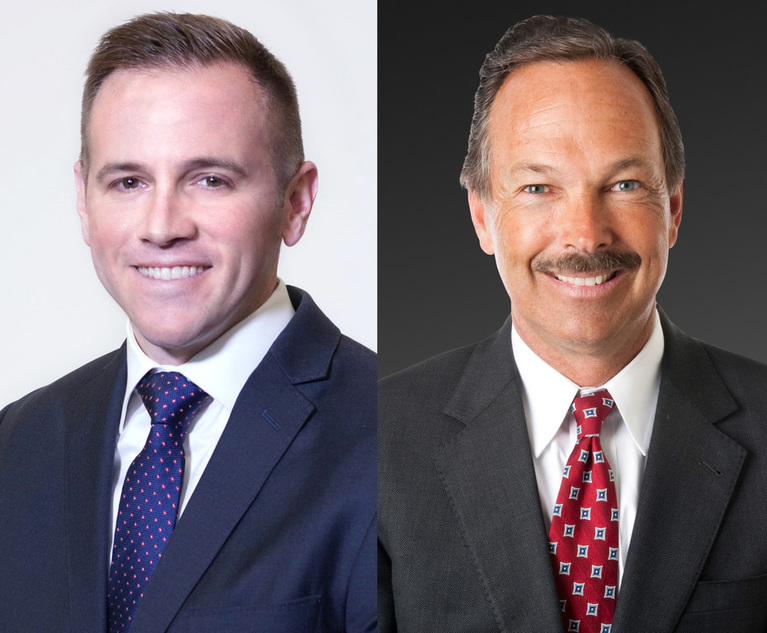
 (L-R)Adam Beradi and Michael Kassek of White and Williams. Courtesy photos
While the world has been focused on the global COVID pandemic, the United States has continued to struggle with its own unique epidemic. The opioid crisis has gripped the country for over two decades and has only continued to worsen over the past two years. Since the start of the COVID pandemic, nearly 179,000 Americans have died from opioids. The CDC estimates that roughly 250 Americans die every day from an opioid overdose. Beyond the devastating physical toll, the opioid epidemic has had severe economic consequences on the nation as well. A bipartisan congressional report issued earlier this year found that the opioid epidemic costs the United States roughly $1 trillion a year.
It thus comes as no surprise that the opioid crisis has produced a flood of litigation primarily aimed at opioid manufacturers and distributors. Many of these lawsuits involve public entities suing opioid companies for the increase in costs for public services associated with the opioid epidemic such as law enforcement, emergency services, and treatment facilities. These litigations have already led to monumental settlements, mostly recently between various drug distributors and state attorney generals for nearly $26 billion. Faced with large verdicts and settlements, as well as the substantial financial burden of defending these massive lawsuits, the targets of the opioid lawsuits are turning to their insurers to defend and indemnify them. Cases interpreting the scope of the insurer's obligations have been few and the results have been inconsistent which is likely to result in an explosion of insurance coverage litigation while the dust settles.
For insurers and insurance law practitioners, substantial coverage issues are presented by these lawsuits under commercial general liability (CGL) policies which generally cover damages for or because of "bodily injury" caused by an "occurrence." While there are variations, an "occurrence" is typically defined as "an accident, including continuous or repeated exposure to substantially the same general harmful conditions." "Bodily Injury" is typically defined as "injury, sickness, or disease sustained by a person, including death resulting from any of these at any time." Generally speaking, CGL policies are designed to provide coverage to the insured for accidental bodily injuries to others. Whether an "Occurrence" or any "Bodily Injury" has been alleged in opioid lawsuits is significantly more complicated than typical cases because such suits are not brought by the injured person seeking compensation for their injuries but rather by entities seeking to be compensated for the economic consequences it suffered as a result of the epidemic. This nuanced issue has been a substantial focus of opioid coverage disputes to date. Two recent decisions illustrate how courts have grappled with these novel issues.
In ACE American Insurance v Rite Aid, 2022 Del. LEXIS 9 (Del. Jan. 10, 2022), the Delaware Supreme Court found that claims made by various Ohio counties seeking to recover economic damages caused by Rite Aid's alleged contribution to the opioid epidemic were not "for" or "because of" bodily injury and therefore were not covered under the insurers' CGL policies. Notably, in order to plead around the Ohio Product Liability Act, the counties had expressly disclaimed personal injury damages for individual residents. Applying Pennsylvania law, the Delaware Supreme Court held that, though the counties' economic losses—including for "medical care"—were arguably linked to care for Ohio residents suffering bodily injury by opioids, "damages for bodily injury are covered losses only when asserted by the person injured, a person recovering on behalf of the person injured, or people or organizations that treated the person injured or deceased, who demonstrate the existence of and cause of the injuries."
A few months after the Rite Aid decision was issued, the same question was presented in the Northern District of California. That court reached the opposite conclusion. In AIU Insurance v. McKesson, 2022 U.S. Dist. LEXIS 64242 (N.D. Cal. Apr. 5, 2022), the court rejected the insurers' argument that, because the government entities themselves had suffered no bodily injury, the claims against the insured opioid distributor were not "for" or "because of" bodily injuries. Finding that the underlying suits alleged opioid abuse, sickness, addictions, overdoses, and deaths, the court held they at least "potentially fall" within the meaning of bodily injury. That the government entities further alleged that they bore costs to provide services to mitigate the bodily injury suffered by residents was sufficient to potentially constitute "damages for … bodily injury."
Although McKesson rejected the insurers' bodily injury argument, the court ruled in favor of the insurers on the occurrence issue, finding that the government entities' claims were based on deliberate conduct—distribution of opioids—that produced the injuries. Under California law, the "inquiry focuses on the injury producing acts of the insured" and it is therefore "irrelevant whether the insured intended the resulting injury." In so holding, the court distinguished rulings from other jurisdictions that find an accident unless there is an intent to injure. See e.g., Cincinnati Insurance v. Discount Drug Mart, 183 N.E.3d 538 (Ohio App. 2021); Liberty Mutual Fire Insurance v. J.M. Smith, 602 Fed. Appx. 115 (4th Cir. 2015) (South Carolina law).
As the above discussed cases illustrate, the court's rulings on these critical opioid insurance coverage issues tend to be jurisdiction specific and the case law is still developing. As a result, both policy holders and insurers are incentivized to seek a favorable forum to take advantage of precedents which favor their position. This is likely to result in an increase in insurance coverage litigation involving jurisdictional disputes, forum battles and which state's laws should apply to the dispute.
While the majority of decisions regarding coverage for opioid claims to date have been in the context of CGL coverage, directors and officers liability (D&O) as well as professional liability (E&O) policies are also potentially implicated by these lawsuits. D&O insurance is primarily intended to protect the personal assets of corporate directors and officers. E&O insurance generally covers claims arising out of an alleged failure to render professional services to a third party.
Importantly for opioid suits, D&O and E&O policies typically contain exclusions for any claim "based upon or arising out of any actual or alleged bodily injury." Thus, the critical coverage issue under CGL policies of whether the claims involve bodily injury can also be outcome determinative as to whether those policies provide coverage. This means that the coverage cases noted above regarding "bodily injury" in the context of public entity opioid lawsuits and CGL insurance may prove useful for D&O and E&O insurers reviewing the same underlying claims. For example, while the Rite Aid decision's holding of no bodily injury would leave the door open for coverage under a D&O or E&O policy notwithstanding the existence of a bodily injury exclusion, the court's bodily injury finding in McKesson would support a D&O or E&O insurer's argument that the bodily injury exclusion precludes coverage.
D&O and E&O policies are also typically "claims-made" policies, meaning that they provide coverage only for claims first made during the given policy period and often have an "aggregation of claims" provision which allows insurers to treat any claim submitted for coverage that arises out of the same "facts and circumstances" as a previously filed claim as a single claim. As factually similar lawsuits continue to be filed against companies involved in the opioid distribution chain, D&O and E&O insurers may have a basis to treat recently tendered opioid lawsuits as a "related claim" to previously tendered lawsuits. If a claim is not first made during the policy period of the initial D&O and E&O insurance policy, insurance carriers are likely to take the position that the later claim is barred from coverage.
While the claims-made issue has not been specifically addressed by any court, a related "specific litigation exclusion" commonly found in D&O and E&O policies, was the focus of Miami-Luken v. Navigators Insurance, 2018 U.S. Dist. LEXIS 122009 (July 11, 2018 S.D. Ohio). There, a D&O policy issued to an opioid distributor named as a defendant in a 2012 West Virginia suit contained a "specific litigation exclusion" that precluded coverage for any claim "based upon … the same or substantially the same facts, circumstances or allegations which are the basis or subject" of the 2012 West Virginia lawsuit. In 2015, the distributor received an order to show cause from the DEA alleging that it failed to maintain effective controls against the diversion of opioids in West Virginia. Coverage was denied pursuant to the specific litigation exclusion. In the ensuing coverage action, the court agreed with the insurer explaining that "when considering whether the facts, circumstances, or allegations for the two actions are the same or substantially similar, the answer clearly is yes."
While the opioid epidemic has raged for over 20 years and litigation against opioid manufacturers/distributors has been going on for more than a decade, the insurance coverage issues arising are still developing and largely unsettled. What is clear is that these lawsuits have the potential for significant insurer exposure under multiple lines of coverage. Insurers should keep abreast of decisions like those discussed above and consider the potential impact those rulings may have under various lines of insurance when responding to opioid lawsuit tenders.
Michael Kassek is a partner with White and Williams. He has more than 30 years of experience as lead counsel litigating large complex commercial matters including cutting edge insurance coverage and healthcare disputes.
Adam Berardi, a partner with the firm, represents major national and international insurance companies in coverage disputes and complex commercial litigation around the country. His practice focuses primarily on resolution of coverage claims for long-tail liabilities involving environmental cleanups, mass tort and products liability.