

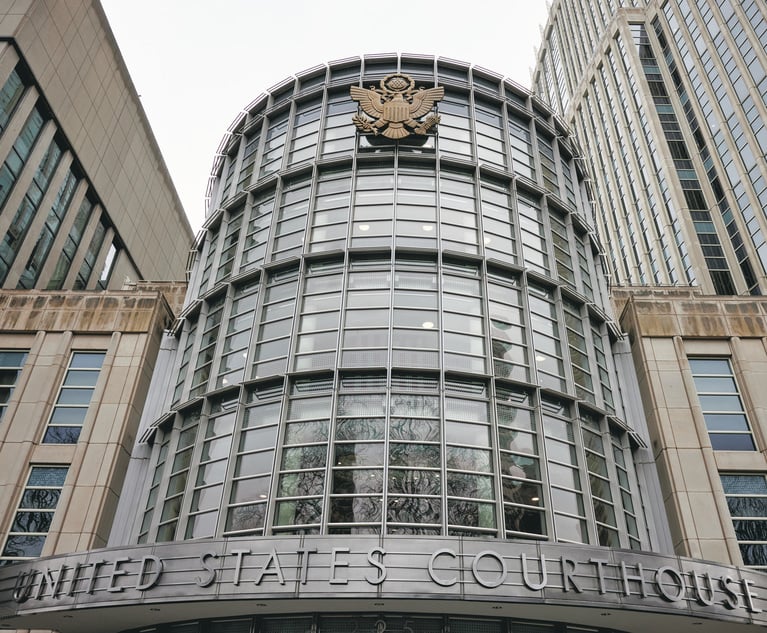
 U.S. Courthouse, Eastern District of New York in Brooklyn, New York. Photo: Ryland West/ALM
U.S. District Judge Joan Azrack of the Eastern District of New York has ordered an insurance company to pay the criminal defense costs incurred by attorney Jason Kurland, whose trial on fraud and money laundering charges began on July 11th.
Kurland was a former partner at Rivkin Radler, who represented the winners of lottery jackpots. He had a professional liability insurance policy through Fireman's Fund Insurance Co. Through his civil attorneys at Cohen Ziffer Frenchman & McKenna, Kurland sued the insurer in November after Fireman's Fund denied coverage for legal fees and costs related to the ongoing criminal case.
Judge Azrack rejected Fireman's Fund's argument that the criminal case does not constitute a "claim seeking damages" under the terms of the insurance policy, and granted Kurland's motion for partial summary judgment,
"Fireman's Fund must therefore 'provide a defense' to Kurland in the Underlying Action until such time Kurland's alleged acts are 'ruled either by trial verdict, court ruling, regulatory ruling, or legal admission as dishonest, fraudulent, criminal, or malicious,'" she found.
Azrack ordered Fireman's Fund to "immediately pay, on a current and ongoing basis and up to the Policy's Limit of Liability, Kurland's defense costs in the Underlying Action."
Azrack found that Fireman's Fund "could have easily limited" the terms of its coverage to exclude criminal matters, but the insurer "failed to do so."
She found that her interpretation of the terms used in the policy was further supported by a provision in the policy excluding coverage for claims that arise from "dishonest, fraudulent, criminal or malicious act or omission, or deliberate misrepresentation" while requiring Fireman's Fund to "provide a defense of such actions until such time as the act is ruled either by trial verdict, court ruling, regulatory ruling or legal admission as dishonest, fraudulent, criminal or malicious."
"If 'suit' and 'compensatory judgment' did not encompass at least criminal restitution proceedings, then this provision would, arguably, be superfluous," she wrote.
Cohen Ziffer partner Andrew Bourne praised the ruling in the following comment.
"The district court's well-reasoned decision should remind criminal defendants (and their attorneys) to review all potentially applicable policies carefully. While it remains unlikely that insurance companies are going to volunteer to provide coverage for criminal defendants, unless a policy is clear and unambiguous in its language, criminal defendants may be able to find coverage in places they did not expect."
Jane Wester

Jane Wester is a litigation reporter for the New York Law Journal. Email her at [email protected] or find her on Twitter @janewester.