

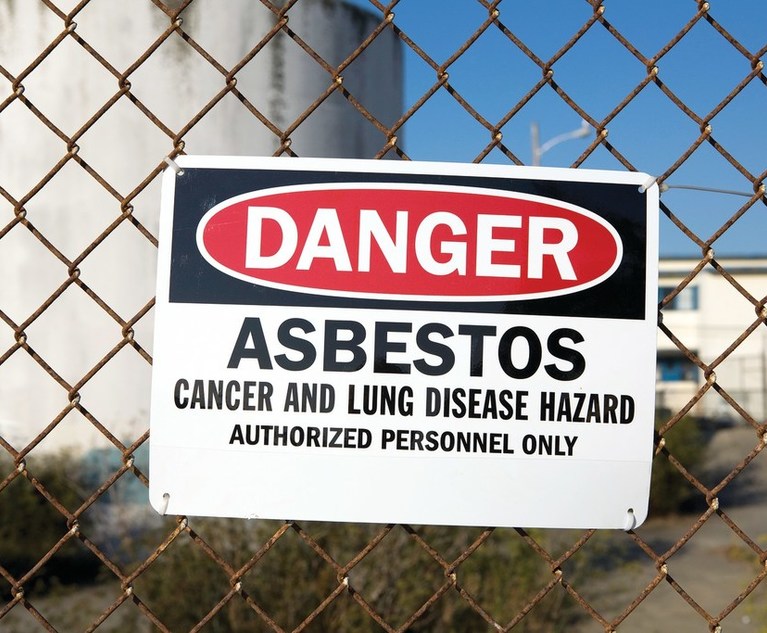
 A California jury awarded $43 million to a woman with mesothelioma, one of the largest asbestos verdicts since courts across the nation reopened last year.
Friday's verdict, all compensatory damages, followed two weeks of in-person trial. The jury found Algoma Hardwoods Inc. liable for Deanne Warren's mesothelioma, which she got in 2019 after being exposed to asbestos. The lawsuit had facts similar to those in a South Carolina case, where a jury awarded $32 million last year to a woman who got mesothelioma from doing laundry, exposing herself to asbestos dust that was on the clothes her husband wore while at work.
The trial, which took place in the Long Beach courthouse of Los Angeles County Superior Court, involved Warren, 64, and her husband, Craig Warren, 66, who worked in residential and commercial carpentry in the late 1970s and became a general contractor in the 1980s.
"She has never really worked in any capacity where she could have been exposed to asbestos," said Weitz & Luxenberg partner Benno Ashrafi of his client. "She was on-site at times, helping him on weekend jobs, but most of the exposure was take-home or household exposure. She did his laundry, so there was exposure there. Also, just staying in the home."
Ashrafi, who is in Los Angeles, tried the case alongside Leonard Sandoval, of counsel at Weitz & Luxenberg in Los Angeles.
Algoma, now owned by Masonite International Inc., was represented by Robert Rodriguez and Jacqueline DuBois, senior counsel and partner, respectively, at Gordon Rees Scully Mansukhani in San Diego. Neither responded to requests for comment.
The award is one of the largest asbestos verdicts since courthouses reopened amid the COVID-19 pandemic. Some of the highest asbestos verdicts have included $36.5 million in Montana, $18 million in Florida, $20 million in Missouri and $10.3 million in Louisiana.
Algoma made doors that are fire resistant but had asbestos in them from 1977 to 1980. Jurors found Algoma 50% liable and assessed comparative fault against five other defendants who were not at trial: 10% to T.M. Cobb Co.; 2% to Black & Decker; 15% to Georgia-Pacific; 5% to Johnson & Johnson and 18% to U.S. Plywood/Champion International Paper.
Ashrafi said he handled another California asbestos trial earlier this year in Alameda County Superior Court that was entirely on Zoom. Remote asbestos trials moved forward during the pandemic in Northern California, but Los Angeles County Superior Court was closed entirely until about 10 months ago.
"It was a bone of contention for a lot of people because we thought the LA courthouse wasn't getting creative," he said. "But, luckily, they were able to get open and do them in person."
One of his first asbestos trials in person in Los Angeles involved Johnson & Johnson's cosmetic talcum powder. Most of those cases were put on hold after a Johnson & Johnson subsidiary filed for Chapter 11 bankruptcy protection on Oct. 14. But on Oct. 15, Weitz & Luxenberg won a $27.4 million verdict for a mesothelioma victim and his wife.
Although everyone wore masks and spaced out, one member of the defense team got COVID-19, though no one else did, Ashrafi said.
This month's trial, which began on May 9 before Judge Michele Flurer, had few COVID-19 restrictions. The only pandemic holdover was that three witnesses and two experts testified live via Zoom, Ashrafi said.
"I feel like COVID wasn't as much of an issue," he said. "Back then, there were mask mandates, everybody wearing masks in the courtroom. In this particular case, it was optional. So, in jury selection, when it was 75-80 jurors, I feel most of the people, 90%, were wearing masks. But once the trial got started, the courtroom spreads out, and it's down to 14 jurors, then most of the lawyers took the masks off."
Amanda Bronstad

Amanda Bronstad is the ALM staff reporter covering class actions and mass torts nationwide. She writes the email dispatch Law.com Class Actions: Critical Mass. She is based in Los Angeles.