

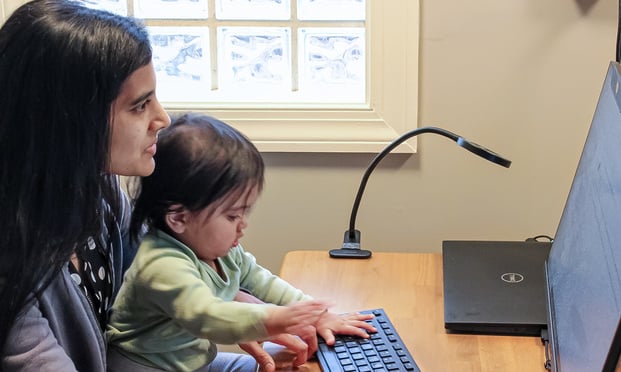
 Arnold & Porter associate Pari Mody works with her 10-month-old daughter, Lalana, on her lap. Courtesy Photo
The COVID-19 pandemic has taken the delicate balance of working and parenting many lawyers aimed for and thrown it into disarray. The pandemic has required sacrifice, and no two situations are identical across geographies, practice or family structure.
Several of those parents spoke with Law.com in recent weeks, reflecting on the past year.
One made significant financial sacrifices. Another spent their maternity leave without families and friends, confined to the one-hour radius of their house. Some have been fortunate to live in smaller cities with leaders who have made in-person school, and thus child care, possible for much of the pandemic.
Here are their stories.
View the slideshow: Inside the Home Office, Where Lawyers Mixed Work and Family During the Pandemic
Running Late
Arnold & Porter Kaye Scholer partner Kristen Riemenschneider, a mother of three, is woken up at 5 a.m. sharp by her 10-year-old daughter Kate, who had a nightmare. Kate climbs into bed.
An hour and a half later, her husband Bob wakes up with a headache, and, almost simultaneously, Riemenschneider's 8-year-old, Ben, also comes into bed. He has a headache. Now that Riemenschneider thinks about it, her headache from last night has carried through to the morning as well.
 Arnold & Porter partner Kristen Riemenschneider and her two daughters Kate, 10, and Keira, 12. Photo courtesy of Kristen Riemenschneider
At 7 a.m., Riemenschneider, now one of four people in her bed, decides there is no point in trying to get some sleep. She makes some breakfast and fires up the washer to rewash clothes that had been sitting for two days. Her husband goes to work.
Shortly after Riemenschneider jumps into her first Zoom call at 9 a.m., Ben comes into her home office to tell her that his "tummy hurts." She tells him to eat some grapes and sit down for virtual school, which starts in a minute.
By 10:45 a.m., Ben's stomach situation has become too much, according to him. Riemenschneider mutes her microphone and turns off her camera to tell him to email his teacher to tell them he needs to take a sick day. She hopes her client thinks her camera being off was due to an internet glitch.
Around noon, she gets a text from 10-year-old Kate: "Sorry about the mess, I'll clean up during my break and I'll empty the dishwasher then too."
Kate has gotten into cooking during the pandemic—she often cooks dinner for the whole family now. Riemenschneider emerges from her office to see that the kitchen is indeed a wreck. And she remembers those clothes she had to rewash in the morning are still sitting in the washer. She heats up some frozen waffles for lunch.
She's late for her 2:30 p.m. call, and apologizes profusely to the associate who has been waiting in the meeting room for 15 minutes.
At Home, but Not at Home
Sidley Austin partner Corin Swift wakes up at 6 a.m., anxious to get a few moments of silence before her day begins. Coffee in hand, she peruses her emails. She focuses first on the emails related to a matter she has in China. People there are about to go to sleep, since they're 13 hours ahead, and Swift feels as if she's already behind.
At 7 a.m., she goes to wake her 13-year-old son, Henry.
Henry has Down syndrome and recently returned to in-person school several days a week, alleviating a lot of the stress Swift has experienced throughout the pandemic. But Henry's other pre-pandemic activities—swim classes, occupational therapy and basketball—have not returned, as he is at high risk for complications if he is infected with COVID-19.
 Sidley Austin partner Corin Swift's son Henry, 13, has Down syndrome and thus is at high risk for complications arising from COVID-19. Photo courtesy of Corin Swift.
On mornings when Henry goes to school virtually, Swift helps him get ready and logged into class by 7:55 a.m. He needs intensive support because he cannot read chats or emails, and sometimes Swift finds herself at odds with her own computer, adding to the technical issues.
But today is an in-person school day. Swift, Henry and their dog, Sedona, pile in the car and she drops off Henry at school. On the way back home she picks up a latte.
Throughout the afternoon, Swift oscillates between working and checking on her kids.
Her older son, Dylan, is 17 and mostly self-reliant. Henry gets home around 2:30 p.m. Dylan jets off to basketball practice. He has been able to play a full season this year, though they are required to wear masks while playing. And he didn't get the opportunity to visit the colleges he applied for.
Pre-pandemic, Swift often traveled throughout the work week. When she got back home, she was able to be present for her family. Now, as she works each day at her house, she has had difficulties adjusting to the fact that she's at home, but at the same time not fully there.
New Mom in a Bubble
Arnold & Porter associate Pari Mody expected her maternity leave to be different. Her firm gave her a generous five-and-a-half-month leave, and Mody had envisioned taking her 10-month-old daughter Lalana to the park, going to lunches with other mothers and babies, seeing family and friends—all the typical socialization and celebration that comes with new motherhood.
"I had it in my head that during maternity leave that I would be hanging out with neighborhood parents," Mody said, adding that her Takoma Park, Maryland, neighborhood is known as a close-knit community.
But the pandemic changed everything. Many of these events got shifted online instead. She found it difficult to connect online and quickly gave up on those. Lalana has yet to meet her husband's parents, who live in Tennessee. In fact, Mody hasn't gone anywhere more than an hour drive from her house since January 2020.
Mody and her husband, Chris Merchant, have not felt comfortable bringing in somebody to help with child care.
So Merchant, a NASA engineer, adjusted his schedule so he leaves for the lab at 3:30 a.m. Mody wakes up around 5 a.m. and takes care of Lalana until Merchant returns at 9 a.m. Merchant then takes over the baby duties so that Mody can log in and work.
In the late afternoon, they take turns watching Lalana. Merchant and Lalana go to bed around 8 p.m. Lalana is not a good sleeper and wakes up four or five times each night.
Almost a year after becoming a parent, Mody says she has difficulties disentangling the difficulties of motherhood from those of the pandemic.
"We're just tired all the time," Mody said. "It somehow becomes normal."
'He Had to Give That Up'
A year after the pandemic first began, family law attorney Shaunis Mercer, who works at the North Carolina-based Rosen Law Firm, is now able to take her oldest child, 8-year-old Jude, to school instead of juggling the precarious child care-work balance at home.
 Rosen Law attorney Shaunis Mercer and her children Jude, 8, and Ben, 4. Photo courtesy of Shaunis Mercer
But it didn't come without sacrifice: Mercer and her husband, Chris Autry, had to refinance the house to take Jude out of public school, where classes sizes were fairly large, to a private school nearby with much smaller class sizes and stricter COVID precautions.
Autry also had to quit his job as a prosecutor and start working as a pharmaceutical contract attorney. Before he left, he was going into the courthouse three days a week, and almost every week there was a COVID scare, which required them to pull their oldest out of school for COVID protocol. It was untenable.
"He was a career prosecutor," Mercer said. "It's what he does, so he had to give that up to make our life work."
'Zoom'd Out'
 Camila, 7, works on her homework. Photo courtesy of Valerie Gonzalez.
Solo practitioner Valerie Gonzalez opened her firm last spring shortly after graduating law school. A single mom, she has been able to work while her parents watch her 7-year-old daughter Camila.
Camila, like many children, has had a difficult time adjusting to the pandemic. She is, as Gonzalez describes it, "Zoom'd out" and uninterested in virtual playdates and events after a year of seeing people through a screen. Nowadays, she attends her online Girl Scout group "begrudgingly." The other day, she didn't want to see her cousins in-person. Like all of us, Gonzalez said, Camila often feels lethargic.
"She's fine, but I see it affect her in little meltdowns even now and then, and it reminds you that they're feeling hurt too," Gonzalez said. "The other day she told me, 'I miss people, I need to see them and touch them.'"
'Super Lucky'
April Kelso, an associate at Oklahoma-based midsize firm Pierce Couch, has been able to take her 2-year-old daughter Magnolia to daycare since last summer. Her 7-year-old daughter, Lola, has been going to school in-person since the fall. Kelso herself has been going into her office since July.
 Pierce Couch associate April Kelso and her two daughters Lola, 7, and Magnolia, 2. Courtesy Photo
"Our lives have been pretty similar to pre-COVID. Daycare is open, so that's the biggest thing for us," Kelso said.
Guthrie, Oklahoma, the town near Kelso's house was among the first cities in the state to pass a mask mandate. Nearby Edmond, Oklahoma, discontinued its July mask mandate Monday.
The adoption of masks combined with the area's lower density, in comparison to major metropolitan areas, have allowed Kelso and her family to feel safe. Lola and Magnolia's daycare has only dealt with one COVID exposure over the past year.
Kelso is well aware of how her experience has been different from other attorney parents.
"It's just kind of interesting to see how different it is. We've been super lucky, and others haven't been so lucky. Some are stuck at home with restrictions that meant they couldn't do anything," Kelso said. "That's true for a lot of people but also not true for a lot of people."
A View of Inequities
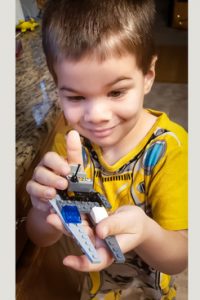 Brodsky Renehan Pearlstein & Bouquet attorney Kristina Badalian's son James, 5, shows off his lego creation. Photo courtesy of Kristina Badalian.
Brodsky Renehan Pearlstein & Bouquet partner Kristina Badalian and her family decided to have their children go to school virtually through the end of the school year. Unlike some of the other parents, she has a nanny who comes in to watch her two children at 10 a.m. while Badalian and her husband, a federal attorney, work from home.
Badalian said she feels lucky to have the financial resources to afford child care during the pandemic. As a family attorney, she regularly sees the difficult positions many families have been put in throughout the past year.
"So, prior to the pandemic, if you worked two jobs that were outside of the house and were a required essential worker and you relied on child care with your family member and your family member is elderly, what did you do?" Badalian said. "Are you bringing COVID home to Grandma every night?"
Badalian hopes that, as more people get vaccinated and the country slowly reopens, the country will not forget about the inequities and trauma spawned by the pandemic.
The COVID-19 pandemic has also laid bare the fragility of the network of support that makes it possible to be a working parent, and the fallout often disproportionately affects mothers. An estimated 3 million U.S. women have left the workforce in the past year, according to federal government data.
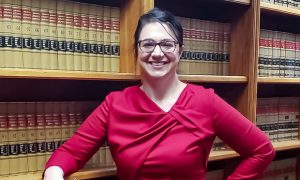 Brodsky Renehan Pearlstein & Bouquet attorney Kristina Badalian stands in her office's law library turned "virtual courtroom". Photo courtesy of Kristina Badalian.
The legal industry's struggles to attract and retain women and minority attorneys are well-worn ground. Many firms have invested millions in perks and resources to address the gap. But, benefits aside, experts and parents say a major component is acknowledging the great effort it takes for working parents, and more so working mothers, to maintain their work and home obligations each day.
Instead, women are often faced with the contention that they should "lean in" and "be able to do it all," Badalian said.
That message, she said, "sets up these standards when people are like, 'Yeah, why aren't you leaning in and doing all of the things?'"
Finally, Hope
Most of the parents who spoke to Law.com said they have felt more optimistic in the past months as vaccinations accelerate and schools slowly begin to reopen. For the first time, there appears to be a light at the end of the tunnel, and many parents have seen silver linings in the pandemic.
Riemenschneider, who worked on U.S. vaccine contracts, said she cried as she watched the trucks leave with the first doses of vaccine.
Badalian has picked up new skills. She has taken to baking and has, for the first time in a long time, been able to regularly workout now that she isn't commuting as much.
Mody's parents are vaccinated and are now able to see their granddaughter, and Kelso and her husband have been gotten their first doses of vaccine and, for the first time, were able to hang out with friends (albeit outside).
Gonzalez said that, given her deftness with technology, she is at an advantage during the pandemic, where business development is done virtually. She's a Los Angeles resident, so visiting a client in-person often means a 45-minute drive at a minimum.
"The things I accomplish in one day I can't imagine doing that if I have to drive all day," Gonzalez said. "I plan to hold onto this virtual component as long as I can and make it part of my marketing."
 Erin Law, executive director of Morgan Stanley's legal and compliance group, with her wife Christine and children: Dylan, 8, Owen, 11, and Caroline, 8. Courtesy photo
Erin Law, executive director of Morgan Stanley's legal and compliance group, said that she and her wife, Christine Reindl, have been able to take advantage of the new online education programs that have spawned in the pandemic.
The couple pulled their children out of virtual school and have home-schooled them. They're taking an online philosophy class at the University of Washington and have taken to the new curriculum.
Reindl—a software developer who stopped looking for a new job at the beginning of the pandemic to take care of their children full time—is thinking about getting her master's degree online when their children go back to school in-person. Law is fully vaccinated and Reindl is half-vaccinated. Law says she looks forward to getting back to some sort of normalcy.
"I'm very excited to see family again," Law said. "I'm excited about the summer."
Dylan Jackson

Dylan Jackson writes about the business of law and race. He can be reached at [email protected] or 305-347-6677. On Twitter @DylanBJackson