

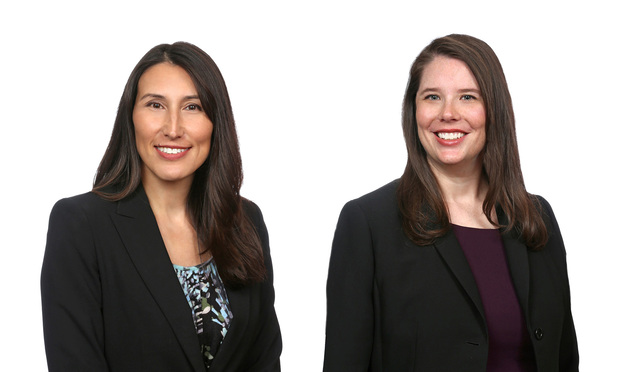
 Shari Klevens, left, and Alanna Clair, Dentons (photo: Courtesy Photo)
For most attorneys, information regarding their background and experience is only a click way. Public information regarding nearly every attorney can typically easily be obtained through a quick online search for the attorney's biography on their firm's website, or perhaps through a networking site such as LinkedIn.
Because of the visibility of such online profiles, many attorneys want to put their best foot forward and include information that highlights their expertise and successes. However, there can be risks when choosing what information to make available to the public online.
Confidentiality Concerns
Attorneys sometimes are so eager to highlight a big victory that they lose sight of their confidentiality obligations. Rule 1.6 of the California Rules of Professional Conduct provides that attorneys may not disclose information protected from disclosure without the client's informed consent, subject to certain narrow exceptions. Business and Professions Code section 6068(e)(1) specifies that the information protected from disclosure includes the client's confidences and secrets, which attorneys must maintain "at every peril to himself or herself." Rule 1.9(c)(2) provides that the same restrictions on the disclosure of information apply to past representations of former clients.
While most attorneys know not to include privileged information in a publication available to the public, many attorneys are paying close attention to ensure that information that may be considered confidential is not disclosed unless the client has specifically consented. The heightened concern stems in part from a 2018 opinion from the ABA Standing Committee on Ethics and Professional Responsibility that generated much discussion. In Formal Opinion 480, the ABA noted that "[l]awyers who blog or engage in other public commentary may not reveal information relating to a representation, including information contained in a public record, unless authorized by a provision of the Model Rules."
Some attorneys may assume that they are free to write about client representations where the representations are a matter of public record. However, relying on Formal Opinion 480, some attorneys and law firms are choosing not to include case details or client names on their bios without express client consent. Indeed, many critics have opined that Formal Opinion 480 is not revolutionary but simply confirms the language of Rule 1.6.
Many attorneys handle this in one of two ways—by obtaining client consent to disclose client relationships or matters (even if the representation is disclosed through public filings or other materials) or by describing relationships and matters in a way that does not reveal the confidential information.
Potential Issues Relating to Advertising Rules
Attorney web bios may also be subject to the ethical rules regarding advertising and what an attorney may or may not say to a potential client.
Rule 7.1 of the California Rules of Professional Conduct prohibits an attorney from making "a false or misleading communication about the lawyer or the lawyer's services." The rule defines a communication as "false or misleading if it contains a material misrepresentation of fact or law, or omits a fact necessary to make the communication considered as a whole not materially misleading." Although attorneys are permitted to describe their past successes (subject to the limitations on confidentiality described above), according to comment [4] of the Rule, "[a] communication that truthfully reports a lawyer's achievements on behalf of clients or former clients…may be misleading if presented so as to lead a reasonable person to form an unjustified expectation that the same results could be obtained for other clients in similar matters … ."
Most attorneys will avoid including anything in their bios that is misleading. If their bios focus on developing clients who may have matters similar to those previously worked on by the attorneys, the attorneys may consider using a disclaimer or other clarification to note that the outcome of any single representation will depend on the facts and circumstances. Many will also strive not to include bombastic or bragging statements in their bio that could run afoul of the rules on advertising (and, from a marketing perspective, may make the attorney less likely to be hired).
Using Bios for Marketing
Online bios are useful tools for lawyers in private practice to raise awareness of their services and attract clients. From a marketing perspective, attorneys may try to find ways to stand out, to summarize their relevant experience, and to highlight their skills.
There are a few parameters of which attorneys can be aware. For example, although attorneys may be able to describe the types of cases they handle or the types of clients they serve, most attorneys will avoid stating that they have a "specialty" in a certain area. This is because many bar rules restrict an attorney from calling themselves an expert in a type of law absent any particularized certification.
In particular, Rule 7.4 of the California Rules of Professional Conduct provides that a lawyer shall not state that she or he is a certified specialist in a particular field of law unless: (1) "the lawyer is currently certified as a specialist by the Board of Legal Specialization, or any other entity accredited by the State Bar to designate specialists pursuant to standards adopted by the Board of Trustees"; and (2) "the name of the certifying organization is clearly identified in the communication." But the Rule does permit lawyers to communicate that they do or do not practice in a particular field of law.
In addition, many attorneys strive to update their bios on a regular basis to reflect recent developments, speaking engagements, and other opportunities. Indeed, an out of date bio is unlikely to present an attorney's skills in the best light. The goal is to use attorney bios to accurately represent the attorney's strengths while ensuring compliance with the applicable ethical rules.
Shari L. Klevens is a partner at Dentons US and serves on the firm's US Board of Directors. She represents and advises lawyers and insurers on complex claims, is co-chair of Dentons' global insurance sector team, and is co-author of "California Legal Malpractice Law" (2014).
Alanna Clair is a partner at Dentons US and focuses on professional liability defense. Shari and Alanna are co-authors of "The Lawyer's Handbook: Ethics Compliance and Claim Avoidance."