

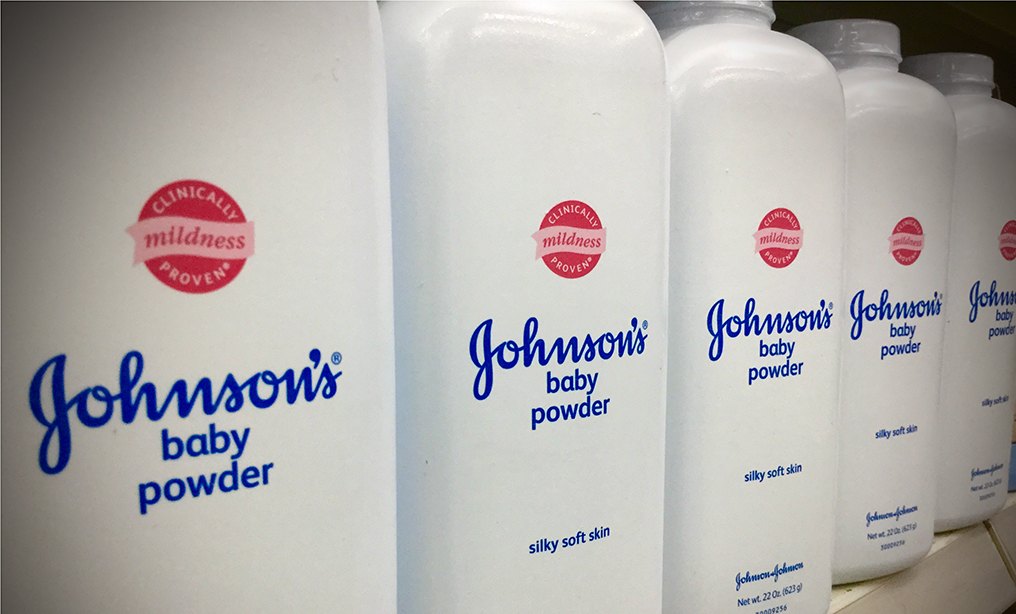
 Johnson's baby powder. Photo: Flickr/Mike Mozart
A woman who claimed that decades of exposure to Johnson & Johnson's asbestos-containing talcum powder had caused her to develop mesothelioma has signed on to a $105 million punitive damages award, after a Manhattan judge reduced a $300 million jury verdict in her favor.
The order from Manhattan Supreme Court Justice Gerald Lebovits found that a jury in 2019 awarded plaintiffs Donna and Robert Olson excessive damages following a 14-week trial on the couple's failure-to-warn and defective design claims against J&J and Johnson & Johnson Consumer Inc.
Lebovits wrote in a 61-page opinion that the jury had plenty of evidence to rule against J&J on the issue of liability, but said that the original award of $300 million in punitive damages violated the companies' due-process rights. In the same ruling, the judge scaled back the Olsons' compensatory damages to $15 million from $25 million, reflecting past and future pain and suffering, as well as lost companionship for Robert Olson.
The revised punitive amount was seven times higher than the new compensatory award, significantly lower than the original 12:1 ratio handed up by the jury last May. Under Lebovits' order, the court would hold a new trial on damages if the Olsons agreed within 30 days to accept the revised awards.
Lebovits signed the judgment Friday.
Jerome Block, a partner with Levy Konigsberg who represented the Olsons at trial, said Friday in an emailed statement that the couple "look forward to moving this case toward completion."
"We are satisfied with the outcome and confident that Justice Lebovits' decision will be upheld on appeal," Block said.
The Law Journal previously reported that the plaintiffs secured a key ruling in the lead-up to the punitive damages trial when Lebovits said the punitives phase could include evidence beyond Johnson & Johnson's finances.
Lebovits last year allowed the Olsons to introduce new evidence, including evidence of the company's out-of-state conduct and advertisements for its Baby Powder products that ran between the 1960s and 1990s.
The plaintiffs had also sought to have the jury consider evidence of J&J's conduct after 2015, the approximate date that Donna Olson stopped using the company's talcum powder, but Lebovits rejected that request.
A J&J spokeswoman had said last year that the science did not support such a high award and that the trial "suffered significant legal and evidentiary errors which Johnson & Johnson believes will warrant a reversal on appeal."
J&J moved to set aside the jury verdict, asking that judgment be entered in the companies' favor.
But Lebovits, in his ruling, found that the evidence presented at trial supported the jury's finding that J&J was responsible for Donna Olson's illness. The lengthy opinion noted that J&J was put on notice as early as the 1950s that it's Baby Powder, and the Italian talc from which it was sourced, contained small but significant amounts of asbestos that could be harmful if inhaled.
There was also sufficient evidence that J&J sought to control scientific research into asbestos and talc and that it had "slanted" information the company provided to the FDA in the 1970s.
Donna Olson testified that she had used J&J's Baby Powder and Shower to Shower every day for more than 50 years. According to court documents, she had lost a lung as a result of her mesothelioma and now requires 24-hour care from her husband. Both Donna and Robert Olson suffered "profound" emotional pain and anxiety, Lebovits found.
J&J did not immediately respond Friday to a request for comment.
Tom McParland

Tom McParland of New York Law Journal can be contacted at [email protected]. Follow him on Twitter @TMcParlandALM.