

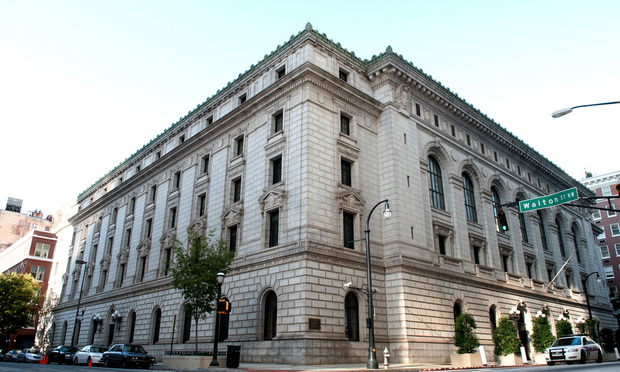
 Elbert P. Tuttle Courthouse, U.S. Court of Appeals for the Eleventh Circuit, Atlanta. (Photo: Rebecca Breyer)
The U.S. Court of Appeals for the Eleventh Circuit resolved a dispute Monday over which policy pays how much of a big judgment—and in so doing lifted the curtain on behind-the-scenes negotiations between insurance companies and lawyers.
"On the eve of trial, the defense team estimated their worst verdict at $1.5 million," Judges William Pryor, Robin Rosenbaum and Robert Luck said in an unsigned unpublished opinion. "But the jury, instead, returned a $72.96 million verdict."
They were talking about the 2015 trial for Stephen Wells, a teacher who was severely burned by an explosion caused by an uncapped gas line in his Sandy Springs apartment. The Fulton County State Court jury awarded $17.9 million to compensate Wells for his injuries, lost earnings and expenses, which included $226,000 in medical bills. The trial then continued into a second phase to consider attorney fees and punitive damages. The basis of the second phase was the allegation that the defendants had acted with "conscious indifference to consequences" of having uncapped gas lines in apartments in violation of building codes. The jury awarded $7 million in attorney fees and $47.9 million in punitive damages against the landlord and management company.
Y. Kevin Williams and J. Tyler Schermerhorn of Weinberg Wheeler Hudgins Gunn & Dial defended the property owner and manager at trial. They declined to comment on the trial. But their opposing counsel, Pete Law, said he told the jury that Weinberg Wheeler was "the gold standard" for defense firms. Law represented Wells along with E. Michael Moran and Christopher Newbern, all of Law & Moran.
"The parties ultimately settled for $15 million, spawning a federal-court proceeding—this case—to determine priority among the insurers for paying the liability," the Eleventh Circuit panel said.
The apartment complex and its management company collectively held five liability insurance policies, according to the judges: Liberty Surplus as a primary insurer for $1 million; ACE Property & Casualty Insurance Co., as an excess insurer for $10 million; AXIS Insurance Co. as a primary insurer for $1 million; First Specialty Insurance Co. a primary insurer for $1 million; and American Guarantee as an excess insurer for $20 million.
In the case at hand, American Guarantee & Liability Insurance Co. filed a claim against Liberty for negligently failing to settle the lawsuit before the verdict. American Guarantee won in a bench trial before Judge Steve Jones of the U.S. District Court for the Northern District of Georgia.
"Because American Guarantee recovered $400,000 through its settlement with ACE, the court awarded American Guarantee $1.6 million from Liberty—that is, the rest of the amount that American Guarantee had contributed towards final settlement in the Wells case," the panel said. That judgment was entered on Sept. 25, 2018. Liberty appealed. The panel affirmed Jones Monday.
American Guarantee was represented by Stephen Schatz, Melissa Kahren of Swift Currie McGhee & Hiers and Thomas Ward of Freeman Mathis & Gary, all in Atlanta.
Liberty was represented by Brian Martin, Chris Avery and Kevin Risley of Thompson Coe Cousins & Irons in Houston. Nicole Leet and Michael Rust of Gray Rust St. Amand Moffett & Brieske in Atlanta acted as local counsel.
The attorneys did not have an immediate response to a request for comment.
In sorting through the facts, the Eleventh Circuit panel revealed how far apart the parties were and how the case could have been settled years ago. The judges said that the plaintiffs attorneys sent defense counsel a letter in March 2013 extending a thirty-day offer to settle for $5 million. The delivery included a "day in the life" video depicting the treatments Wells was having to undergo to remove his burned tissues.
"Liberty's adjuster found that the treatment appeared very painful to endure and that the video was 'somewhat troubling to watch,'" the judges said. But the adjuster also suggested a "defense theory" that somehow Wells had opened the gas valve himself—even though evidence presented at trial shows that would have required a wrench which he did not have, and that he did not even own a gas clothes dryer of the sort the gas line was meant to supply.
In a mediation the next month, attorneys for Wells restated their $5 million settlement offer. "Liberty was the only insurer that attended the mediation, and Wells's attorney expressed surprise that no excess carriers went. The mediation ended without a settlement, and Wells's counsel indicated that he would not negotiate further until Liberty offered its $1 million policy limit," the panel said.
Efforts to negotiate a high-low agreement before trial were no more fruitful. The plaintiffs counsel offered a bracket of $1 million if the verdict came in at less than that and $3 million if the jury went higher. Liberty countered with $400,000 and $900,000. "Wells responded to that offer with a proposal of $900,000/$9 million," the judges said. "In response, ACE and Liberty proposed $250,000/$1.2 million."
The Eleventh Circuit judges affirmed the findings from the bench trial before Jones, including this: "Liberty had been negligent in exposing the insured parties to an unreasonable risk of an excess verdict."
The case is American Guarantee & Liability Ins. Co. v. Liberty Surplus Ins. Co., No. 19-11541.