

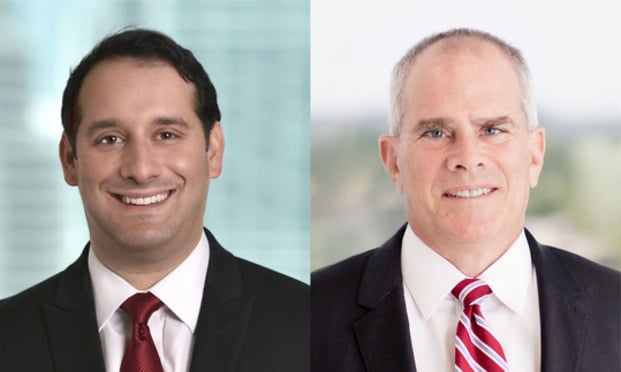
 Cary Steklof, left, and Walter Andrews, right, with Hunton Andrews Kurth.
While businesses nationwide continue to suffer from COVID-19, the insurance industry has been uniform in its message to policyholders: "Don't turn to us for relief." Bent on discouraging claims and avoiding lawsuits, insurance companies have outright denied business interruption claims regardless of the circumstances and despite the clear language of their policies providing coverage for such losses. The industry's effort to construct a case against liability is built around a central pillar—that COVID-19 does not constitute "physical loss or damage" to property necessary to trigger coverage under commercial property policies. In a resounding victory for policyholders a mere five months after the pandemic swept the United States, a federal court in Missouri has issued an opinion signaling that the levee has already broken.
In Studio 417 v. The Cincinnati Insurance Co., the plaintiffs operated hair salons and restaurants in Springfield and Kansas City, Missouri. Each had purchased "all-risk" property insurance policies from The Cincinnati Insurance Co., meaning that they were covered against all risks except for those specifically excluded by the policy. When COVID-19 and various closure orders forced the businesses to suspend or reduce their operations, they submitted insurance claims for their losses. Cincinnati denied the claims and the policyholders filed suit in the Western District of Missouri, asserting a right to payment under the policies' coverages for business income, extra expense, dependent property, civil authority, extended business income, ingress and egress, and sue and labor.
In its motion to dismiss the complaint, Cincinnati focused on the threshold issue that all policyholders must overcome to recover for COVID-19 business interruption losses. Namely, the carrier argued that the insureds failed to allege a "physical loss" to their property, and that this requirement can only be satisfied through some type of "actual, tangible, permanent, physical alteration of property." The court disagreed, holding that the policyholders had adequately pleaded a case for recovery under all of the relevant coverages.
Contrary to the position taken by insurers, the court concluded that COVID-19 can constitute a "direct physical loss" to property sufficient to trigger coverage. The court first reasoned that a "loss," based on its plain and ordinary meaning, necessarily encompasses "the act of losing possession" and "deprivation" of property. Because COVID-19 is a physical substance that attaches to surfaces and renders property "unsafe and unusable," and because this has led to governmental orders prohibiting businesses from remaining open in order to prevent the spread of that physical substance, COVID-19 losses meet the threshold for a "physical loss." Moreover, the court focused on the fact that the policy language extends coverage for direct physical loss or damage. While Cincinnati argued that both "loss" and "damage" require some form of tangible or physical alteration, the court disagreed. Following the rules of policy construction, the opinion aptly concluded that these two terms must have different meanings because of the use of the disjunctive word "or." "Even absent a physical alteration, a physical loss may occur when the property is uninhabitable or unusable for its intended purpose."
After deciding this cornerstone issue in the policyholders' favor, the court went on to reject another argument advanced by insurers to deny civil authority coverage. Despite the obvious and apparent impact of nationwide governmental orders restricting and prohibiting access to all types of businesses, carriers have argued that civil authority coverage is unavailable unless the order completely forbids access to the property. This has become a common refrain particularly regarding restaurants, which were frequently forced to close their dining rooms but permitted to remain open for take-out and delivery services. Rejecting the insurer's argument, the court observed that the policy does not require a prohibition of "all access" or "any access." The fact that there was some prohibition of access with an appreciable decrease in business was sufficient to state a claim for civil authority coverage.
This is a big win for policyholders. To distract from the policyholder breakthrough in Studio 417, however, insurance industry attorneys in Florida have touted the Eleventh Circuit's recent opinion in Mama Jo's v. Sparta Insurance as a victory regarding the meaning of "direct physical loss." A business interruption case unrelated to COVID-19, Mama Jo's involved a Miami restaurant that never ceased any part of its operations yet submitted an insurance claim when parts of its property were dirtied by dust from nearby street construction. In deciding that there was no "direct physical loss," the appellate court reasoned that an item or structure that merely needs to be cleaned does not meet this requirement. The critical distinction from Studio 417, however, is readily apparent. In Studio 417, there was a "direct physical loss" not only because of the obvious physical nature of COVID-19, but because its presence renders property uninhabitable or unusable for its intended purpose. This was not the case in Mama Jo's, where ( the alleged "loss" or "damage" was easily cleanable dust, and the restaurant's operations remained uninhibited.
Countless policyholders suffering from the impact of COVID-19 have foregone business interruption claims due to a perceived low likelihood of success. Studio 417 turns the tables for policyholders and rejects the unreasonably narrow positions advanced by the insurance industry. As COVID-19 litigation becomes more voluminous, courts will continue to deconstruct the carriers' opposition. In the meantime, it is apparent that insurers will not voluntarily pay claims and that lawsuits are the only recourse for businesses intent on recouping their losses.
Walter J. Andrews is a partner at Hunton Andrews Kurth in Miami. His practice focuses on complex insurance litigation, counseling and reinsurance arbitrations and expert witness testimony. Contact him at [email protected].
Cary D. Steklof is a Miami associate at the firm. He represents individual, corporate and municipal policyholders in first- and third-party insurance coverage and bad faith disputes. Contact him at [email protected].