

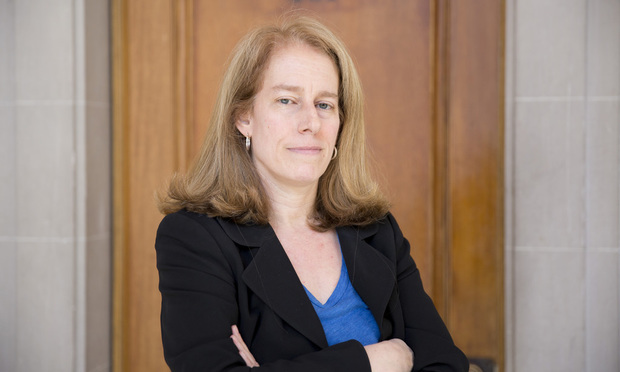
 Shannon Liss-Riordan. (Photo: Jason Doiy/ALM)
A plaintiffs lawyer urged the California Supreme Court on Tuesday to apply its landmark worker-classification decision retroactively, a plea that comes amid broader state and national debates about gig economy workers.
Shannon Liss-Riordan of Lichten & Liss-Riordan argued that the court's 2018 ruling in Dynamex Operations West v. Superior Court did not constitute a wholesale legal change in defining independent contractors and employees. Instead, Liss-Riordan said, the decision and its ABC test "tightened up" standards for classifying workers.
Dynamex was "not a break in the law, it was an evolution in the law," Liss-Riordan told the court during remote oral arguments. "It wasn't an adoption of a completely new and distinct standard."
Tuesday's hearing comes as California voters consider Proposition 22, a ballot measure fueled by record-setting donations from Uber, Lyft, DoorDash, Instacart and Postmates that would exempt ride-hailing and delivery drivers from state law defining them as employees. A late October poll by University of California, Berkeley's Institute of Governmental Studies found voters split on the initiative with the final result likely determined by a small group of undecided residents.
The question of whether Dynamex should be applied to cases retroactively came to the California Supreme Court via the U.S. Court of Appeals for the Ninth Circuit. An appellate court panel in May 2019 said a "strong presumption of retroactivity" weighed in favor of prior application of Dynamex to Vazquez v. Jan-Pro Franchising International, a worker misclassification case brought by janitorial workers.
Jan-Pro's legal team later persuaded the Ninth Circuit to withdraw its finding. The appellate court then asked the California state justices for their take on retroactivity. The case has attracted numerous amicus briefs, including filings submitted by Jenner & Block and Horvitz & Levy for the Chamber of Commerce of the United States of America and the National Employment Law Project on behalf of itself and several workers' groups.
The parties in the case before the California Supreme Court did not hold passionate views on the retroactivity issue. In fact, Liss-Riordan argued, the issue of whether the ABC test should apply to worker-classification suits prior to the Dynamex ruling may be moot since California lawmakers codified much of the opinion in 2019 legislation, Assembly Bill 5.
"When you say the issue may be moot, are you really asking us to decertify the question based on AB 5?" asked Associate Justice Joshua Groban. "To say a couple of days before oral arguments [in recent briefs], 'Hey you can decertify the question' struck me as curious. Is that really what you think we should do?"
Liss-Riordan said the decision would only affect "a small number of cases that are still pending that pre-dated Dynamex."
"This is an unusual situation in which neither party here is asking this court to decide the issue that it has accepted for certification," she continued. "Plaintiffs oppose certification of the retroactivity issue because there has not been conflict among lower courts on that issue. We asked this court to consider this case if it would take on the other issues, which I believe have caused confusion in the lower courts, but this court said it would not do that. … It puts this court, I know, in a very curious position."
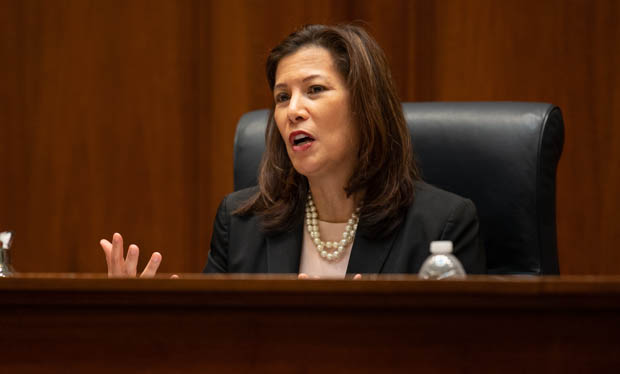 Chief Justice of California Tani G. Cantil-Sakauye. (Photo: Jason Doiy/ALM)
The justices had few questions for either attorney. Willenken partner Jason Wilson, representing Jan-Pro, asked the court to decertify the Ninth Circuit's question, arguing that the appellate court shouldn't have applied the ABC test to his client.
"I want to get to our task here, based on if we do not decertify the question," said Chief Justice Tani Cantil-Sakauye. "Is it your position that the ABC test, then, is retroactive?"
No, said Wilson, noting the court's 1989 ruling that shaped worker-classification decisions in S.G. Borello & Sons v. Department of Industrial Relations. "It's a sea change in the law," Wilson said. "It's completely different than Borello. Borello had a multi-factor test. It emphasized control more than anything else and a number of secondary factors. The ABC test was adopted from a different jurisdiction, is adopted from a different jurisdiction and is different."
Mike Scarcella

Mike Scarcella is a senior editor in Washington on ALM Media's regulatory desk. Contact him at [email protected]. On Twitter: @MikeScarcella. Mike works on a slate of newsletters: Supreme Court Brief | Higher Law | Compliance Hot Spots | Labor of Law.