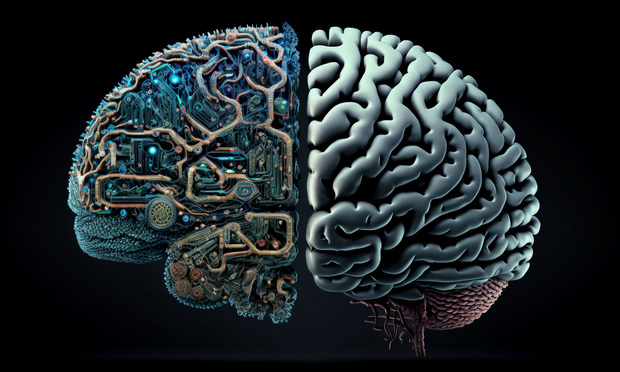
 Credit: Atlas/Adobe Stock - AI Generated
As artificial intelligence infiltrates the daily functions of insurance companies, industry leaders are either upskilling their human employees to manage the technology or keeping others around to offer compassion to customers.
More than 9,000 insurance professionals met at ITC Vegas in mid-October to discuss key tech trends impacting the sector including AI and machine learning, telematics and blockchain adoption.
While there, PropertyCasualty360.com spoke to Richard Hartley, CEO and co-founder of Cytora, about the state of technology in the insurance industry. Founded in 2013, Cytora has been at the forefront of the digitalization of the insurance industry, winning multiple awards and launching one of the first uses of agentic AI in insurance. In 2025 Cytora was acquired by Applied Systems.
PropertyCasualty360.com: Will insurance carriers place a premium on empathy as AI dampens human interaction between the customer and carrier? (When someone loses their home or car after a disaster or traffic accident, they want to speak to a human being, not a robot.)
Hartley: While AI is reshaping insurance operations, it’s also reinforcing the importance of something technology can’t replicate—human empathy. As discussed above, freeing professionals from administrative work gives them more time to focus on the moments that truly define the industry: guiding a business owner through a loss, helping a family rebuild after a disaster, or reassuring a client facing uncertainty. These are the interactions where compassion, understanding, and trust matter most.
As digital tools handle more of the routine work, carriers can turn their focus—and newly freed resources—toward deepening human connection as a differentiator. Speed and accuracy may win efficiency, but empathy wins trust. When a customer faces loss or uncertainty, they want genuine understanding from a person who listens and helps them recover. The carriers that use technology to create space for that kind of care will stand out—not just for how quickly they process a claim, but for how personally they support the people behind it.
What is the state of the insurance industry? How has ITC Vegas addressed the sector's trending concerns?
Hartley: The insurance industry is entering a period of transition. After several years of sustained rate increases, the hard market is beginning to soften across most major commercial lines, with premium renewal rates growing more slowly than at any time since 2019.
This moderation spans property, commercial auto, general liability, and other key segments, supported by stronger carrier balance sheets and a renewed focus on growth. At the same time, technology – in particular AI - is playing an increasingly central role in helping carriers and agencies navigate these shifts. Digitized, automated, connected workflows, real-time market insights, and data-driven decision-making are enabling carriers to respond faster to changing market conditions while improving service with their agency partners.
PropertyCasualty360.com: Why is the digitization of the full policy life cycle vital to today's insurance carriers? (Without the digitization of data, AI is useless?)
Hartley: A lack of digital connectivity doesn’t just create inefficiencies and duplicative data entry tasks for staff. It also prevents carriers from realizing the full value of data and automation across the policy lifecycle.
Applied Systems and Cytora make this clear: digitizing all stages of the risk lifecycle—from submission, endorsements and renewals, to mid-term adjustments, claims, and financial reconciliation—is essential because without consistent, clean, decision-ready data, advanced technologies like AI and automation can’t safely or reliably enhance workflows or support better risk and business decisions.
Applied’s Digital Roundtrip of Insurance vision rests on digitized, automated and connected workflows at every point in the policy journey, from client submission to in-force policy. Cytora’s risk-digitization platform shows how transforming both structured and unstructured data into a unified, usable form enables carriers and brokers to reduce quote turnaround times from weeks to hours, improve underwriting capacity, and make more profitable underwriting decisions. With full digitization, carriers gain the speed, accuracy, and efficiency needed to operate in a connected, data-driven market.
PropertyCasualty360.com: What critical insurance workflows take the most time and incur the most cost without AI? Has there been any forecasting data showing the differences by using AI instead of human roles?
Hartley: As your readers know, there are many workflows in our industry that are unnecessarily manual and repetitive. But let’s expand on the conversation above and look at the submission and underwriting workflows.
The manual, time-consuming email exchange of forms and information between an agency and carrier during the commercial underwriting process prevents them from working together effectively. The breadth and variety of forms required for commercial submissions – ACORD forms, customer forms, carrier supplementals – live in multiple systems and are delivered inconsistently. Underwriters, when they receive a submission absorb over 40% of their time reading, interpreting and rekeying risk information.
We’ve heard from carriers that one in three commercial submissions are never even reviewed by an underwriter due to this complexity and resulting backlog, making it challenging for carriers to underwrite desired business and for agency partners to optimally place it.
PropertyCasualty360.com: As AI and other automated technologies become a more integrated part of everyday function in the insurance business, what traditional roles could be eliminated in the near future? Will these employees be upskilled?
Hartley: As AI and automation become a larger part of daily operations, many traditional roles in insurance aren’t disappearing—they’re evolving. For years, skilled professionals have spent much of their day on “admin work”: rekeying data, sorting emails, reconciling forms, and tracking submissions across multiple systems.
These tasks are necessary, but they pull focus away from the “hero work” that drew many into the industry—helping clients protect what matters most and making sound, informed underwriting decisions. AI-powered technology helps rebalance that equation by automating repetitive administrative work that slows people down, allowing underwriters, account managers, and service teams to spend more time on strategic, relationship-driven, and problem-solving work that truly adds value.

This shift isn’t about replacing roles, but about upskilling professionals to use digital tools that make their expertise—and their human judgment—matter even more. Therefore, these roles will be able to participate in more fulfilling work as they move from purely data-entry roles to revenue-generating, strategic or advisory roles. Producers can spend more time with clients, helping them understand the risks they face.
Underwriters are able to elevate their view of risk to the portfolio level, focusing on how they optimize the target portfolio relative to dynamic changes in risk.
Claims handlers can focus on understanding shifts in claim trends, across the claim portfolio. Fortunately, upskilling is another area that technology is targeting, with step-by-step prompts to bring users through a system so they can learn workflows more quickly as they step into new roles.
© Arc, All Rights Reserved. Request academic re-use from www.copyright.com. All other uses, submit a request to TMSalesOperations@arc-network.com. For more information visit Asset & Logo Licensing.