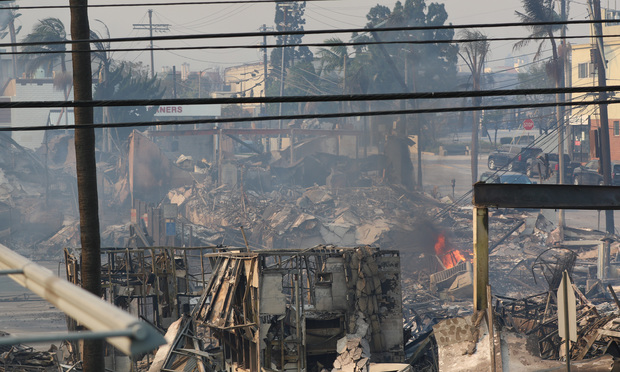
 Palisades wildfires in January. Credit: Pierce/Adobe Stock
To say that 2025 was a tumultuous year for the insurance market in California is like saying that the Los Angeles Dodger’s back-to-back World Series wins are barely worth a slow clap. Given everything that has transpired over the last 12 months, a recap is certainly in order.
The January wildfires pushed an already very fragile property insurance market to the brink. As of Jan. 30, 2025, insurance carriers paid $4.2 billion to their policyholders, 31.210 claims had been filed. But by March 5, 2025, the payouts were at $12.1 billion. While homes and businesses will be rebuilt, and claims will be paid, the real question remains.
Can the market recover?
In order to ensure that the market recovers, the Department of Insurance (DOI) has proposed reforms and ramped up enforcement efforts, while carriers and courts work to stabilize conditions.
The writing was on the wall well before the 2025 fires that the California property insurance market was at risk of an eminent collapse.California insurance carriers had been fleeing the state for several years. Since the passage of Proposition 103, the cost of doing business was out of balance with the increasing cost of wildfire claims. As carriers left, property owners and renters were forced to buy insurance through California FAIR Plan Association, the state’s insurer of last resort., causing FAIR Plan’s enrollment to increase up to 555,868, which was up 104,000 from 2024.
The question leading up to 2025 was what could be done to fix the problem without burdening Californians with unreasonably high premiums?Well, on Dec. 13, 2024, the Commissioner rolled out what called a “first of its kind” catastrophe modeling and ratemaking regulation, a central part of his Sustainable Insurance Strategy (also known as SIS). “These now 37-year-old rules have contributed to rate spikes and balloon premiums following major wildfire disasters without fully accounting for the growing risk caused by climate change or risk mitigation measures.”
All is not lost. On Nov. 21, 2025, a major national insurance carrier expressed its approval of the SIS reforms by announcing that it was eliminating the cap on the number of homeowners insurance policies it offers in California. The carrier also filed a new rating plan incorporating elements of the Commissioner’s SIS plan. And in September 2025, five carriers joined forces to request a rate increase allowing them to return to the market.
By July 1, 2025, The DOI announced that FAIR Plan must become far more transparent and must publicly report total exposures. Beginning July 26, 2025, FAIR Plan offers high-value commercial coverage, including HOAs and affordable housing. The DOI mandated public reporting of exposures, policy counts, and financials, investigated smoke-claim handling, and supported AB 226.In addition to reforming the property insurance market, the Commissioner also seeks to enforce the rules intended to protect the public, and carriers, from both fraud and improper claim handling.
Meanwhile, while the fires were still smoldering, the Commissioner issued an alert to all of Southern California, in an effort to prevent property insurance fraud. The DOI also filed a First Amended Accusation (Case No. LA202000454) against public adjuster Aleksander Guldshadt and National Insurance Claims Advocates (NICA). The DOI alleges widespread misconduct that spanned from 2020 to the present, including filing false claims, forging signatures, and fake estimates.
In late July 2025, the DOI filed an action against FAIR Plan after receiving numerous consumer complaints showing a pattern of denying smoke damage claims (Case No. DISP-2025-00281). It is the result of a multi-year investigation which discovered 418 violations. FAIR Plan is challenging the allegations.
There have been some interesting developments on the litigation front as well:
- Gharibian v. Wawanesa General Insurance Co. (Cal. Ct. App., 2d Dist., Div. 2, Feb. 2025), 108 Cal.App.5th 730: Court affirmed summary judgment for Wawanesa, holding wildfire debris did not constitute “direct physical loss” as it was removable and caused no lasting alteration (citing Another Planet v. Vigilant Ins. Co., 15 Cal.5th 1106 (2024)).
- McGranahan v. GEICO Indemnity Co. (9th Cir., Mar. 2025), 2025 WL 869306: Ninth Circuit affirmed summary judgment for GEICO, holding insurer acted reasonably by requesting medical records before responding to a time-limited demand.
- Aliff v. California FAIR Plan Ass’n (L.A. Super. Ct., June 24, 2025), No. 21STCV20095: The court granted summary adjudication finding that certain provisions of the FAIR Plan police were “unlawful.” The Court concluded “[t]he CFP Policy’s definition of ‘direct physical loss’ as ‘actual loss or physical damage, evidenced by permanent physical changes’ is unlawful under Ins. Code § 2070, in that this language limits coverage to be less favorable than and not substantially equivalent to the Standard Form Policy contained in Ins. Code § 2071.”
- State Farm Fire & Casualty Co. v. Diblin (Cal. Ct. App., 4th Dist., Oct. 7, 2025), 114 Cal.App.5th 1245: Court held injuries from insured’s intentional gender-abusive conduct were not an “accident” and thus not a covered “occurrence.” Once to watch.
- The California Supreme Court has a review pending in 11640 Woodbridge Condominium Homeowners’ Ass’n v. Farmers Ins. Exch., 110 Cal.App.5th 211 (2025), The California Supreme Court granted review in July 2025, a decision is expected in 2026.At issue is whether a provision in an “all-risk” property insurance policy covers water damage to the interior of a building caused by rain that entered while the roof was being repaired.
The trial court concluded that “the policy did not cover the HOA's losses because both the water damage exclusion and the faulty workmanship exclusion applied.” Id. at 220. The Court of Appeals reversed determining “that rain damage resulting from roof repairs are covered unless expressly excluded by another provision of the policy, such as the faulty workmanship exclusion.” Id. at 228.
Bottom line: Stabilizing California’s insurance market will require collaboration among carriers and. The challenges of 2025 were a wake-up call—2026 promises change. It seems evident that this requires more than one approach.How things appear a year from now remains to be see, but we will all be watching.
Michele is a Partner in FBT Gibbons Product, Tort, & Insurance Litigation practice group. She handles a broad range of insurance defense and coverage matters, both litigated and non-litigated. Her experience includes rendering coverage opinions, managing first-party property and automobile claims, conducting examinations under oath, and overseeing insurance defense litigation involving personal injury, suspicious first- and third-party claims, and bad faith actions.
© Arc, All Rights Reserved. Request academic re-use from www.copyright.com. All other uses, submit a request to TMSalesOperations@arc-network.com. For more information visit Asset & Logo Licensing.