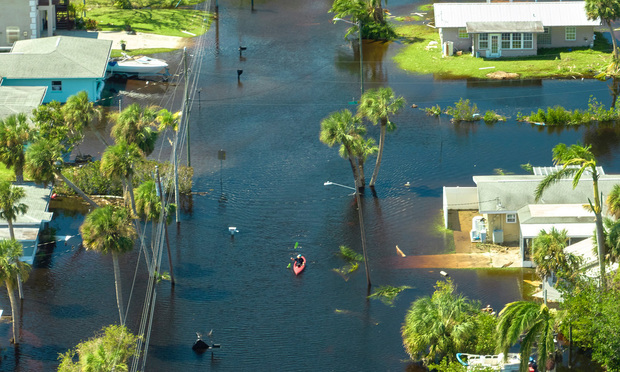
 Hurricane Ian flooded houses in Florida residential area. Credit: bilanol/Adobe Stock
Contemporary scammers now use fake photos and videos to receive donations after a natural disaster.
There were over 100,000 deepfake-related attacks in the U.S. last year, with scammers creating convincing fakes made in minutes with just a few seconds of audio or a single photo pulled from socials.
Recently, PropertyCasualty360.com spoke to Brian Long, an AI and deepfake expert and CEO of Adaptive Security, about the increase of deepfake scams after natural disasters.
PropertyCasulty360.com: Why are we seeing more scams related to fake videos after devastating events like hurricanes, fires?
Long: Moments of chaos and tragedy create a perfect storm for misinformation. People are desperate for updates and don’t have time to verify what they see, which makes them more vulnerable to fake videos. Attackers exploit that urgency by impersonating officials or aid groups to spread scams. Scammers often pose as officials or aid groups, exploiting trust and urgency, turning disaster into an opportunity for deception.
PropertyCasulty360.com: How quickly can convincing deepfakes be made?
Long: This isn’t a fringe threat anymore. In the U.S., there were more than 105,000 deepfake-related attacks last year – one every five minutes. That’s a 17x increase from 2023 to 2024. Thanks to inexpensive, globally available AI tools, realistic disaster-themed deepfakes – fake charity appeals, fabricated videos – can be assembled in minutes. Low cost and minimal skill requirements mean these scams proliferate fast.
PropertyCasulty360.com: There were over 105,000 deepfake-related attacks in the U.S. last year, nearly one every five minutes. Will these attacks increase over time?
Long: Unfortunately, yes. The cost to create deepfakes is dropping, the tools are getting easier, and the rewards are growing. In fact, deepfake-related fraud attempts surged by more than 3,000% last year, and there’s no sign of slowing down. Every advance in AI creation tools makes it cheaper and faster for bad actors to churn out fakes at scale, while detection and verification struggle to keep up. Without stronger safeguards, deepfakes risk becoming the new spam: everywhere, relentless and far harder to recognize.
PropertyCasulty360.com: What practical steps can consumers take?
Long: One of the simplest defenses is also the most overlooked: remove your personalized voicemail greeting and use your carrier’s default – don’t give scammers that raw audio.
Pause before reacting to urgent calls or messages, and verify via another channel before sending money or clicking links. When donating after a disaster, don’t follow unsolicited links – donate only through official sites. Limit what you share on social platforms – every clip you post can be repurposed. Together, these habits – restraint, verification and discretion – are your best protection.
PropertyCasulty360.com: How can insurance help protect consumers and businesses against deepfake scams?
Long: Insurance isn’t a cure all, but it can soften the blow when these scams succeed. Some traditional crime policies cover impersonation fraud, though usually with low limits. Cyber policies go further – they may reimburse stolen funds, pay for investigations, and even cover crisis response if a deepfake is used against you.
We’re also seeing insurers adapt. Some now offer AI-specific coverage and require companies to strengthen their defenses as part of underwriting. The key is to review your policy closely so you understand what’s actually covered before an attack happens.

Commercial crime vs. cyber policy: Traditional policies may offer limited sub-limits for social engineering, while cyber insurance generally offers broader protections and higher limits for deepfake-related losses.
Evolving coverage: Insurers are introducing AI-specific endorsements and forcing policyholders to implement stronger security measures – such as multi-factor authentication and deepfake detection tools – to qualify for coverage.
Proactive claim handling: Cyber policies typically cover more than just the loss – they can pay for investigations, legal fees, data recovery, and crisis PR in the event of a deepfake-driven breach or scam.
Risk management and training: Forward-looking insurers are investing in detection technology and fraud training – enabling claim handlers and underwriting teams to identify deepfake threats more effectively.
© Arc, All Rights Reserved. Request academic re-use from www.copyright.com. All other uses, submit a request to TMSalesOperations@arc-network.com. For more information visit Asset & Logo Licensing.