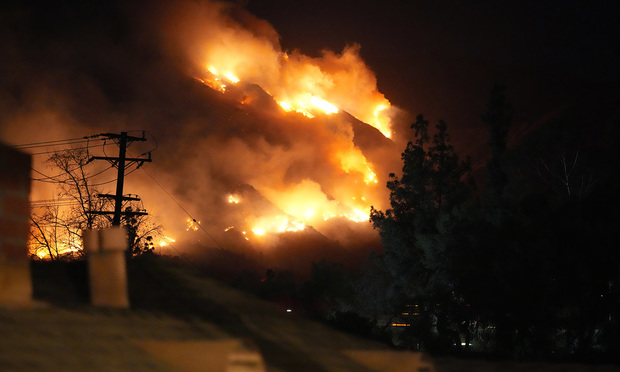
 Eaton Canyon Fire Spread to Arcadia in Los Angeles 2025. Credit: Kyle/Adobe Stock
The devastating January 2025 Eaton and Palisades wildfires left behind widespread destruction, and for many, a second disaster in the form of an arduous, inconsistent, and in some cases, an exasperating insurance claim process.
As the state’s largest home insurer, State Farm endured most of the responsibility for claims in the region. Yet from the early days following the fires, complaints by wildfire victims began mounting against State Farm: delays in payment, unresponsive adjusters, lowball estimates, and a lack of continuity in the claims process.
The scale of these fires is among the most destructive in California’s history. Indeed, over 16,000 homes, businesses, and structures were damaged or destroyed. Adding fuel to the fire, State Farm was granted a 17% (and is still seeking approval for a 30%) emergency rate increase on California homeowner policies—even as the insurer faces regulatory scrutiny. Consumer advocates have opposed these increases, urging a pause until the Department of Insurance concludes its Market Conduct Examination into State Farm’s claim handling practices.
As State Senator Sasha Renee Perez said, her constituents—many of whom have been loyal State Farm customers—“feel like they’ve been left in the cold.” The individual testimonials often do not fare any better.Policyholders have complained about delays, misrepresentations concerning the scope of coverage, and the lack of good faith in the claims handling process.
State Farm insures approximately 20% of California’s homeowners, making it the dominant player in the market. The company claims to have paid $4.2 billion on over 13,000 wildfire claims to date, but many policyholders have received only partial settlements or remain stuck waiting for meaningful progress.
Despite being the largest homeowner insurer in California, the scope of the Los Angeles area wildfires left the company flat-footed. State Farm was forced to enlist out-of-state adjusters, many of whom were reportedly unfamiliar with California’s specific insurance regulations and consumer protection laws. Making matters worse, wildfire victims often had their adjusters reassigned mid-claim, often without proper handoff, leaving State Farm’s policyholders to re-explain their cases or start over entirely.
The discontinuity has caused many State Farm policyholders, despite submitting documented losses resulting from the wildfires, only to receive a fraction of what’s needed to restore their home and their lives. State Farm appears to have exacerbated the general systemic issues of the claims process by its overall handling of policyholder claims and State Farm’s conduct in response to the wildfires has prompted a regulatory response.
Outside of State Farm’s claims handling practices, there are several existing lawsuits which allege that State Farm systematically underinsured policyholders in the affected wildfire areas. Additionally, State Farm is currently facing a certified class action lawsuit in California federal court, where homeowners allege the company unlawfully reduced actual cash value payments by depreciating sales tax on property claims, contrary to California Insurance Code Section 2051(b). Just this week, the court found that the plaintiffs presented a viable method for calculating damages on a class wide basis, allowing the case to proceed toward trial as policyholders seek recovery of funds they claim were improperly withheld.
A turning point for wildfire survivors and policyholders
On June 12, 2025, California Insurance Commissioner Ricardo Lara took a decisive step by announcing a formal Market Conduct Examination into State Farm’s wildfire claims handling.
This comprehensive examination is aimed at uncovering unfair practices across claims handling, recordkeeping, and communication protocols. It is State Farm’s fourth such investigation since 2014—a troubling indicator of recurring concerns amongst significant proposed rate increases for California policyholders.
What is a market conduct examination—and why is it different?
A Market Conduct Examination is a rigorous, multi-month review by the California Department of Insurance (“CDI”) that goes beyond individual complaints. Unlike routine audits or compliance reviews, a Market Conduct Examination is a deep, fact-driven review that scrutinizes an insurer’s practices across the full spectrum of claims handling, underwriting, and customer service. It reviews a random sample of all claims (open or closed) and is designed to uncover systemic issues, not just isolated incidents.
The findings of a Market Conduct Examination are documented in a public report, and insurers are given the opportunity to respond. Both the report and the insurer’s comments are posted for public review, ensuring transparency and accountability. If violations of the California Insurance Code or Unfair Practices Act are found, the CDI can require corrective action, monitor compliance, and, in some cases, pursue enforcement actions or penalties.
The scope of the Market Conduct Examination for State Farm will likely involve an analysis into many of the claims handling issues that have confounded State Farm policyholders to determine if the problems are driven by corporate practices or are unique.The analysis will likely include a review of the following issues:
- Whether State Farm is handling the wildfire claims fairly and in accordance with California law;
- Whether State Farm is communicating consistently and adequately with its policyholders;
- Whether State Farm is engaging in deficient recordkeeping leading to delays or denials; and
- Whether State Farm is properly investigating the wildfire claims—including the investigation of smoke damage claims, which has appeared as a particularly contested issue.
How does a market conduct examination help policyholders?
For businesses and homeowners, this investigation is a positive development. It signals that the California Department of Insurance is taking consumer complaints seriously and is committed to holding State Farm accountable to ensure fair and prompt claims handling.
If you are a policyholder who has experienced concerns with State Farm—this investigation may help validate your concerns and could assist in more fair and timely claim resolutions.
What should policyholders do now?
If you are facing challenges with your insurer’s handling of your wildfire claim -- whether it’s State Farm or not—the best practice is to create a paper trail of all interactions with your insurer. Request that all communication be in writing and preferably through email to speed up the correspondence.
When engaging in telephone conversations it important to follow up these conversations with an email confirming the conversation with the claims handler and make sure that any specific requests are in writing. All of this documentation is crucial to validate your claim in any type of dispute resolution with an insurer.
Keith A. Meyer is a partner in Reed Smith's Insurance Recovery Group in its Los Angeles office, representing policyholders in complex insurance coverage disputes and with a focus in recovery for losses arising from product liability claims, toxic tort disputes, environmental issues, business interruption claims, employment liability matters, D&O issues, errors and omission claims and first-party property issues. He can be reached at kmeyer@reedsmith.com.
Jessica Gopiao is an associate in the firm’s Insurance Recovery Group in its Orange County, Calif., office, where she serves as coverage counsel for policyholders and. negotiates with insurers to reverse denials, secure defense funding, and obtain settlements. She can be reached at jgopiao@reedsmith.com.
Kalid Knox is an associate in the firm’s Insurance Recovery Group in its Los Angeles office, where he focuses his practice on representing policyholders in insurance coverage disputes. He can be reached at kknox@reedsmith.com.
© Arc, All Rights Reserved. Request academic re-use from www.copyright.com. All other uses, submit a request to TMSalesOperations@arc-network.com. For more information visit Asset & Logo Licensing.