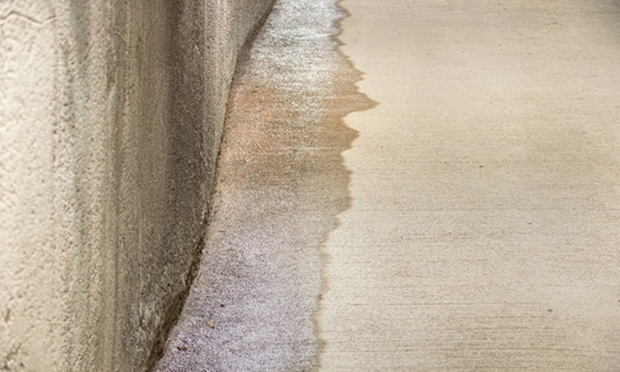
 An active plaintiff’s bar is one reason construction firms are at risk of being sued for perceived design defects long after a building has been completed. (cunaplus/Adobe Stock)
Biotech firm and vaccine manufacturer Moderna Inc. is suing a construction firm for $10 million, claiming a design flaw at its Massachusetts-based manufacturing facility caused a water leak, mold, bacteria and other damage.
“If something is not built or sealed properly, there may be an environmental issue festering behind the walls,” says Nicholas Freeman, associate managing director and Casualty broker at Burns & Wilcox Brokerage. “These issues can be extremely costly, causing significant damage that may not manifest immediately.”
Issues like faulty construction and other non-weather issues at commercial properties cost insurers $13 billion annually, according to the National Association of Insurance Commissioners (NAIC).
An active plaintiff’s bar is one reason construction firms are at risk of being sued for perceived design defects long after a building has been completed, says Richard Morehouse, a Burns & Wilcox professional liability broker. “We are constantly communicating with our construction clients to help them understand how to protect themselves.”
Moderna alleged in April that defective construction resulted in mold within the roof system, resulting in loose exterior panels and noticeable water infiltration throughout its manufacturing facility, which was purchased in 2023. The lawsuit seeks damages from general contractor The Gutierrez Co.
Professional and pollution liability coverage
Most construction or architecture & engineering (A&E) firms have general and employers’ liability along with workers’ compensation and excess umbrella policies to help mitigate claims risks. However, most of these policies exclude professional and pollution liability.
Design-build insurance coverage is essential for managing the unique risks associated with design-build projects. Design-build firms face various liabilities including legal disputes with clients and subcontractors that should be considered. Additionally, errors & omissions (E&O) coverage can cover legal fees and damages from design, engineering and construction management obligations.
Policyholders also might carry reputation protection insurance included within these policies in case an accident or delay harms a contractor’s reputation. Firms can even look at project-specific insurance. Design-build jobs may introduce new risks, so it’s crucial to make sure a construction project's insurance program addresses these additional challenges.
What's more, pollution liability coverage provides industrial, commercial and agricultural property owners, managers and developers with a broad range of related protection possibilities for gradual and sudden, accidental, first-party and third-party environmental liabilities.
Whether a perceived design flaw is tied to a pollutant or environmental issue as defined by ISO policy and the CG 0001 form, it is likely that the only coverage preventing out-of-pocket costs is pollution liability. Clients do not always require construction firms they hire to carry pollution liability, so it is often up to the firms themselves to purchase it.
“Pollution liability is generally considered to be a type of periphery coverage,” Freeman says. “Unfortunately, some general contractors may not think pollution liability is needed because they are dealing with building wood frames or steel beams. But a pollution-related claim is very possible any time water is involved.”
In some cases, the work determined to have caused pollution may have been completed by a subcontractor, and a pollution liability policy held by that subcontractor could be impacted instead.
Claims mitigation protection
Inflation can make such lawsuits like Moderna’s more expensive, especially given higher placement cost, Morehouse says. With an estimated $2 trillion being spent on new construction in the U.S. in 2025, the potential for voluminous claims is significant.
Morehouse says A&E firms need sufficient financial backing and insurance coverage to accept high-value contracts.
“Construction firms should be well funded and well protected by their insurance coverage before taking on this type of a project,” Morehouse says. “They need to make sure they understand the insurance requirements and what type of policy is needed to address the scope of the project.”
Environmental exposure is common.
Social inflation is driving up the costs of claims expenses and settlements. Conditions such as mold, indoor air, legionella, and weather-related events are on the rise as well. Any builder can be exposed to pollution and environmental claims, Freeman says. Many common substances besides mold are considered a pollutant.
“Pollutants can extend beyond chemicals and can include a range of seemingly innocuous items,” Freeman says.
Fortunately, Construction and A&E firms can benefit from plenty of Pollution Liability options from E&S carriers, he adds. The current market for Pollution Liability is considered to be soft, which means most insureds will have options.
“Right now, it’s fairly easy to get a pollution liability policy. Capacity is available and rates are affordable,” Freeman says.
Construction firms should secure enough coverage to adequately protect themselves against potential claimants like investors, tenants, and subcontractors. Issues like bodily damage, management coordination and supervision and pollution are common exclusions as well.
“This would be an example where having Professional Liability and a Pollution policy in place would be important,” Morehouse says.
Since general contractors often rely on subcontractors, Freeman recommends they use “finely crafted language” in their contracts with subs to limit potential liability.
“In this case I would expect Moderna to try and push the liability down to the subs,” Freeman says. “A lot of this will fall downhill. That’s why the amount of potential liability in this example is based upon the contract language between Moderna and Gutierrez, and then Gutierrez and any of their subs.”
Additional coverages to consider
With the increased use of technology products and services within the construction space comes additional exposure. While these products help streamline work there is a chance the product could fail thus leading to a design issue and financial loss.
Technology products and service extensions is an additional coverage that can help a firm if the technology they use leads to a financial loss. “Firms should be aware the technology can also create a liability for the firm if the technology creates an issue with the project. This extension is not readily available with every policy,” Morehouse says.
Brokers and agents should also counsel their general contractors to be aware of the client’s goals when a construction project or renovation is planned.
“You want to understand the length of the policy required by contract as well as the expected timeline of completion,” Morehouse says. Most of these contracts will require a policyholder to purchase “extended reporting” long after the job is completed. “You also want to make sure the limits are sufficient for your company’s size and scope.”
Layered protections may need to be added to ensure proper coverage, Morehouse says. For example, rectification insurance provides first-party coverage for the costs a contractor incurs in correcting a design defect. It pays for the expenses incurred during mitigation of a negligent act arising from professional services. Protective indemnity protection can also be considered for damages incurred by the contractor and legally entitled to recover from errors created by design professionals. It is important contractors are vetting the technical and relative experience of any subcontractor to avoid these issues.
Morehouse concludes: “You have to consider the uptick in severe claims and the cost to defend a claim in today’s litigious society.”
This article first published on the Burns & Wilcox website and is reproduced here with permission.
© Arc, All Rights Reserved. Request academic re-use from www.copyright.com. All other uses, submit a request to TMSalesOperations@arc-network.com. For more information visit Asset & Logo Licensing.