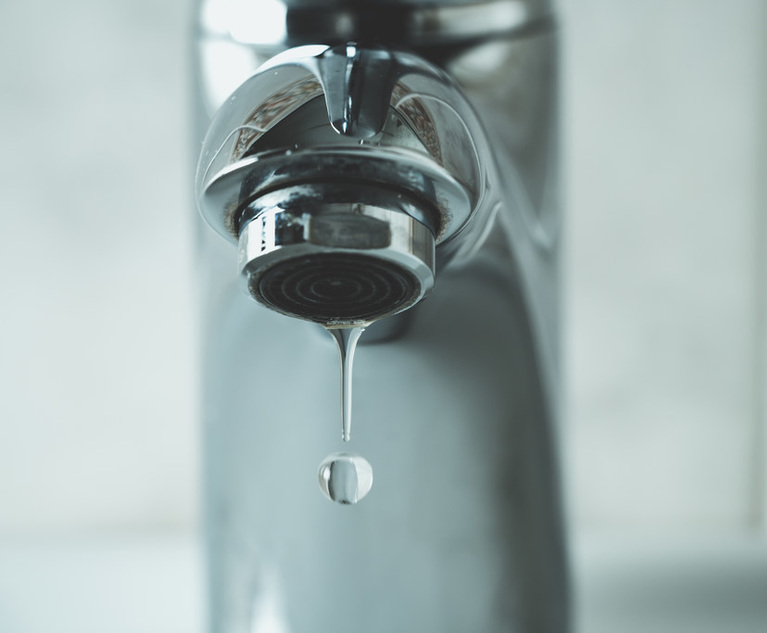
 Today's water sensors are more sophisticated than they once were. They use AI machine learning to monitor and analyze water flow dynamics and usage patterns over time. (Credit: Credit: banusevim/Adobe Stock)
With more than 40 states expecting water shortages by 2024, according to the U.S. Environmental Protection Agency, it's becoming an increasingly urgent priority for Americans to address the issue of water conservation in a meaningful way.
As building owners and government entities look for ways to curb water waste, one important component will be addressing leaks across water systems, which account for 14 out of every 100 gallons of water being wasted.
From the perspective of insurers, water damage caused by leaks is becoming an uninsurable risk. Although all buildings eventually experience some sort of water-related damage, the causes and severity can be widely dissimilar, making the cost nearly impossible to price. As a result, deductibles have skyrocketed, placing much of the financial responsibility for water damage on building owners themselves.
However, emerging technology driven by AI is on the verge of bringing new clarity to the causes of water damage and overall water usage patterns in large buildings. In doing so, it has the potential to help leaks get fixed before they cause major damage, making the financial burden of water damage much more predictable.
While sensors have been part of buildings for decades, they now have a much wider range of uses, even as their prices have dropped by thousands of dollars. Their effectiveness has also improved dramatically.
New and improved
We've evolved past the first wave of water-detecting sensors, which had one simple purpose — to send an alarm whenever they detected water on a surface. The second generation of sensors is far more sophisticated, using AI machine learning to monitor and analyze water flow dynamics and usage patterns over time.
Water usage on a given Tuesday, for instance, can be compared against previous Tuesdays, and the sensors can detect changes in patterns on an hour-by-hour or minute-by-minute basis. If the sensors detect higher-than-usual water usage that could be evidence of a leak, they'll alert the user so that the issue can be investigated. Not only that, the algorithms learn over time to identify patterns of water usage, reducing false alarms.
The next generation of sensors will take these insights another step further. Artificial intelligence and machine learning can now understand a pipe's distinct frequency, similar to a microphone, making it possible to detect changes from deep inside a building. Taking this technology even further, it may be possible to accurately detect when a piece of equipment is nearing the point of failure. This could spur building managers to do preventative maintenance before the failure occurs and minimize any ensuing damage.
New technology is also making it easier to manage the vast quantities of data gathered by sensors without the need for massive central systems. Instead of having to install a computer hub inside a building, cloud computing now makes it possible to aggregate that data in a single online interface that can be accessed from anywhere.
All of this is happening just as the paradigm shift of microinsurance is taking place. Policies are becoming dynamically tuned to the behavior of the insured, and that ongoing relationship makes it possible to reduce risk over time. Insurers can continually change the pricing of a policy and work with the insured to spur a gradual improvement in their habits.
As data is accumulated from the buildings where sensors are installed, it will soon be possible to develop "automated actuarial tables" that allow risk to be priced based on real-time data inside a building. Other diverse data can be factored in, such as the historical failure rate of individual building components or the average temperature, humidity and weather patterns in the city where a building is located.
The more we understand about water usage patterns, the easier it will become to focus in on the areas most in need of improvement — from building design or failure-prone pieces of equipment to wasteful habits by building occupants. With these technological tools at its disposal, the insurance industry can drive the adoption of new water conservation standards — leading to more responsible water usage and reducing waste.
 Dr. Dennis Shelden
 Dr. Dennis Shelden is chief technology strategist and co-founder of InsureTEK, a pioneering B2B platform aggregator that integrates building sensors, installation, insurance, financing and artificial intelligence/machine learning to predict, mitigate and minimize building owners' loss from water damage and other perils. Dr. Shelden holds three degrees from MIT and is an internationally recognized architect, academic, author and entrepreneur with a strong focus on the convergence of architecture, engineering and information technology. He is an associate professor at Rensselaer Polytechnic Institute in New York State, where he serves as the director of the CASE Center for Architecture, Science, and Ecology and co-director of the EBESS Institute for Energy, Built Environment and Smart Systems.
© Arc, All Rights Reserved. Request academic re-use from www.copyright.com. All other uses, submit a request to TMSalesOperations@arc-network.com. For more information visit Asset & Logo Licensing.