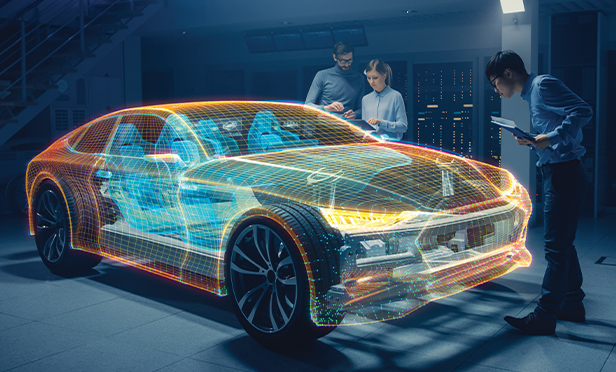
 Touchless claims serves as a prime example of a metaverse sector that could benefit from 5D virtualization. (Photo: Gorodenkoff/Adobe Stock)
Insurance technology is constantly evolving and Scott Ackerson, CEO of Quidient, predicts that a new artificial intelligence (AI) domain called "5D virtualization," used in combination with AI estimatics, will automate scope of loss assessment once and for all.
Virtualization is the process of digitally twinning real-world content, according to Quidient's marketing and communications manager, Stara Diamond. "Virtualization can be manual or automatic," Diamond explained. "Digital artists perform virtualization manually using 3D modeling. However, to be touchless, virtualization must be automatic."

True touchless requirements can be demanding and include:
- Gold Standard. High enough accuracy to create a gold standard.
- Usable by anyone. Even asset owners can virtualize using their smart devices.
- Remote viewing. Asset can be viewed/inspected from anywhere in the world.
- Enabling successful AI estimatics. High-quality AI input makes high-quality AI output possible.
Automatic methods that have been tried by the auto physical damage (APD) industry include structured light scanning, deflectometry and photogrammetry. "Although these remarkable technologies can produce excellent results, they can't meet the industry's needs for true touchless," explained Ackerson.
Ackerson said that a new approach has emerged for touchless claims called Generalized Scene Reconstruction (GSR). Referred to by some as "the new 3D," GSR is a 5D method for automatically virtualizing objects and scenes from images.
"While 3D scanning methods today only capture spatially located matter, GSR also captures the 2D light field," explained Ackerson. "3D plus 2D equals 5D. Using photos or video, GSR simultaneously reconstructs all light flowing through a scene, which allows it to discover the light interaction properties of matter, such as its transparency, reflectivity, color, etc."
It also provides exact dimensions, which can serve as highly accurate input for AI estimatics systems.
With the ability to capture both light and matter fields, Ackerson said GSR would enable users to create 5D models of vehicles (including true-to-life damage) using their smartphones. This is a significant leap forward in touchless claims.
5D virtualization in action
Quidient is currently virtualizing objects and scenes of interest for the property and casualty industry. For example, the company virtualizes 5D models of dents on car panels to six microns precision. According to Ackerson, "This is the accuracy needed to create a gold standard for touchless hail damage assessment."
The company has adapted the platform for an entertainment company, the U.S. Air Force, Space Force and Department of Energy. Projects include virtualization of aircraft surfaces, orbital debris, and nuclear powerplants for inspection.
"The Air Force has tried to develop a method of detecting delamination in composite structures for years," said Col. Clayton Seale (ret.), chief of the maintenance division at Headquarters Global Strike Command. "This technology [GSR] has the potential to completely change the way the Air Force conducts inspections on both metal and composite material."
Seale maintains that GSR will reduce the time needed to inspect aircraft structures and will increase the accuracy level that can be achieved.
"This has the potential to be useful on every weapon in the inventory, including fifth-generation aircraft," Seale added. "It could reduce aircraft downtime and provide accurate damage mapping and monitoring of defect growth."
A reality portal to the APD metaverse
Quidient sees 5D as the portal to the APD "metaverse" where car owners, carriers, insurtech companies, OEMs, dealerships and body shops exchange and update vehicle information virtually. Once virtualized, an asset can be inspected, change-tracked, showcased, insured, appraised and more.
"The APD metaverse is coming," said Bo Opanasyuk, COO of Paintless Dent Repair. "In many ways, it already exists. Whenever we digitally exchange estimates, photos or reports of vehicle condition (between adjusters, repairers, insurance carriers and policyholders), we're solidifying the lines of communication that will one day carry 5D models. 5D models just simplify these communications by including all vehicle information in a single digital twin."
Touchless claims serves as a prime example of a metaverse sector that could benefit from 5D virtualization. "For auto and property insurers, claim cost represents about 70% of total outflow and is therefore, a fertile area of improvement opportunity," said Stephen Applebaum, managing partner of Insurance Solutions Group.
"As the property and casualty insurance industry is highly focused on digitizing and streamlining its business processes, in particular claims, new and emerging technologies such as General Scene Reconstruction are attracting attention," said Applebaum. "GSR has an impressive ability to improve damage assessment accuracy, reduce claim-related costs, compress cycle time, and thereby elevate customer and user experience and retention."
He added that greater damage assessment accuracy will help reduce supplemental estimates and extra steps, improving efficiency for claim adjusters and body shops.
Other APD industry use cases for 5D virtualization include:
Rental Companies. Damage can be caught early in the rental process, minimizing disputes about the source and date of damage. 5D virtualization also allows rental companies to keep a continuously updating digital twin of their fleets to track the rate of wear and tear.
Repair and Auto Body Shops. Customers can preview potential vehicle changes, such as new paint or hubcaps, on 5D models. This would likely improve customer satisfaction and increase demand for visually enticing options. Models can be analyzed to catch any missed issues and provide customers the option to make a more thorough repair. After the process is complete, the quality of vehicle modifications can be documented to help mitigate liability.
Virtual Showroom. 5D models of used vehicles can give buyers an accurate, immersive view of vehicle conditions. Buyers can also test out legroom, storage and seating in virtual reality.
Reflecting on these use cases, Ackerson notes, "We built Quidient from the ground up to solve key APD problems, including the need for truly touchless claims and much more. The company stands ready, along with all participants of this amazing market, to enter the true touchless age."
Stacey Phillips (stacey@radiantwriting.com) is an award-winning writer based in Southern California. As the owner of Radiant Writing & Communications, she specializes in providing original content and digital marketing for the automotive, insurance and technology industries.
© Arc, All Rights Reserved. Request academic re-use from www.copyright.com. All other uses, submit a request to TMSalesOperations@arc-network.com. For more information visit Asset & Logo Licensing.