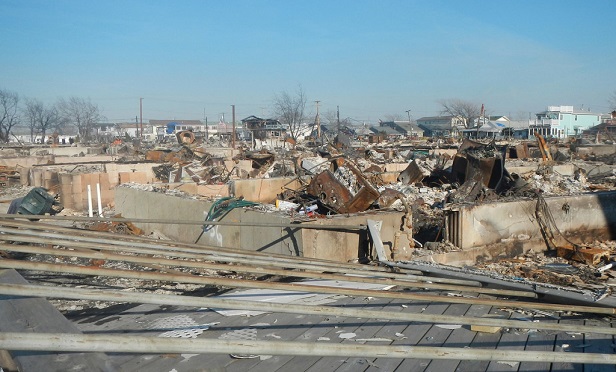
 The cost to repair or replace a damaged business will not include any increased cost attributable to enforcement of or compliance with any ordinance or law regulating the construction, use or repair of any property. This is Breezy Point in Queens after Hurricane Sandy and fires damaged the area. (New York Law Journal)
Analysis brought to you by the experts at FC&S Online, the recognized authority on insurance coverage interpretation and analysis for the P&C industry. To find out more — or to have YOUR coverage question answered — visit the National Underwriter website, or contact the editors via Twitter: @FCSbulletins.
Question: I'm working with an attorney on a fire claim. The policyholder has a commercial policy in place. The building is deemed a total loss, and the insured has been paid the Actual Cash Value (ACV).
The insured had a bar/restaurant that burned, and now he wants to rebuild a bed and breakfast instead. We have determined by using several contractors that the cost to rebuild a similar-sized bar/restaurant with like, kind and quality would exceed the limit of insurance.
Now the insured wants to rebuild a bed and breakfast instead again using a similar-sized building with the same type of construction. My question is "can the insured collect full replacement cost provided he builds a like kind and quality building even though it would be used for a different type of business?"
Can you help me decipher this coverage issue?
— Trial Subscriber
Answer: With respect to the replacement cost option of the ISO commercial property form CP 00 01 10 12, the insurer will not pay more for loss or damage on a replacement cost basis than the least of the below three options. In addition, the cost of repair or replacement will not include any increased cost attributable to enforcement of or compliance with any ordinance or law regulating the construction, use or repair of any property.
The replacement cost options are:
- The limit of insurance applicable to the lost or damaged property;
- The cost to replace the lost or damaged property with other property of comparable material and quality; and used for the same purpose; or
- The actual amount spent necessary to repair or replace the lost or damaged property.
Therefore, replacement cost valuation would not include the cost to replace the bar/restaurant with a building to be used for a different purpose, such as a bed and breakfast.
Replacement cost instead of actual cash value
Question: With respect to the Loss Settlement condition, we have a situation where covered damage to a building is reported in excess of 180 days from the date of loss (but within two years). The delay is not prejudicial to the company. Paragraphs D. and E. of the loss settlement condition is creating some confusion. Is there a way for the insured to be eligible for replacement cost since they cannot notify us of their intent to do so within 180 days?
Where would an actual cash value payment fall into this?
— Illinois Subscriber
Answer: The option to take ACV instead of replacement cost, with claiming replacement cost within 180 days of the date of loss, is a conscious decision by the insured.
Look at the wording; it states that the insured may DISREGARD the replacement cost settlement and opt for ACV, and that he can change his mind with notification to the carrier within 180 days of the loss. The carrier pays ACV until the repairs are complete, but then the replacement cost difference is paid.
For example, an insured has a fire, and begins repairs. He is paid ACV until the repairs are complete, and then is paid the difference. His neighbor has a fire but does not claim replacement cost — he may do something different with the porch that burned so he opts to take ACV and call it a day. The neighbor then has 180 days from the date of the loss to change his mind and tell the carrier, 'Hey, I'm going to repair it after all, and I want the replacement cost on the porch'. That is the difference between D and E. See E below.
- You may disregard the replacement cost loss settlement provisions and make claim under this policy for loss to buildings on an actual cash value basis. You may then make claim for any additional liability according to the provisions of this Condition D. Loss Settlement, provided you notify us, within 180 days after the date of loss, of your intent to repair or replace the damaged building.
Is a CraigsList purchase the same as a replacement?
Question: We have a theft claim involving a 2005 ATV. Per the insured, the ATV is used to service the insured's residence and coverage has been accepted by the carrier. The risk is located in North Carolina and is on an HO 03 04 91 Homeowners policy. The policy also has a replacement cost endorsement, HO 04 04 91, which provides replacement cost to personal property.
The carrier has located several 2005 ATVs on Craigslist and is offering to purchase one for the insured less the deductible; or pay the insured based on the 2005 ATV they have located. Does the carrier owe for a brand new ATV?
— North Carolina Subscriber
Answer: You are correct, unless the cost of a new ATV is above the policy limit. Replacement cost in the endorsement is the lesser of replacement cost, full cost to repair at the time of loss, limit of liability, or applicable special limits. None of these includes getting a used vehicle off Craigslist. A used 2005 is deducting for depreciation.
Replacement cost contractual obligations
Question: Under a replacement cost contract on a commercial insurance policy, is the insurer's indemnity obligation on equipment that has been leased with an option to buy after a total loss limited to only the amount of the buyout?
In this case, the insured entered into a seventy-two month lease for a graphic art-processing center with a buyout based on fair market value at the end of the lease term. Approximately seventeen months into the lease, the equipment was destroyed. The insurer claims that although the manuscript, replacement cost policy provides coverage for property of others, the policy only owes "to the extent of the interest of the insured in such property." According to the insurer, this is the buyout, which is far less than the replacement cost of the equipment. We believe the interest of the insured is the legal obligation under the lease to provide insurance for the equipment and to replace the equipment in the event of a loss.
The insurer claims that a replacement would unjustly enrich the insured. Would the true measure of value under a replacement cost policy simply be a new piece of equipment providing that the equipment is in fact replaced?
— Ohio Subscriber
Answer: The ISO Building and Personal Property Coverage Form, CP 00 10, contains a provision that extends replacement cost to personal property of others with a limitation. The limitation states, "If an item of personal property of others is subject to a written contract which governs your liability for loss or damage to that item [in this case, the lease requiring the insured to insure and replace the equipment in the event of loss], then valuation of that item will be based on the amount for which you are liable under such contract".
Of course, coverage is limited to the actual replacement cost/policy limit. If the lease states that, the insured is responsible for insuring the entire cost of replacing the equipment, then that is the amount that would be payable via this provision.
Related: 3 challenges with property claims
Replacement cost for multiple items
Question: I need information on requirements for an insured to be paid hold back. Our insured has a contents claim involving large and expensive manufacturing equipment, about 150 pieces. The replacement cost and actual cash value loss and damages in whole for all 150 pieces are agreed and depreciation, on the RC policy, was taken on a line item basis. ACV was paid.
The insured has purchased several large pieces, but not all of the 150 damaged pieces have been replaced. On the 20 large pieces purchased so far, the insured spent exactly the amount that was settled for on the RC basis for each of the pieces purchased.
The insured has proved the expenses incurred through checks and invoices for the pieces and there is no dispute by the carrier that the insured spent what was agreed for the same as the RC settlement for that piece. The insured has filed a claim for the hold back for each piece that was bought.
The insurer said that the insured must spend at least the aggregate ACV amount of the total claim before hold back claims per piece can be made. Is this accurate?
— Texas Subscriber
Answer: The commercial property form does not address the loss of multiple items. It just states that if the insured wants to make a claim on a replacement cost basis, the replacement cost will not be paid until the lost or damaged property is actually repaired or replaced.
In the situation you describe, the property has been replaced. Therefore, in our opinion, the insured should receive the hold back amount on those items. Since the form does not address how replacing some of the items in a multiple-item loss will be paid, the benefit of the doubt should go to the insured.
Deciphering replacement settlement provisions
Question: We have a fire claim under the HO 00 06 04 91, Unit Owners Coverage form, with the replacement cost endorsement on personal property. Our insured, who was single, died in the fire. We are now working with the insured's daughter in settling the property claim, which is mostly for coverage C, personal property.
We have a question regarding the replacement cost loss settlement provisions. Since our insured is deceased, she will not be able to replace the items for her benefit. Does the daughter or the estate have the same rights as our insured in electing to replace personal property items?
Understandably, the daughter or the estate should be reimbursed for the actual cash value, but it does not seem right that the replacement cost rights under the policy should go to someone who is not our insured. Had the lady passed away for reasons other than the fire, the daughter or the estate would have had the rights to the property, but it would have been used property and not new.
We appreciate your opinion on this subject.
— North Dakota Subscriber
Answer: The ISO form states that the person having proper temporary custody of the property until appointment and qualification of a legal representative is an insured. There is no clause stating that the estate gets only ACV because the insured is no longer living. Likewise, the legal representative of the deceased is an insured with respect to the property covered at the time of death. Replacement cost should be paid.
See also:
© Arc, All Rights Reserved. Request academic re-use from www.copyright.com. All other uses, submit a request to TMSalesOperations@arc-network.com. For more information visit Asset & Logo Licensing.