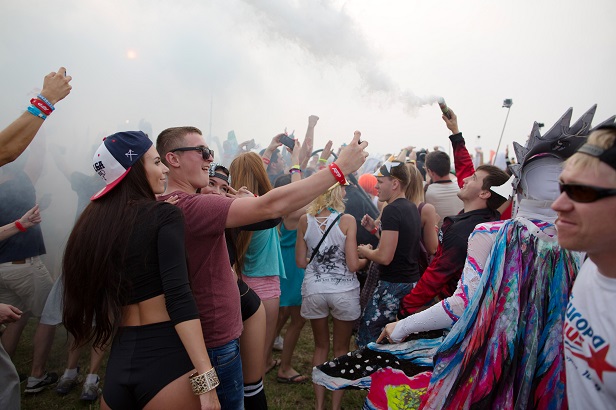
 Concertgoers take a 'selfie' during the Alfa Future People electronic music festival in Nizhny Novgorod, Russia. By teaming up with smartphone tech developers, this event gave concertgoers free access to the FindFace mobile app, which can provide facial recognition in crowds. (Photo: Andrey Rudakov/Bloomberg)
 The live event industry — in partnership with providers of property and casualty insurance — has a strong track record of solving safety threats as they arise.
After a string of weather-related incidents including those at the 2011 Pukkelpop Festival in Belgium, during which a violent storm took lives and ripped through infrastructure, or the Indiana State Fair, where a wind-driven stage collapse also turned deadly, insurance carriers and industry groups worked together to develop and implement new safety regulations.
Related: Insuring mass shooting events
Tech-driven solutions
The insurance industry recognized the value of onsite weather tracking, increased regulations enforcement and created better emergency planning procedures. We saw the problem, discussed possible solutions, and implemented new procedures.
Now, in the wake of the Route 91 Harvest live music festival shooting in Last Vegas in 2017, insurers must continue to work with the live event production community to improve safety and emergency response.
Insurers entered 2018 facing an expanding range of risks that challenge event organizers, venue owner/operators, touring entertainers and equipment rental suppliers. Finding solutions that will keep events profitable and participants safe will come through continued cooperation between insurance carriers and industry groups.
Modern emergency response
In recent years, crowd control and mass emergency exiting have received much greater consideration by larger shows and events.
But the aftermath of such horrific scenes as the June 2016 Pulse nightclub attack in Florida or the November 2015 Bataclan concert shooting in France underscore the need for new safety measures and improved planning.
For the public, the media, the live event industry and law enforcement, it's clearer than ever that any public space can now be a target, and any location can be used as cover for those meaning to do harm.
Perimeters around events have always been part of the conversation. They now need to be considered with heightened awareness.
Insurer preparedness
Historically, the events industry has done a good job of keeping dangerous people out of venues. Those of us working with that industry intend to retain that record. That's why the time is now to develop a set of best practices that all municipalities and venue operators, large and small, can benefit from when planning events.
The insurance industry must do more to improve risk mitigation at large live events, beginning with greater use of safety and security experts and closer working relationships between safety services and event promoters, producers, venues and entertainers.
From an insurance perspective, the risk of active shooters and attacks during large public events is clearly high enough to justify the expense of obtaining additional coverage.
Internally at my agency, we constantly discuss how live event insurance might change as a result of any mass injury or casualty event. We share what we learn from each of these events in the hopes that the industry will collectively recognize the danger posed and continue the conversation to enact changes to keep the public safe.
The last thing any event wants is injured visitors, but should something occur, it is of course better to have comprehensive insurance protection.
Tough nut to crack
Confront violent attack is complicated. It requires more than infrastructure safety or weather monitoring. There are no computer models to warn of an imminent attack like we use to track storms, and no simple regulatory changes that can protect outdoor venues from distant shooters.
But these challenges are not insurmountable.
I believe that if we come together as an industry and entertain all ideas for risk mitigation, we can find a solution that will protect the public and provide the peace of mind we expect when enjoying professional performances.
In the same way the industry quickly adapted to weather anomalies by utilizing computer models and advanced, up-to-the-minute forecasting, insurers and their event-industry partners can adapt procedures and perimeters to protect guests from human threats both inside and outside the venue.
As the most urgent concern for the worldwide live event industry, there is simply no time to waste in developing concrete solutions to better protect customers, performers, and all of the parties involved in staging a live event. We are a resilient industry with billions in revenue, so we must come together to ensure a prosperous future and maintain the respect and trust of the public at large.
Scott Carroll is executive vice president and program director at Take1 Insurance in Laguna Hills, Calif. He can be reached by sending email to scott.carroll@take1insurance.com.
The opinions expressed here are the author's own.
See also:
© Arc, All Rights Reserved. Request academic re-use from www.copyright.com. All other uses, submit a request to TMSalesOperations@arc-network.com. For more information visit Asset & Logo Licensing.