 In the aftermath of the Costa Concordia collision, a significant environmental disaster has been averted. Now that experts have determined that there is little risk of the heavily battered ocean liner sliding into deeper waters, the painstaking process of siphoning more than 500,000 gallons of fuel stored in the ship's 17 tanks can begin.
Meanwhile, both insurers and reinsurers brace themselves for losses that could ultimately surpass $1 billion, according to Moody's Investors Service. In a separate statement, made on Jan. 23, Hannover Re estimates that its marine hull insurance losses from the wreck will reach $39.1 million. Moody's further notes that insured losses from the accident will primarily stem from:
- Marine hull insurance covers damage to the vessel, with policy limits at an estimated $513 million.
- Liability insurance claims from passengers.
- Costs associated with recovery of the wreck.
- Possible environmental liability claims related to any fuel spillage that occurs.
John Woods, a partner at the New York City office of Clyde & Co., discusses in further detail the impact of the wreck on marine insurers' profits. Drawing upon his 31 years of experience representing largely marine insurance interests in both the U.S. and in London, Woods estimates the toll on the global industry will be heavy indeed.
"From what I understand, [the Costa Concordia] is insured at 264 million euros for the hull," Woods explains. "If the cost of raising and repairing the vessel exceeds that, then she would be declared a constructive total loss. In that case, the hull insurance would pay out both the maximum on the hull plus a separate increased value (IV) policy in the amount of 131 million euros."
As for the removal of the wreckage itself, Woods says the vessel's liability insurers would typically cover the associated expenses, if the vessel is a total loss. This is carried under protection and indemnity (P&I), a type of marine insurance coverage that would cover liabilities such as passenger claims and pollution and in event of CPL.
"It is still very early, but in addition to the deaths there are reportedly 70 or more personal injury claims," Woods says. "Every passenger may be entitled to some compensation."
Woods expects that crew death and injury passenger claims will be significant but predicts they will be "dwarfed by the hull and wreck removal claims."
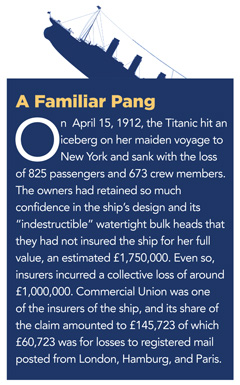
The 'Italian Titanic'
In light of reports of a chaotic, disorganized evacuation, miraculously the majority of the 4,200 people aboard managed to reach safety. This is a stark contrast to the maritime tragedy to which the Costa Concordia wreck has been compared.
"[The initial outcome] could have been more like the Titanic, had the collision not happened so close to shore," Woods says. "Remember that the Titanic was out at sea and also battling bad weather."
 The tragedy underscores concerns raised by many marine insurance experts over the last few years.
"As these ships get bigger, so too do the potential losses associated with a disaster," Woods says.
This is coupled with the fact that owners of the massive luxury liners tend to opt out of business interruption coverage due to the exorbitant premiums.
"It is not surprising that Costa does not reportedly have loss of earnings insurance for the vessel," Woods says. "However, if a total loss is declared, then that IV policy is intended to assist in some of loss, even though it is not explicitly worded as a 'loss of earning.' IV is nevertheless intended to help recoup such losses. It could take years to contract for and build a comparable vessel, should the Concordia be declared a total loss."
The MSC Napoli and MV Rena illustrate that salvage efforts associated with large vessels are protracted and costly.
"The MSC Napoli had structural difficulties and was deliberately grounded," Woods says. "Removal of its containers took more than a year." Marine insurers have larger issues looming, as Woods points out:
"I've seen different estimates about the potential impact," he says. "It remains to be seen exactly what the total impact will be. Undoubtedly, it will be huge. Because of the timing with the new year, this already means that a lot of marine insurers will not make money this year, depending on their net loss overall.
"It is a bad start to the year," he continues. "I imagine the impact will be felt in significant premium increases.
Moody's expects Costa Concordia losses to be minor in the context of both core earnings power and capital for insurance and reinsurance companies. The earnings drag from this loss event, however, "will impede capital growth for affected firms and contribute to the perception among investors that the reinsurance sector cannot earn its cost of capital," Moody's says.

© Arc, All Rights Reserved. Request academic re-use from www.copyright.com. All other uses, submit a request to TMSalesOperations@arc-network.com. For more information visit Asset & Logo Licensing.