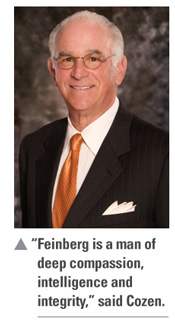
 Stephen A. Cozen's reputation precedes him. Indeed, attendees at this year's ACE conference may have recognized his name in the on-site brochure or in news releases detailing his involvement in developing the criteria for the $20 billion BP compensation fund. However, the Philadelphia-based founder and chairman of the Cozen O'Connor law firm began garnering acclaim long before the mere mention of the Deepwater Horizon disaster aroused sadness, derision, and inflamed tempers at dinner tables, offices and courtrooms.
Simply put, Cozen has an exemplary track record in property catastrophe litigation, especially with cases involving tremendous loss. Prior to being hired by Pay Czar Kenneth Feinberg to draft disbursement guidelines last year, the attorney handled the multi-billion dollar reinsurance and coverage claims arising from the Sept. 11, 2001 World Trade Center attacks, along with litigation tied to the 1980 fire at the MGM Grand and the meltdown at Three Mile Island in 1979.
His extraordinary work with these large-scale losses brought about a new distinction on June 15, 2011—namely the "opening act" at ACE. While delivering the distinguished keynote address to kick off the conference, Cozen explored the recent catastrophes that have befallen the U.S. and the resultant issues on the P&C insurance front. He also spoke to catastrophes in a broader global context—including supply chain bottlenecks, CBI, and other coverage considerations—focusing on the Fukushima Daiichi power plant accident.
"The crisis at the Fukushima plant in Japan definitely has potential ramifications for the U.S.," he said. "The earthquake that struck in March and triggered deadly tsunamis was 200 times more powerful than the 1995 quake that rattled Kobe. As a result, Tokyo is now 9 inches closer to the Pacific Ocean. One immediately thinks of the nuclear power plants in California that lie perilously close to fault lines."
When applying some lessons gleaned from the Three Mile Island disaster in 1979 to the ongoing crisis at the Fukushima plant, which is one of the 15 largest nuclear power stations in the world, Cozen offered sobering statistics:
"The meltdown at Three Mile Island was rated a 'Level 5' on the International Nuclear and Radiological Event Scale (INES)," he said. "For comparison purposes, the Fukushima accident has been rated 'Level 7.' To date, the only other nuclear accident to share the Level 7 rating is Chernobyl. We need to realize that it could take a decade or more to decommission the site in Japan."
Among other topics covered were the proliferation of Chinese drywall claims and how courts today appear "poised to reject litigation that could impose ruinous liability on every business in the country." Of course, an afternoon with the illustrious Stephen A. Cozen would not be complete without delving into some prickly questions and misnomers about the BP compensation fund, Kenneth Feinberg, and, yes, lobsters.
Before leaving the Big Easy, I spoke with Cozen about the payment criteria he helped establish with nine other lawyers from his law firm as well as the unwarranted vilification of Kenneth Feinberg:
Are there misconceptions about your involvement in the BP fund that you'd like to clear up?
Cozen: Yes. Regarding our work in connection with the Gulf Coast losses, some think that we trained evaluators. That was not the case, although there were very preliminary discussions about that possibility. Now, we were asked by Ken Feinberg and his people to help develop criteria for compensation for a variety of claims that would arise from spill. The guidelines we formulated were disseminated to the community. The basic tenet of that instruction was the goal of being somewhat more generous and less restrictive than the Oil Pollution Act (OPA). We outlined what would be covered, the type of proof required, and the actual damage and/or injury sustained and its relationship to the event.
Why do you think that Feinberg reached out to you specificallyfor this project?
Cozen: Well, he recognized the fact that I have 40 years of experience in dealing with catastrophes and unique claims, involving loss of income and especially business interruption (BI) claims, the latter of which many anticipated would result from the oil spill. Essentially we worked with Ken to understand the liability of BP under OPA and what various state laws would require. This was modified by Ken's intent to be as generous to those who had not only suffered physical damage but could also prove actual damage. Ken is a man of deep compassion, intelligence, and integrity, so he wanted all eligible claimants to be compensated.
You mentioned establishing payment protocols that were "reasonably fair and consistent with legal precedent." What does that mean exactly?
Cozen: It means that we didn't want to pay on claims by people who owned, say, a restaurant in Boston, Mass. and weren't able to serve as much lobster, and so forth. We had to be able to determine the causal relationship between what happened and inability to do business or offer a particular commodity. It was important for people to know that this was not going to be some sort of giveaway.
© Arc, All Rights Reserved. Request academic re-use from www.copyright.com. All other uses, submit a request to TMSalesOperations@arc-network.com. For more information visit Asset & Logo Licensing.