From the December 5-12, 2011 issue of National Underwriter P&C • Subscribe!

A Question of Ethics: Rate Increase Denied

One insurance commissioner in the Northeast recently denied an insurer a rate increase that would have anticipated a 3 percent underwriting gain. The commissioner’s justification: Given the state of the economy, the insurer should not profit at all. 

Naturally, there was no shortage of criticism of the insurance commissioner’s actions. Yet the commissioner’s personal ethics are not at issue here. Rather, the issue is how insurers and their employees should respond to the decision—on an ethical level.
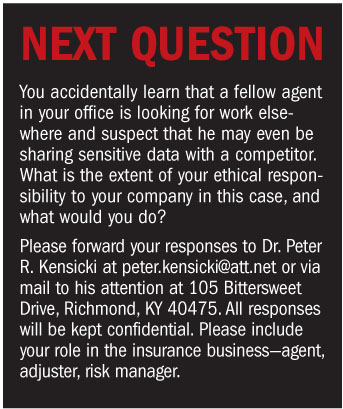
Before summarizing their responses, it is noteworthy that so many readers see it necessary to list actions they would believe unethical that should not be considered by insurers or their employees. For example, one former Pennsylvania adjuster writes, “It would be inappropriate to invalidate the decision by not paying or delaying legitimate claims, by artificially decreasing reserves or delaying payments to vendors.” A law professor from Kentucky agrees: “The insurer cannot, legally or ethically, deny or delay payment on valid claims.”

One association executive maintains the commissioner’s action isn’t actually a question of ethics at all: “I would not consider any response unethical if a regulator is trying to eliminate profit, as long as it does not mislead insureds. The company has a right to manage for a profit.”

Others suggest taking action relative to the commissioner. “Management should increase its efforts to educate the regulator and the decision should be challenged in the courts,” a New York broker writes. An Illinois company employee says he would “write an article for the local press and trade journals explaining the impact of this type of decision.”

Others favor a more litigious approach. “Consider a lawsuit over the decision,” one California consultant writes. A District of Columbia attorney agrees: “The first option for the insurer is to appeal the regulatory decision to the courts.” 

“Work to be sure he or she is not re-elected,” another reader suggests, assuming the commissioner was an elected position. A former agent from California concurs: “Challenge the election or appointment of the commissioner at the conclusion of his or her term.”

One Pennsylvania educator offers an adjustment-flavored suggestion: “Request assurances from the commissioner that ‘make-up’ rates would be allowed when the economy changes.” 

While offering these responses, all readers recognized that legal and educational efforts would take a considerable amount of time—and the potential negative effects of the commissioner’s decision would still impact the bottom line of the insurer. Therefore, internal actions also would be necessary. 

“It would be up to executive management to devise an alternative underwriting plan that will fulfill the financial goals of the company while adhering to the commissioner’s ruling,” the aforementioned Pennsylvania adjuster writes.

One Georgia employee of an insurer summarizes three possible internal actions: “Take the rate and live with it. Tighten underwriting standards. Cease writing business in the state.”

A Pennsylvania respondent suggests adding procedures to reduce underwriting and claim-adjustment expenses. Such reductions could be accomplished by “freezing hiring, downsizing, limiting travel and education expenses, reducing employee benefits and reducing commissions.”

Suggestions for ethical changes in underwriting policy came from nearly every respondent. The list included, if allowed by state law: cancellation or nonrenewal of marginal accounts; reducing underwriting credits; reducing the number of exceptions to underwriting guidelines; changing underwriting classifications; modifying policy terms and conditions; insisting on insurance to value; increasing liability limits; outsourcing the underwriting function; increasing the use of inspections; and increasing the scope of premium audits.

It was also suggested that while these underwriting changes may help achieve the projected 3 percent profit originally projected, the changes would have a negative effect on various directly affected groups. 

For example, cancellations, nonrenewals and tightened underwriting standards directly affect the insuring public. Modifying policy terms and conditions could adversely affect both insureds and third-party claimants. Downsizing, reducing employee benefits and reducing commissions could potentially harm employees and agents alike. If any of the changes in underwriting operations were made, the various interests of the public, employees and agents would have to be balanced to minimize damage.

Perhaps the most widespread harmful—but ethical—action would be withdrawal from the state. “If withdrawal is used as a threat, the insurer needs to be able to back up the threat if the commissioner does not budge,” one insurance professor writes. “Of course, withdrawal is not a move to be taken lightly, and it tends to be an irreversible maneuver.”

“Withdrawal from the state would get the commissioner’s attention,” the D.C. attorney notes. “But, bottom line, if there is no danger of insolvency, the best approach may be to bite the bullet, wait for the economy to improve and resubmit the request for a premium increase.”

In summary, the question posed a difficult problem for respondents. First, the problem to be addressed was created in a political environment and was both a questionable and probably legally challengable action on the part of the commissioner. Second, no response would provide any immediate method of mitigating the fallout from the commissioner’s decision. 

Finally, any action taken by an insurer, while potentially resulting in the short-run profit otherwise denied by the commissioner, would have many undesirable effects on a variety of interested parties. Put another way, this question posed the most difficult of ethical dilemmas: While there are multiple “correct” or “ethical” responses, there are many potentially damaging effects from adopting any “ethical” action. 

There’s really no “win” here—except, perhaps, for the commissioner’s political status.

Page 1 of 2
Comments

Resource Library

View All »

Bring the Benefits of Decision Tree Analysis to Your Everyday...

In this on-demand webinar, learn how to counter the challenges of litigation with predictive analytics...

Learn and Apply the Secrets of Successful Businesses to Your...

What does it take to elevate your agency to be known as the best of...

Have you outgrown your QA system?

Your claims audit tools must handle organizational growth and changing best practices. Download the "25...

Complimentary Sales Closer Questionnaires for Commercial Residential Property Insurance

Help property owners or managers compare your commercial residential property insurance coverage vs. the competition....

The Latest Business Intelligence Capabilities to Reduce Costs and Enhance...

SIMS Insight is the advanced business intelligence module of SIMS Claims. Want more information? Download...

When Banks Won't Help, Oak Street Funding Will.

Our commission-based loans are designed to help agents and brokers invest in their business, consolidate...

Home Run Leads are Here!

Our high quality leads will have you swinging for the fences and knocking your sales...

We Have Your New Formula for Success!

Your goal is to deliver maximum impact on those critical aspects of business that drive...

Complimentary White Paper: What Makes a House a Home?

The restoration vendor is the first person on site after a disaster strikes a home...

Complimentary Case Study on Data and Analytics Solutions

Infinilytics provided their client a solution platform with an increased scope of data insight and...

PropertyCasualty360 Daily eNews

Get P&C insurance news to stay ahead of the competition in one concise format - FREE. Sign Up Now!

Advertisement. Closing in 15 seconds.