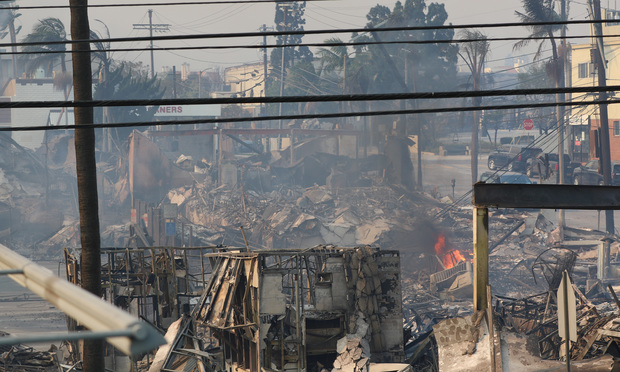
 Palisades wildfires in January. Credit: Pierce/Adobe Stock
One year after the Los Angeles wildfires, California lawmakers introduced Senate Bill 876 (SB 876), the "Disaster Recovery Reform Act," authored by Senator Steve Padilla and sponsored by Insurance Commissioner Ricardo Lara.
Why this bill matters
For many smoke-damaged households, recovery has been prolonged by disputes over habitability and reduced living-expense benefits, even where independent testing found lingering heavy metals and other toxins.
Reporting also indicates that a large share of survivors remain displaced, contributing to a "K-shaped recovery" where wealthier households move forward while others await claim resolutions. SB 876 targets these delays and gaps by tightening claims-handling rules and coverage obligations during declared emergencies.
Stronger claims handling and oversight
SB 876 requires insurers to maintain a written disaster response plan, update it every two years, and provide post-disaster reporting to the Department of Insurance. During a declared emergency, carriers must proactively communicate with claimants and report aggregate losses within 15 days of the emergency declaration.
To ensure continuity when adjusters change, the bill requires insurers to designate a primary claims adjuster and provide a written status report within five business days after assigning a subsequent adjuster.
Increased penalties and restitution
The bill raises penalties for unfair practices committed during a state of emergency from $5,000 to $10,000 per act, or $20,000 if willful, and authorizes the Insurance Commissioner to order restitution.
Faster payments and expanded living expenses
Recognizing real-world housing costs, SB 876 would expand policy limits for Additional Living Expenses (ALE) by 100% for a covered total loss related to a declared emergency and extend ALE for 15 days beyond the date the home is deemed habitable.
It would require prompt payment of Actual Cash Value within 30 days of a total loss determination and payment of any undisputed replacement cost within 30 days after the policyholder signs a rebuild or purchase contract.
Replacement cost and code upgrade protections
In a declared emergency, guaranteed replacement cost coverage would trigger an automatic 50% increase in limits for the dwelling and other structures. The bill also clarifies that ordinance or law (building code upgrade) coverage applies to building codes in effect at the time of rebuilding and requires at least 20% of the dwelling limit to be available in a declared emergency.
Streamlined contents claims after a total loss
If a furnished primary residence suffers a covered total loss during a declared emergency, SB 876 would require insurers to pay 100% of contents limits within 30 days of the total loss determination, with interest accruing if payment is late, while preserving all other policy rights.
Rebuilding at the same or a new location
The proposal confirms that policyholders may rebuild or replace at a new location without improper deductions for land value. If the policyholder rebuilds elsewhere, payable building code upgrade costs include all code-related costs that would have applied at the original location, and, in a declared emergency, policyholders may combine payments across dwelling, other structures, and contents if dwelling limits alone are insufficient.
How SB 876 builds on recent reforms
Recent reforms provide context for SB 876's approach and demonstrate a policy trend toward speed and consumer protection. The "Eliminate 'The List' Act" (SB 495) requires insurers to pay 60% of contents limits without an itemized inventory after a total loss and gives survivors at least 100 days to submit proof of loss in a declared emergency.
The "Business Insurance Protection Act" (SB 547) extends the one-year nonrenewal moratorium to many commercial policies, including businesses, HOAs, condominiums, affordable housing, and nonprofits. The "FAIR Plan Stability Act" (AB 226) authorizes the FAIR Plan, subject to the Commissioner's approval, to access catastrophe bonds through the California Infrastructure and Economic Development Bank and to obtain lines of credit or loans to ensure timely claims payments after major disasters.
These statutes built on earlier executive actions after the Jan. 7 wildfires, including directing upfront payments to policyholders, imposing a nonrenewal moratorium, and measures to stabilize FAIR Plan finances. SB 876 would build on that framework by hardwiring emergency-ready claims protocols, enhanced penalties, and stronger ALE and replacement-cost tools directly into statute.
Practical takeaways for policyholders
By codifying emergency protocols, doubling penalties during declared emergencies, expanding ALE and replacement-cost tools, and aligning code coverage with real-world rebuilding, SB 876 aims to shorten the time from loss to restoration.[xx] Even before enactment, its structure and stated objectives can serve as a practical benchmark when policyholders seek expedited benefits and prompt claim payments from insurers.
Conclusion
SB 876 is designed to make post-disaster insurance faster, clearer, and fairer for wildfire survivors by tightening claims-handling requirements, increasing penalties for unfair practices, expanding living-expense and replacement-cost benefits, and ensuring code-upgrade coverage reflects current standards at the time of rebuilding.
Reed Smith lawyers have provided over 800 hours of pro bono services to Palisades Fire and Eaton Fire victims. If you have any questions regarding SB your insurance coverage, submitting a claim, or how SB 876 may affect your claim, please fill out this form and a Reed Smith lawyer will be in contact with you.
Jessica Gopiao is counsel in Reed Smith's Insurance Recovery Group in its Orange County, CA, office, where she has recovered millions through high-stakes coverage and bad-faith matters resolved both in and out of court for clients across industries, while also advising proactively on policy placement and risk management.. She is passionate about advocating for policyholders because she believes insurance should work for clients, not against them, when it matters most, and especially after catastrophic losses like the Los Angeles wildfires. She can be reached at jgopiao@reedsmith.com.
Kya Coletta is a senior associate in the firm's Insurance Recovery Group in Los Angeles office, where she represents clients in a wide range of commercial civil disputes across industries. Her practice primarily focuses on representing corporate policyholders in complex insurance coverage disputes in state and federal courts, and she has also taken on individual policyholder claims arising from the Los Angeles wildfires. She can be reached at kcoletta@reedsmith.com.
Sharifa Hurt is an associate in the firm's Insurance Recovery Group in its Los Angeles office, where she represents a range of clients in commercial civil disputes, with a focus on insurance coverage and financial services litigation in state and federal courts and arbitrations. She can be reached at shurt@reedsmith.com.
Opinions expressed here are the author's own.
© Arc, All Rights Reserved. Request academic re-use from www.copyright.com. All other uses, submit a request to TMSalesOperations@arc-network.com. For more information visit Asset & Logo Licensing.