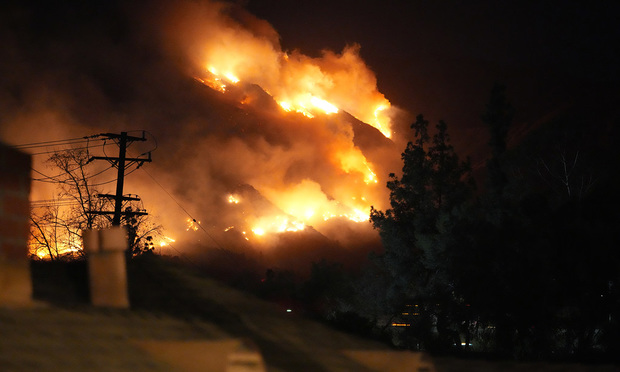
 Eaton Canyon Fire Spread to Arcadia in Los Angeles 2025. Credit: Kyle/Adobe Stock
One year ago, the Eaton and Palisades fires tore through Los Angeles, becoming the largest insured wildfire in U.S. history.
Destroying more than 18,000 structures and killing 31 people, the fires caused an estimated $250 billion to $275 billion in total damage and economic loss, according to an AccuWeather analysis. Final insurance claims costs associated with the fires are expected to reach $40 billion, according to the American Property Casualty Insurance Association (APCIA).
More than 42,000 claims have been filed, and insurers have paid out $22.4 billion to affected families so far, according to the California Department of Insurance. The department says 94% of claims filed have been at least partially paid.
Yet, many of those affected by the wildfires are still struggling with recovery, according to Jonathan Porter, AccuWeather’s chief meteorologist.
“The process to secure permits, clear debris and obtain insurance claim payouts has been incredibly challenging for some families and businesses,” he said in statement. “Thousands of families were displaced by the fires, and many are still facing an uncertain future. Some people have left the region, and others have decided to move out of California.”
Health issues are also an ongoing concern. Heart attacks, lung issues and other medical conditions spiked in Los Angeles County in the days and weeks following the wildfires, according to research from Cedars-Sinai. Research has found that smoke from urban wildfires is much more dangerous than smoke from wildfires that burn only vegetation. Extreme heat can turn common urban objects, from car tires to kitchen faucets, into highly toxic gases.
A recent New York Times investigation found unsafe levels of contaminants in a home that survived the fires but suffered from smoke damage. Farmers Insurance had told the homeowners that it was safe to move back in, even after the owners paid for independent testing that found hazardous levels of lead in the home.
Testing done for the Times found 27 times the federal hazard limit of lead in the kitchen as well as unsafe levels of contaminants in other areas of the house. A hair strand analysis of one of the family’s children found the level of arsenic in her hair had increased after returning home, reaching 10 times the normal levels found in children’s hair in California.
Multiple lawsuits have already been filed against California insurers as well as the state’s FAIR Plan for denial or partial payment of smoke damage claims, prompting the California Department of Insurance to create a smoke damage task force.
For their part, insurers are advocating for stricter standards when it comes to wildfire mitigation. APCIA has thrown its support behind Zone 0 standards, which are currently being considered by CAL FIRE and the California’s board of forestry.
The standard would require no vegetation or combustible materials within five feet of a home, and any bark within five feet of a home would need to be replaced with stone. Wood fencing touching a home would need to be replaced with metal sections, and debris would need to be cleared from gutters, decks and roofs regularly. It would also require Class A fire-rated roofs and ember-resistant home improvements, such as 1/8-inch vent screens.
“We must adapt and learn to live with wildfire by bending down the risk curve and lowering losses,” said Karen Collins, APCIA vice president, property & environmental, in a statement. “When community resilience is done at scale, this positively impacts the availability and affordability of insurance.”
Recent storms in California have reduced drought conditions this winter, lowering the current risk for wildfire, but danger could return later this year.
“As that moisture soaks into the ground and the snowpack melts, it can fuel rapid grass and vegetation growth this spring,” said Paul Pastelok, AccuWeather’s lead long-range expert, in a statement. “If hot and dry weather develops during the summer, that vegetation can dry out quickly and become an abundant source of fuel for wildfires.”
Photo credit: Kyle/Adobe Stock
© Arc, All Rights Reserved. Request academic re-use from www.copyright.com. All other uses, submit a request to TMSalesOperations@arc-network.com. For more information visit Asset & Logo Licensing.