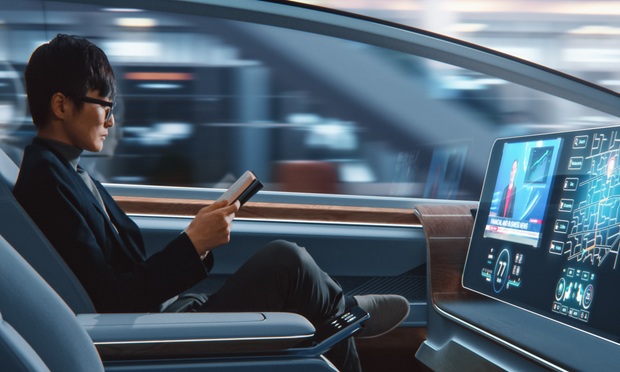
 How receptive will insurance carriers be to the prospect of insuring self-driving vehicles? There’s both excitement and caution in the air, and for good reason. (Image credit: Gorodenkoff/Adobe Stock)
Anyone who’s ever wished for a chauffeur during a bumper-to-bumper commute or while parallel parking can appreciate the promise and potential of self-driving cars, also called autonomous vehicles (AVs).
No longer just an invention of science fiction writers, this technology is progressing at an unprecedented pace, as evidenced by a growing array of self-parking automobiles to completely driverless robotaxis made possible by industry leaders such as Tesla and Waymo in America and BYD and Pony.ai in China.
Currently, more than 1,500 commercial AVs are on the road in five different U.S. cities, a number that’s expected to increase to 35,000 nationwide in five years and command around 8% of the American rideshare market. Receptiveness among U.S. drivers is also trending upwards. According to AAA, 13% of drivers now say they would trust riding in a self-driving vehicle, up from 9% last year.
Redefining liability
For insurance industry professionals, determining liability becomes much more complex when cars drive themselves. We’ve entered a world where attributing fault requires understanding who or what was in control at the time of the accident. Human error and poor driving habits are no longer the assumed culprit. To reconstruct what happened and who or what was in control, carriers will need to increasingly rely on detailed vehicle telemetry, such as sensor readings, steering and braking inputs, and software version histories. The NHTSA and other regulators increasingly demand this kind of data-driven evaluation in post-incident investigations. That means insurers have to work from the same evidence base to decide whether fault lies with the vehicle manufacturer, software provider, or person behind the wheel.
It also means policy writing needs to evolve from static assumptions to dynamic suppositions that account for the fact that driving is now shared between machine and human. Traditional underwriting models depend heavily on driving history and demographics. But underwriting strictly on driver history will need to take a backseat in the age of AVs, as insurance companies will have to start factoring in data from the vehicle itself: automation levels, software versions, how reliably the driver monitors the system, and how frequently self-driving is engaged. And it won’t be long before we see new policy verbiage that clarifies accountability when control of the car switches between human and machine, as well as incentives for drivers who share performance metrics that demonstrate safer outcomes.
Cost reduction, evolving policies
The good news is that autonomous driving has the potential to lower insurance costs thanks to fewer expected crashes caused by human mistakes and bad driving habits. But we’re a long way from reaching that lofty goal. Plus, the potential for lower policy premiums could be offset by many different factors, from uncertainty about how flesh-and-blood drivers will interact with automation, unpredictable repair costs for sensor-heavy vehicles, and evolving liability models. Still, with machines increasingly taking the wheel instead of human beings, policies will need to adapt in real time and come with different pricing. If carriers observe consistent loss-ratio improvement as well as positive and reliable data that quantify the safety advantages, rates should eventually come down.
Additionally, as AVs become more mainstream, new and improved insurance coverages and products will almost certainly surface, such as hybrid policies that merge personal auto with elements of product liability, cyber, and even software warranty coverage.
In commercial driving, fleet insurance will likely evolve into a single blended policy that combines traditional auto coverage with technology errors-and-omissions, product liability protections, and cyber insurance to safeguard against both everyday operational risks and the algorithmic vulnerabilities of autonomous systems.
Artificial intelligence in AV Insurance
It’s hardly a surprise that “AV” and “AI” are nearly identical acronyms separated only by a single letter. But for the former to make the kind of progress the experts are prognosticating, the latter will be essential, especially to insurers that will need assistance interpreting and acting on the massive volume of data that autonomous vehicles produce. Artificial intelligence will be invaluable for reconstructing accident timelines, detecting safety patterns, and differentiating between system and human error in milliseconds — enabling insurers to react in near real-time. It’s the not-so-secret sauce that will help make AV insurance coverage predictive as well as reactive, paving the way for pricing, claims, and coverage to dynamically adapt as driving becomes more hands-free and computer-controlled.
Industry outlook
How receptive will carriers ultimately be to this advancing technology and the prospect of insuring self-driving vehicles?
There’s both excitement and caution in the air, and for good reason. It makes sense that insurers want to get behind innovations that make driving safer. However, they are rightfully guarded about accepting new and poorly understood risks from mixed-mode driving behaviors and software glitches. I expect forward-minded companies with strong data partnerships and less wariness about AI-driven underwriting to be the early adopters, employing real-world data to grow more accepting of how automation can change loss severity and frequency. But other carriers will likely sit things out until actuarial and regulatory data increase their comfort level.
Gemma Ros is chief technology officer for TheZebra.com.
(Lead image credit: Gorodenkoff/Adobe Stock)
© Arc, All Rights Reserved. Request academic re-use from www.copyright.com. All other uses, submit a request to TMSalesOperations@arc-network.com. For more information visit Asset & Logo Licensing.