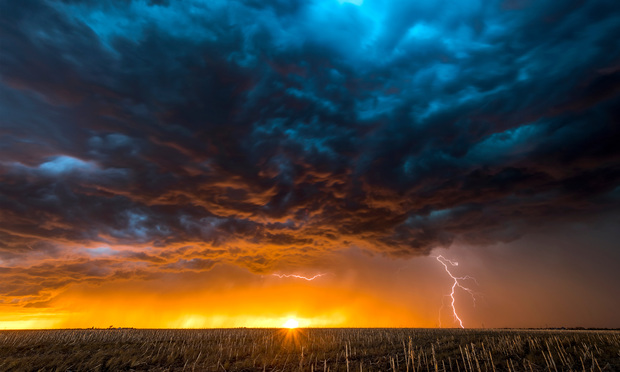
 Severe convective storms, including tornadoes, are on track to generate more insured losses in 2025 than any other natural catastrophe. (Credit: cherylvb/Adobe Stock)
A new insurance research center will try to better understand the impact of severe convective storms, one of the biggest causes of costly insurance claims.
The Center for Interdisciplinary Research on Convective Storms, or CIRCS, launched this month at Northern Illinois University, in partnership with the University of Wisconsin-Madison.
CIRCS will focus on research that will help improve resilience, allowing communities to better withstand the impacts of convective storms. Led by Victor Gensini, an NIU atmospheric science professor, the center will include roughly two dozen scientists from atmospheric science, engineering, geography, physics, and computer science as well as actuarial science and risk and insurance.
The center has received $1.5 million in funding from the National Science Foundation over five years to help launch CIRCS, and about a dozen private property-casualty insurers are also providing funds.
Severe convective storms are on track to generate more insured losses in 2025 than any other natural catastrophe. It would be the third year in a row that convective storms have generated the highest losses.
The U.S. had $46 billion in insured losses from convective storms at the end of the third quarter, more than the $40 billion in losses from January’s L.A. wildfires.
Severe convective storms are now occurring on 75% of days each year in the U.S., potentially driven by a warming climate.
© Arc, All Rights Reserved. Request academic re-use from www.copyright.com. All other uses, submit a request to TMSalesOperations@arc-network.com. For more information visit Asset & Logo Licensing.