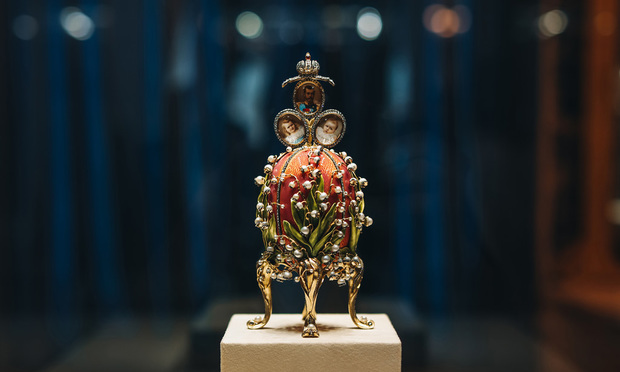
 Most museums outside the U.S. are not insured for their permanent collections, especially if they are owned by national or local government. (Credit: asauriet/Adobe Stock)
On Oct. 19, a group of thieves disguised as construction workers broke into the Louvre in Paris and stole eight pieces of the French crown jewels. The baubles are worth an estimated $102 million.
The Art Loss Register is the leading due diligence provider for the art market, and maintains the world’s largest private database of stolen art, antiques and collectibles. Items are added to the database on behalf of the victims of looting or theft, insurers and the police. The database can then be used by clients in the art market to ensure they're working with items to which no claim will arise.
We spoke with Olivia Whitting, head of cultural heritage at the Art Loss Register, about the heist and its insurance implications.
PropertyCasualty360.com: How common are thefts like these? And why did the thieves target jewelry instead of other art?
Whitting: We have seen a rise in the number of thefts of items whose materials are intrinsically precious. An item made of gold and diamonds, regardless of its historic significance, will always reflect at the very least the price of those materials. It is easier to sell a stolen item that does not need to remain in its recognizable form in order for it to have value. A Picasso painting, for example, only has a value as a Picasso painting, whereas a gold and diamond brooch can be broken up and remain a valuable group of items whilst only losing a fraction of its market value due to the loss of its historical significance or royal connections. It is highly unlikely that these thefts are executed to obtain specific objects commissioned by a collector. Rather, the perpetrators are likely to target items with broader market appeal or potential, thereby increasing their prospects for resale to a wider range of buyers — some of whom may unwittingly acquire re-cut gemstones or reconstituted gold that were once part of the French crown jewels.
PropertyCasualty360.com: What steps can museums take to better protect themselves?
Whitting: Having robust and tested security is essential for any museum; however, it is expensive and requires updating and training. Museums that are purpose-built can incorporate security more seamlessly into the fabric of the building, but it is difficult for older museums whose original purpose was quite different. The Louvre, for example, was built as a palace and place of government, not as a museum open to the public. Putting in security that is both effective and unobtrusive so as not to spoil the experience for the 30,000 visitors the Louvre receives daily, is very difficult to do retrospectively. Whilst it is expensive, it is certainly worth it compared to potentially losing objects, as well as lost revenue due to the closure of museums in the aftermath of the theft, not to mention reputational damage. If a theft does occur, then reporting the items immediately to the police and The Art Loss Register increases the chance that the items will be found, even years later, on the market.
PropertyCasualty360.com: How does insurance play a role in museum heists? Should museums be re-evaluating anything, insurance-wise, to better protect themselves?
Whitting: Most museums outside the U.S. are not insured for their permanent collections, particularly if they are owned by national or local government. The cost is considered too great and governments tend to be self-insured. Exhibitions in which loans are being made by private collectors and other museums are insured both for the transit risk and on display because of the liability to the owners.
In some cases, the very high cost of insurance for blockbuster exhibitions for values may be in excess of $1 billion. This leads to national governments issuing government indemnities, which remove the need for commercial insurance. This may also prevent civil claims against items in the collection owned by foreign governments with whom there are civil disputes or against whom political action might be taken. For example, when Russia invaded Ukraine, France did not prevent the return to Russia of the greatest impressionist collection lent by the Hermitage and the Pushkin to the LVMH museum in Paris.
In the event of a heist from a museum that is insured, the insurers will normally register the loss with the The Art Loss Register, and we will work on the recovery, over many years, if necessary.
There have been many thefts from insured museums in which The Art Loss Register has been responsible for the recovery. The theft in the 1990s of a bronze sculpture by Matisse from a Swiss Museum was reported to us by the insurer and the item placed on our database. In 2017, we spotted the item for sale at a French auction house and arranged its return to the museum through the insurer. A further example is the theft of (another!) Matisse, this time a painting, from the Museum of Modern Art in Stockholm Museum in 1987, which we recovered over 30 years later in 2013.
Another case that is particularly relevant is the Tate Britain in London, which, in 1998, paid some of their insurance payout back to their insurer to regain legal title to two stolen Turner paintings taken in 1994. The works were stolen whilst on exhibition in Frankfurt, by Balkan criminals who used a German lawyer to negotiate a ransom for their return. That payment was excessive and has made other similar cases we are handling more difficult.
Perhaps if more people understood that many museums are not insured, they would be less likely to steal from them in the first place. That nice reward from an insurer may not be as available as they think.
© Arc, All Rights Reserved. Request academic re-use from www.copyright.com. All other uses, submit a request to TMSalesOperations@arc-network.com. For more information visit Asset & Logo Licensing.