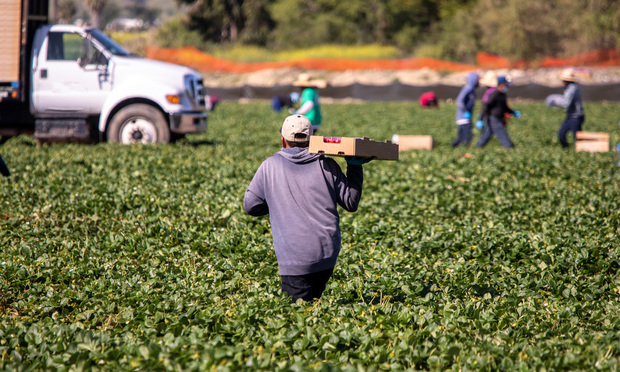
 The U.S. was the top exporter of soybeans to China before tariffs; now it's Brazil. (Credit: F Armstrong Photo/Adobe Stock)
American farmers are worried about their future after a tumultuous year of tariffs and immigration crackdowns, according to farmers union representatives.
Speaking on a press call Oct. 16, Chad Franke, president of the Rocky Mountain Farmers Union, said the tariffs are creating a lot of uncertainty for farmers.
“Farmers and ranchers need to make long-term plans for planting and livestock,” he said. “When policies keep changing, it adds a new layer of complexity to those decisions. More uncertainty during this time is adding economic and mental stress in family agriculture.”
Tariffs have made it more difficult for farmers and ranchers to sell their products in overseas markets, Franke said. Storage facilities are becoming maxed out, as crops roll in with nowhere to go.
Gary Wertish, president of the Minnesota Farmers Union, said the United States was the top exporter of soybeans to China before Trump. Due to tariffs, Brazil now fills that role.
“We’re losing our trust as a reliable trading part around the world,” he said. Even as tariff deals have been cut and re-cut with some countries, “we haven’t gotten those markets back, and we probably never will,” he said.
Crops building up in storage will likely have to be sold at a depressed price, Wertish said.
Tariffs have also driven up the cost of farming equipment and parts, most of which are manufactured outside of the U.S, as well as fertilizer, seed and other essentials.
“Combines are upwards of $1 million, and a lot of their parts are produced in other countries,” he said. “Add in tariffs and it makes it that much more unaffordable.”
The Trump administration’s immigration policies are also taking a toll on farmers, said Julie Blaha, Minnesota’s state auditor.
“The immigration chaos is affecting more than just people who are undocumented,” she said. “It’s creating a lot of fear in documented immigrants as well, and they make up a very large part of the workforce in agriculture. People don’t believe that it’s necessarily going to be done fairly or precisely, and there’s plenty of evidence that it’s not. And that has a lot of impact on the workforce.”
More stressors include rising health care costs; Wertish said one farmer just got notice that his premiums will rise 23% this year.
Reductions in Supplemental Nutrition Assistance Program, or SNAP, benefits, included in Trump’s One Big Beautiful Bill Act, will likely hurt rural communities, which make up 20% to 30% of farmers’ customers in some areas. The government shutdown also means SNAP benefits might not be available starting in November, unless Congress acts.
Another factor causing uncertainty is the farm bill, a key piece of legislation that shapes food security, agricultural stability, natural resource conservation and rural infrastructure investment. The last bill was passed in 2018 and extended to September 30, 2025. Congress let it expire, leaving the future of many key programs and resources in limbo.
All of the chaos is taking a toll, Blaha said.
“One of the indicators of farm health in Minnesota is to look at the number of farmers in mediation with their lenders,” she said. “This year, 144 notices were issued in August. That’s three times higher than August of last year and the highest total since 2019.”
Blaha said farm failures will have ripple effects throughout the entire economy. The U.S. agricultural economy represents 5.5% of the country’s GDP, contributing over $1.5 trillion in 2023.
The human toll is important too, Franke said. He pointed out that farmers are 3.5 times more likely to commit suicide than the general population.
“They don’t need any extra stress, and the way trade policy and tariff policy is being done is just adding to that stress,” he said.
Farm aid is available through the government — but not during the shutdown. Farmers don’t necessarily want handouts anyway, Wertish said.
“Farmers don’t want aid; they want trade,” he said. “It’s very frustrating that the president’s love of tariffs is causing all these problems for farmers.”
© Arc, All Rights Reserved. Request academic re-use from www.copyright.com. All other uses, submit a request to TMSalesOperations@arc-network.com. For more information visit Asset & Logo Licensing.