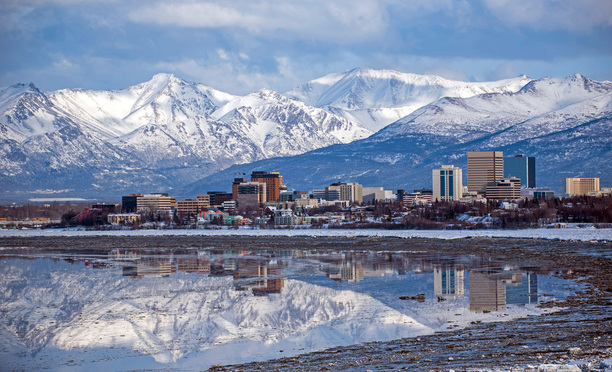
 Many residents displaced by the flooding have been evacuated to Anchorage. (Credit: Rocky Grimes/Shutterstock)
Beginning October 8, a series of powerful storms, including the remnants of Typhoon Halong, brought record-breaking flooding and extreme winds to the southwestern edge of Alaska. This had devastating effects on villages along the coast. The state reports that more than 1,000 people were displaced by the storm, and at least one person has died.
Kipnuck was one of the hardest-hit villages, with an initial assessment reportedly showing 90% of homes in the village were destroyed by the storms.
Alaska Governor Mike Dunleavy has requested that President Donald Trump declare a federal disaster in the area. In his letter to President Trump, Dunleavy explained that the impacted area represents “between 1,500 and 2,500 miles of coastline and more than 50 remote, insular and predominantly subsistence-based Alaska Native communities.”
He noted that the state's disaster costs have exceeded $300 million over the last decade. Alaska has experienced 14 disasters that required federal disaster assistance over the last year; including floods, a landslide, fires and various storm events.
Alaska’s Association of Village Council Presidents has also formally asked President Trump to approve the emergency declaration and deploy immediate federal assistance to the area. In addition to their requests for the declaration and federal aid, the AVCP’s letter also urged the president to establish a Western Alaska Response Center in Bethel, fund public safety officers in every village and invest in permanent federal infrastructure in the Arctic.
Kipnuk is an area that has proven vulnerable to flooding, with the 2019 Denali Commission Threat Assessment predicting it will suffer damaging impacts to critical infrastructure in the short-term. Data from Alaska’s Department of Natural Resources show that Kipnuk has experienced at least 30 flood incidents since 1979. These included two ice jam floods, two snowmelt floods and numerous storm surges.
Three of these flooding incidents were considered “major” events. These include floods in 2000, 2015 and 2016, which saw flood levels reach between 4 and 4.7 feet above mean higher high water (MHHW).
Author’s note: The MHHW is the average of the highest of the two high tides per day.
With this event, flood waters in Kipnuk reached 6.6 feet above MHHW.
Recovery from this flooding could prove slow and challenging due to the remote nature of the impacted area.
In his letter to the president, the governor explained, “Additional impactful sea storms are forecasted to impact all areas, further exacerbating already challenging response and recovery operations. Alaska winter is a few short weeks away, and all impacted communities are hundreds of miles from the road system, accessible only by boat or aircraft. As the storm systems are continuing, the largest full-scale domestic evacuation operations are underway.”
Dunleavy said he anticipates more than 1,500 Alaskans will be evacuated to our ‘major cities, with many of them unable to return home for as long as 18 months.
On October 16, the Alaska Division of Insurance published a bulletin urging insurers to provide relief to those impacted by these storms. In it, they asked insurance companies to extend affected policyholders a minimum two-week grace period in order to avoid lapses in coverage.
Related:
© Arc, All Rights Reserved. Request academic re-use from www.copyright.com. All other uses, submit a request to TMSalesOperations@arc-network.com. For more information visit Asset & Logo Licensing.