More than 4.3 billion square feet, or roughly 12 by 13 square miles: That’s the estimated area of roofing shingles insurance companies replaced because of claims involving hail in the United States in 2024 alone, according to data from Verisk’s XactAnalysis®.
That's enough roofing to cover around 75,000 football fields (end zones included!), and it’s the reason hail is quickly becoming among the costliest perils for insurers in the United States.
Wind and thunderstorm catastrophe losses have grown at 15% annually over the past 10 years, according to data from Verisk’s Property Claim Services business, and the frequency of $25 million events has doubled when comparing the most recent 10-year period to the prior.
As severe hail events increases, understanding damage drivers to proactively manage roof-related risks is essential for insurers to reduce future losses.
A growing challenge
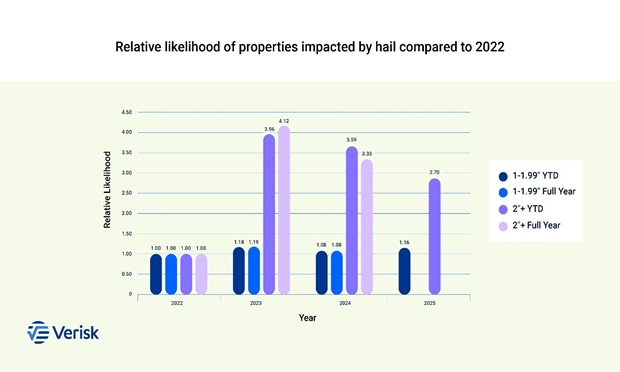
To better understand the drivers behind recent hail-related losses — and potential steps to address surging roof claims — Verisk analyzed all U.S. hailstorms from 2022 through mid-August 2025 using its Respond maximum hail size data. The analysis compared large hail (1 to 1.99 inches) and very large hail (2 inches or greater) to distinguish between events that occur more frequently but are only sometimes damaging, and those that are less common but more likely to result in substantial damage. The analysis also examined the impact of these hail size ranges in terms of total geographical area affected and the number of properties exposed to roof and other damage.
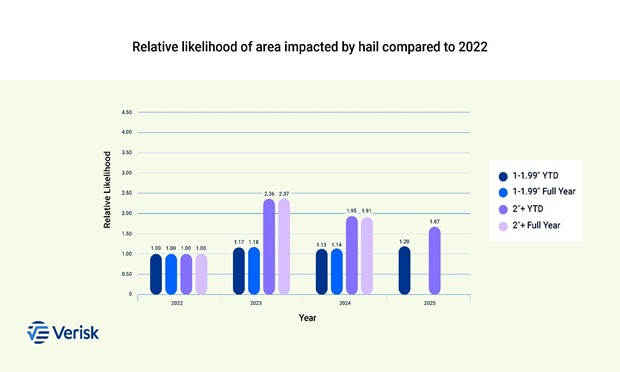
Comparing 2023 and 2024 hail activity with 2022, Verisk’s analysis revealed:
- Both areas affected and properties exposed to large hail increased 20% in 2023 compared with the year prior.
- In 2024, the area affected was 14% higher, while the number of properties exposed increased by 8%. These elevated exposures contributed to higher hail-related losses in both years.
- The most significant driver of increased claim activity appears to be very large hail. In 2023 and 2024, the areas affected by very large hail surged by 137% and 91%, respectively, over 2022.
- Compounding these impacts, these very large hail events increasingly struck densely populated areas, leading to a dramatic rise in properties affected — 312% in 2023 and 233% in 2024.
Putting the data into perspective
Verisk compared the 2025 hail season through mid-August to the same period in 2022, 2023, and 2024. Notably, in each of these years, just under 90% of annual hail events occurred by mid-August, indicating that 2025 results through this point likely reflect the eventual full-year results. Through mid-August 2025, compared to 2022, there has been a 20% increase in area and a 16% rise in properties affected by large hail —an increase closely mirroring the full-year increase observed in 2023. However, when looking at properties and areas affected by very large hail, 2025 only recorded a 67% increase in area and a 170% increase in properties. This remains a significant jump over 2022, but a much smaller increase than we saw in 2023 or 2024.
Regionality of storms

Although hailstorm frequency and severity were higher in 2023, 2024, and 2025 compared with 2022, there is much greater regional variability. Many believe significant hailstorms are a peril unique to the Great Plains. However, Verisk found that only around 60% of very large hail from 2022 to 2024 occurred in this region; meaning roughly 40% fell elsewhere, including areas where roofing is less likely to be hardened against hail.
In 2025, the Midwest experienced greater impacts from large hail than the Southern Plains. Additionally, while it’s a smaller relative impact, the Mid-Atlantic recorded its highest area affected by very large hail across the four-year period. These regional shifts highlight the variability of hailstorm impacts year over year. For instance, in 2025, both the Midwest and Mid-Atlantic saw above-average hail activity relative to their four-year mean. In contrast, 2023 saw average or below-average impacts in those same regions, while the Southern Plains and Southeast experienced elevated activity, accounting for approximately 75% of the nation’s very large hail events that year.
The takeaway
Over this study period, Verisk found that large hail occurred 30 to 40 times more frequently than very large hail. Therefore, despite very large hail typically resulting in a greater likelihood of damage vs. large hailstones, the larger hail only caused around 1 in 10 hail claims.
This insight highlights a significant opportunity to potentially reduce hail-related losses through the adoption of more resilient roofing materials— particularly those designed to withstand the more common hail sizes of less than 2 inches.
Tory Farney is vice president of Verisk Weather Solutions, and Cortney Miller is director of Verisk Weather Solutions.
© Arc, All Rights Reserved. Request academic re-use from www.copyright.com. All other uses, submit a request to TMSalesOperations@arc-network.com. For more information visit Asset & Logo Licensing.