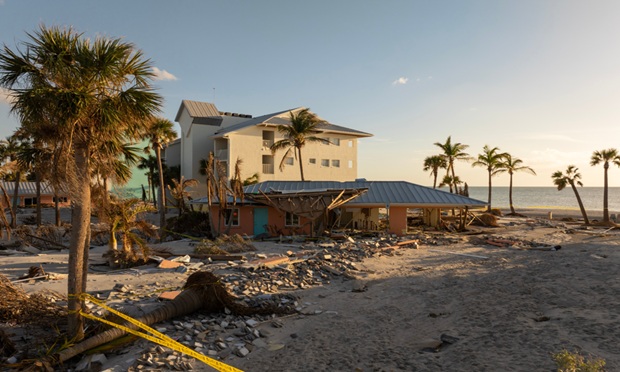
 Coastal properties in Manasota Key, Fla., suffered as a result of Hurricane Milton. (Credit: bilanol/Adobe Stock)
As admitted insurers retreat from catastrophe-prone areas, wholesale, excess and surplus lines carriers are filling the gap.
Since 2020, the E&S insurance marketplace experienced an influx of business from the standard markets.
“This was mainly caused by admitted markets not achieving rate adequacy in states prone to catastrophes and due to the E&S marketplace becoming increasingly competitive,” says Brett Brownell, head of wholesale property at Navigators, a brand of The Hartford. “In certain areas of the marketplace, such as regions of the western U.S. that face significant wildfire risk and southern states that are wrestling with increased flooding and wind events, many standard carriers have exited the market.”
Consider California, where wildfires and high building costs led major insurers to limit or cease new commercial and residential property policies. Elsewhere, hurricanes and flooding events in Florida and Louisiana have devastated real estate, prompting insurers to restrict coverage or leave altogether. And the trend isn’t isolated to these states.
“As a result, the E&S marketplace has stepped in to provide coverage,” Brownell says.
It follows that the U.S. surplus lines insurance market recorded $46.2 billion in premium through the first half of 2025, a 13.2% increase over the same period last year, according to the new midyear report from the nation’s stamping and service offices.
The data, compiled from 15 states, also showed a 12.4% rise in the number of items filed, totaling 3.7 million transactions. The midyear results continue the strong performance from 2024, when the market grew 12.1% to reach $81.6 billion in total premium.
Commercial liability and property lines continue to make up the bulk of the excess and surplus (E&S) market, accounting for a combined 70.6% of all premium written in the first half of the year.
Risks typically written in the surplus lines market fall into three basic categories, says Brady Kelley, president and chief executive of the Wholesale and Specialty Insurance Association. These categories are:
- Non-standard risks, which have unusual underwriting characteristics;
- Unique risks for which admitted carriers do not offer a filed policy form or rate; and
- Capacity risks where an insured seeks a higher level of coverage than most insurers are willing to provide.
“These risks can be difficult to insure in the standard market because they often involve higher or evolving risk exposure, they have complex coverage needs and there is often insufficient data or loss history,” Kelley says. “Wholesale brokers specialize in building custom coverage for these types of risks.”
Commercial property owners appreciate that level of industry-specific expertise. “A major advantage for insureds is that engaging a wholesale expert comes at no additional cost,” Kelley says.
Businesses face constantly evolving risks and challenges. “Damage from fire, rain and water are among the costliest claims” says Bromnell, whose company insures a variety of properties including warehouses, health care and manufacturing facilities, hotels and offices. The insurer works with agents and brokers to help business owners to better understand how property-damaging events will affect their property and prevent issues from happening.
Loss prevention
Weather’s effect on a business is hard to predict, Brownell adds, but it’s essential that property owners take proactive measures to help protect their company and assets. “By updating property to adhere to the latest building codes, using advanced technology and making infrastructure improvements, businesses can make a difference.”
Property owners also can improve buildings by adding protection from fire damage, such as by installing smoke detectors and automatic fire sprinklers in every building and connecting a fire alarm to a central station or local fire department.
Brownell noted that in flood-prone areas, technological advances led to devices and building materials that can help property owners and managers protect a building in severe storms. Water sensors installed in a building can alert them when there is a water intrusion or a leak.
“This is particularly important if the building or facility has had a history of water damage because these kinds of devices can capture an issue before it becomes a major loss,” he said.
© Arc, All Rights Reserved. Request academic re-use from www.copyright.com. All other uses, submit a request to TMSalesOperations@arc-network.com. For more information visit Asset & Logo Licensing.