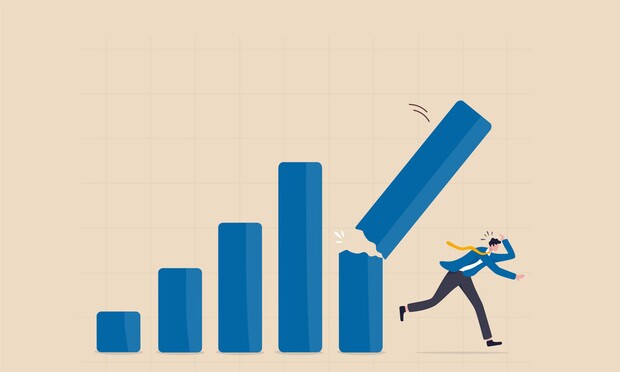
After months of relative calm, recession warnings are once again echoing through Wall Street and Washington.
Economists are pointing to a convergence of troubling signals — from weakening job growth to stubborn inflation and trade policy pressures — that could push the U.S. economy into a downturn, or even a bout of stagflation, before the year is over.
The alarm has grown louder in recent weeks. At the end of August Moody’s Chief Economist Mark Zandi warned in a LinkedIn post that the economy was “on the precipice of a recession.” At the time, recession was not Moody’s baseline outlook, but Zandi said the economy was already struggling and “it wouldn’t take much to push the economy over.” He also cautioned that tariff hikes and tighter immigration policy were weighing on growth while fueling inflation, raising the prospect of stagflation.
By early September, his concerns had sharpened. In an interview with Newsweek, Zandi said the risks of recession had grown, adding, “I don’t think the economy is in a recession, at least not at this point, but it feels like it’s on the brink, it’s on the precipice of this recession.”
The softening labor market is at the center of those concerns. Job creation has slowed to a “virtual standstill,” Zandi said, with the only buffer preventing a downturn being the historically low levels of layoffs. But even that measure is difficult to gauge. The federal government’s Mass Layoff Statistics program was eliminated in 2013 as part of budget cuts ordered under then-President Barack Obama. Since then, the Bureau of Labor Statistics has combined layoffs and firings into a single data point, obscuring the detailed picture of workforce cuts.
Private-sector data is more troubling. Job placement firm Challenger, Gray & Christmas reported that U.S. employers cut 85,979 jobs in August, a 39 percent jump from July and 13 percent higher than the year before. It marked the worst August for layoffs since 2008, during the Great Recession, and brought the total planned U.S. job cuts this year to 892,362—up 66 percent from the first eight months of 2024 and the highest January-through-August total since 2020. The federal government has been the single largest contributor, with 292,279 layoffs announced so far.
Inflation remains another pressure point. While Zandi said tariffs have not been the dominant factor pushing prices higher, he warned that Americans would increasingly feel inflation in their everyday purchases. “Prices are already rising, you can see it in the data, but it’s going to rise to a degree that it will be impossible for people to ignore,” he said.
Other analysts see similar risks. Economists at UBS recently put the probability of a recession at 93 percent in research cited by Fortune. Their analysis of “hard data” from the National Bureau of Economic Research — including consumption, personal income and industrial production — showed “historically worrying levels” between May and July. Yield curve inversions, which have long been viewed as a recession signal, also remain deeply negative, with the curve currently 23 percent inverted. Separately, credit market data shows a 41 percent recession probability.
Still, UBS stressed that the outlook, while fragile, is not fatal. The economy, they concluded, is “soggy, soft, weak, yes, but not collapsing.”
This article first published on GlobeSt.com.
© Arc, All Rights Reserved. Request academic re-use from www.copyright.com. All other uses, submit a request to TMSalesOperations@arc-network.com. For more information visit Asset & Logo Licensing.