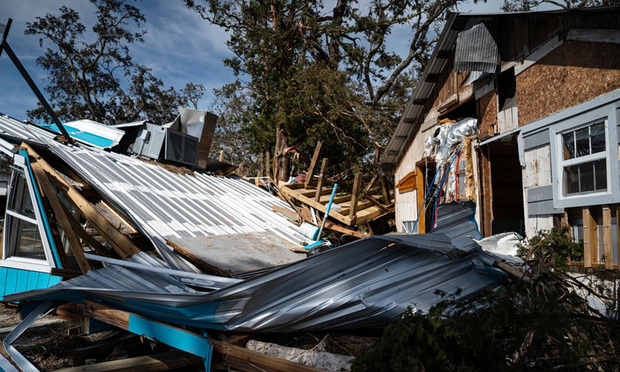
 Hurricane Helene caused damage in Florida and further inland. (Credit: Brigida Sanchez/U.S. Army Corps of Engineers, Jacksonville District)
We just passed the 20th anniversary of Hurricane Katrina on Aug. 29. The Category 3 storm devastated New Orleans and parts of the Mississippi coast in 2005. It remains the costliest disaster and the third deadliest hurricane to ever impact the United States.
If Hurricane Katrina were to hit again, though, would we be better prepared? A new report from Swiss Re says sort of.
Total insured losses of $105 billion (in 2024 dollars) made Katrina the most expensive natural catastrophe event for the global insurance industry ever, across all perils and regions. Swiss Re’s models found that a repeat of Hurricane Katrina today would result in $100 billion in losses (in 2024 dollars) – an improvement, but not by much.
Most of the savings stem from the adoption of better building codes in the region as well as a new flood protection system for New Orleans, both of which were put in place post-Katrina.
But losses would also be lower just because fewer people live in New Orleans now: the population of the metropolitan area is still about 13%, or 150,000 residents, lower than it was pre-Katrina. That means lower insurance exposure, Swiss Re says.
While Swiss Re’s exercise was to replicate Hurricane Katrina but in 2025, the trouble is that we’ll likely never see a storm that moves exactly like Katrina did. We’ll probably see something worse.
Climate change is warming the Atlantic and the Gulf of Mexico, contributing to rising sea levels and intensifying storms. A study from MS Amlin recently found that hurricane losses could rise by 50%, with stronger storms moving further inland, as the Earth’s temperature continues to increase. We already saw an example of this with Hurricane Helene last fall.
And while New Orleans has seen its population decline, much of the hurricane-prone Southeast has seen large population gains. According to the New York Times, Florida added more than 3 million people between 2000 and 2023. North and South Carolina added another 2.5 million. Texas, including Houston, has also seen major gains.
Building codes and engineering can only do so much, especially when they’re not uniform from state to state or even city to city. For example, Mississippi passed a statewide wind code in 2014, but it allows counties and communities to opt out, creating a patchwork of codes across the state.
And worsening conditions can quickly make upgrades out of date. A report from Munich Re points out that New Orleans’ new flood system was designed to protect against a “100-year flood,” but that was in 2011. Since then, local relative sea level has risen by 2.5 to 3.5 inches.
With more people, properties and assets at risk than ever before, are we better prepared for a Katrina-style hurricane? Or do we just want to think so?
Opinions are the author's own.
© Arc, All Rights Reserved. Request academic re-use from www.copyright.com. All other uses, submit a request to TMSalesOperations@arc-network.com. For more information visit Asset & Logo Licensing.