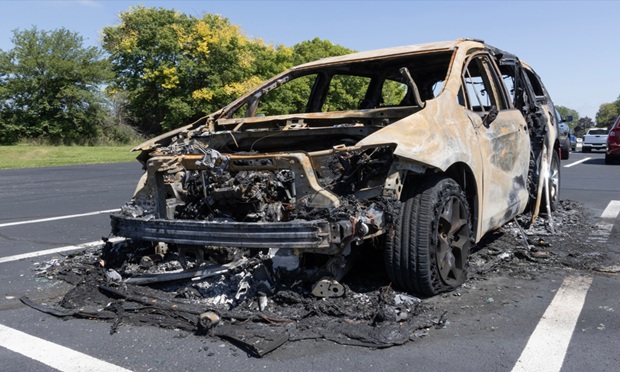
 When EVs burn, the consequences can be severe. (Credit: jetcityimage/Adobe Stock)
Despite economic headwinds that have put pressure on the automotive sector, global sales of electric vehicles (EVs) have continued to break records as electric models become increasingly affordable.
Sales exceeded 17 million globally in 2024, according to the International Energy Agency, putting EVs’ share of the global car market above 20% for the first time. The agency has previously said that as many as 200 million EVs could be on our roads by 2030, albeit this number is dependent on certain scenarios.
The rise of the EV economy, and the batteries that are powering it, is playing a key role in helping governments and industries reach their decarbonization targets with a cleaner transport solution. Yet it also brings a host of challenges that have only become truly evident after deployment including high-profile fire incidents on land and at sea, cyber vulnerabilities, infrastructure power capacities, and complex disposal issues.
EV fires can burn hotter and reignite, making them difficult to control with traditional methods. Emergency services have had to adapt quickly. Fire brigades have adopted new tools such as thermal imagining cameras (TICs), fire blankets, HCT’s F500EA (encapsulating agent), and even submerged containment tanks. At the same time, police and first responders have implemented new protocols for isolating vehicles to prevent fire propagation to adjacent exposures, and for managing post-crash battery hazards.
Given the growing number of unintended consequences, risk experts continually scan the horizon for vulnerabilities. One of the most pressing may be EV charging infrastructure. As these units proliferate across cities, highways and commercial sites, they introduce a new layer of complexity that is only beginning to emerge.
Strained EV chargers can overheat or short circuit, potentially causing damage to the vehicle’s battery system. In some cases, this can trigger thermal runaway, a condition in which a lithium-ion battery cell overheats and enters an exothermic chemical reaction (self-sustaining cycle of rising temperature). The heat causes internal reactions that generate even more heat, rapidly spiraling out of control.
EV fires: Less frequent, but severe consequences
According to the United States National Transportation Safety Board (NTSB), EVs experience approximately 25 fires per 100,000 vehicles sold, while gasoline-powered vehicles average around 1,530 fires per 100,000 — making internal combustion engine vehicles about 61 times more likely to catch fire.
Data from the International Council on Clean Transportation (ICTT) and a number of government authorities supports this, indicating that EVs pose no higher fire ignition risk than combustion-engine cars — and often lower.
The problem is that when EVs do burn, the consequences can be severe. Fires involving charging infrastructure can cause severe damage. While EV fires may be less likely when compared to ICE autos, a notable share of those that do occur are linked to charging; estimates suggest in the range of 15% to 30%. When they do occur, the losses can be substantial, often amounting to hundreds of thousands of dollars, and typically including adjacent exposures.
In May 2025, four vehicles caught fire while an EV was charging in Mountain View, Calif. The source was traced to a lithium-ion system. Total damages, including vehicles and charging equipment, reached an estimated $275,000. For station operators, further costs can follow: Downtime, environmental cleanup and site contamination are liabilities often covered only by tailored insurance policies.
Many businesses have rushed to install EV chargers, viewing them as a market opportunity. However, EVs are still an emerging technology, and building codes can struggle to keep pace.
Evidence at the bottom of the sea
The Morning Midas cargo ship caught fire on June 3 and sank on June 23, 2025, in the North Pacific near Alaska. Onboard were approximately 3,000 vehicles including around 70 fully electric and 700 hybrid electric cars that likely intensified the fire. Industry losses are estimated in the hundreds of millions of dollars.
Establishing the exact causation of fires on vessels whose cargos have included EVs is challenging. One notable incident in 2010: The origin of the fire on the Pearl of Scandinavia, which was traveling from Oslo to Copenhagen, was traced to the battery pack in the rear end of an electric car that was being charged during the voyage, according to the Danish Institute of Fire and Security Technology. The car was originally a conventional vehicle with a combustion engine but had been rebuilt by the owner to be powered by electricity. Fortunately, the onboard sprinkler system did its job, and no one was harmed.
Other, more recent high-profile fire incidents, including the Felicity Ace and the Fremantle Highway, also had EVs on board, but determining causality has proven elusive. Typically, when EVs are implicated in a fire incident on a commercial vessel, the fire origin is undeterminable due to the vessel being at the bottom of the ocean, or the fire event duration burning any evidence to ash, or the lack of firsthand eyewitnesses.
Regardless of the cause, EV batteries store a large amount of energy in a compact space. If that energy is suddenly released, the resulting fire can burn intensely and be challenging to control.
A growing trend among ferry operators, particularly in Europe, is to install on-board charging stations for customer use during trips. While it makes sense, a concern is whether consistent safety standards and updated protocols are being applied and whether operators are fully aware of the risks.Additionally, has adequate training been provided to all crewmembers, as well as shoreside first responders at each end of the ferry’s journey?
The grid stress test
Looking ahead, grid overload is one of the most underappreciated risks associated with EV chargers as cutting-edge technology is being plugged into century-old infrastructure. This issue won’t remain theoretical for long. As EV adoption climbs and millions of drivers plug in after work — just as solar output drops — the risk of overload grows exponentially. Now is the time to invest in smarter, more resilient systems and to foster closer collaboration among all stakeholders, to avoid a cascade of failures in the future.
Capt. Randall Lund is senior marine risk consultant for Allianz Commercial. This article is published with permission from the author and Allianz Commercial. It may not be reproduced.
© Arc, All Rights Reserved. Request academic re-use from www.copyright.com. All other uses, submit a request to TMSalesOperations@arc-network.com. For more information visit Asset & Logo Licensing.