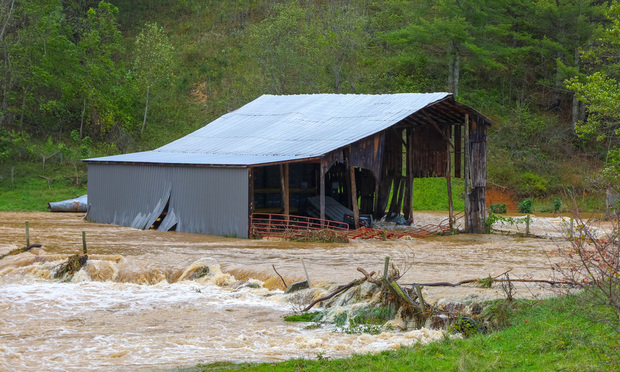
 Hurricane Helene brought 30 inches of rainfall over just two days. (Credit: Timothy/Adobe Stock)
Only about 4% of U.S. homeowners carry flood insurance, even as flood risks are on the rise in several regions.
In a recent Burns & Wilcox webinar about flood and wind risks, Brad Turner, vice president, national product manager, flood, said business has been moving from the National Flood Insurance Program to private markets, but that hasn’t translated to an uptick in coverage.
“Much of the market is still driven by lender requirements, and a lot of those lender requirements are still driven by dated flood maps,” he said.
Many flood maps are seven to 10 years old and don’t reflect current risk, he said. Last year, the U.S. saw $21 billion in insured losses from floods, and the estimated economic loss was $124 billion.
“There’s so much loss related to flood and we haven’t done a great job in the market of really educating consumers about what their risk is,” Turner said.
He noted that insureds are 30 times more likely to have a flood claim than a fire claim over the life of a 30-year mortgage, but most homeowners don’t perceive it that way.
Even among homeowners who have flood coverage, many are not carrying the appropriate limits, Turner said, with coverage that doesn’t consider the impact of inflation over the last several years.
Lots of new players are entering the flood insurance space, he said, and they sometimes make pricing promises that won’t hold over the long term.
“It’s important to look at sustainability versus flash-in-the-pan pricing,” he said. “With some, the rate is good at first but it will double at renewal.”
Parametric options could eventually help bridge the flood coverage gap, Turner said. “It’s allowing us to cover things that we haven’t been able to cover in the past.”
© Arc, All Rights Reserved. Request academic re-use from www.copyright.com. All other uses, submit a request to TMSalesOperations@arc-network.com. For more information visit Asset & Logo Licensing.