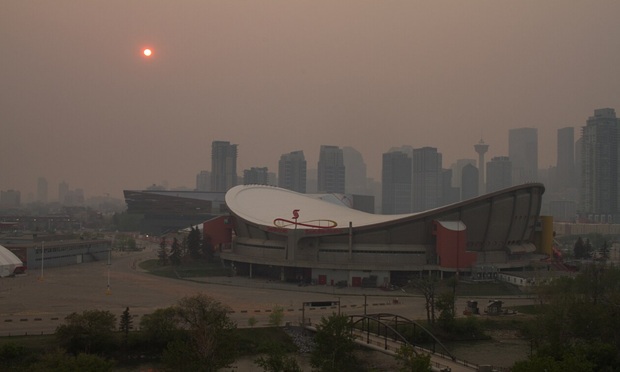
 In May 2023, wildfires in northern Alberta, Canada caused significant impact on air quality as thick smoke engulfed areas across Canada and the United States. Canada is warming at twice the rate of the global average, which means wildfires will be more likely to occur in Canada as temperatures rise. (Dwayne Reilander/Wikimedia Commons)
Examining last year's unprecedented natural catastrophes in Canada, it becomes readily apparent that the unexpected — or what was once referred to as a “black swan event" — has become the norm, which means society must prepare accordingly.
2024 marked Canada’s costliest year on record. In the space of just a few weeks in July and August, four different events unfolded that saw insurers and reinsurers pay out over $8 billion in claims.
- $1 billion in insured losses stemmed from the summer floods in Ontario and the Greater Toronto area.
- $2.9 billion came from the post-tropical storm that travelled across southern Quebec in the aftermath of Hurricane Debby.
- $1.2 billion in insured damages was inflicted by wildfires in Jasper, Alberta.
- The remainder was the result of a record-breaking hailstorm in the Calgary area in early August, which caused nearly $3.2 billion in insured losses and is the second costliest NatCat event in Canada’s history.
Notably, all four of these events are classified as secondary perils, a term that can be misleading.
Traditionally, natural catastrophes have been split into primary and secondary perils. Primary perils, such as earthquakes and hurricanes, are severe but relatively infrequent. In contrast, secondary perils such as floods, wildfires and hailstorms occur frequently but have historically been less severe than primary perils. Primary-peril modeling has kept pace with key loss drivers like inflation, urbanization and climate change, while modeling of secondary perils requires continued focus and investment.
Last year's total industry insured cat losses of around $8.9 billion far outpaced the $6 billion from 2016 (adjusted for inflation), the year of the Fort McMurray wildfires, and is 12 times the annual average of $701 million recorded in the decade between 2001 and 2010. Yet much of 2024’s losses were driven by two secondary perils: the Calgary hailstorm and Hurricane Debby, which combined nearly equaled the total annual cat losses in Canada from 2021-2023.
What drives these increased trends?
In recent years, secondary perils have accounted for more than 60% of annual natural catastrophe losses globally. So was last year an aberration, when secondary perils accounted for nearly 90% of total losses in Canada?
If you look across the past 10 years, Canada had nine secondary peril losses greater than $1 billion (adjusted for inflation). Essentially, the industry should expect a billion-dollar cat loss every year. In addition, 2022, 2023 and 2024 were among Canada’s largest insured natural catastrophe loss years, which illustrates the upward trend of cat frequency and severity.
Climate change always comes to the forefront of this rising trend. For example, it’s clear that wildfires will increase as temperatures rise. But did you know that Canada is warming at twice the rate of the global average? In fact, further north in the Canadian Arctic, it is more than three times the rate of the global average, according to government research. This means wildfires will be more likely to occur in Canada as temperatures rise and we may see fires occurring in areas that haven’t traditionally been a concern. The Halifax fire in 2023 the Manitoba wildfires this year are examples.
It's important to acknowledge that climate change is not the sole cause of increased secondary perils. Urbanization and inflation also play a major role, with more costly assets increasingly being impacted by secondary perils.
More people are moving to cities and more buildings are built to accommodate a growing population, including houses. When a cat event occurs, there is more exposure, which leads to more claims and larger claims. Between 2016 and 2021, Canada’s population grew about 5%, while 18 of the largest 25 municipalities saw population growth of over 10%. In fact, the United Nations expects Canada to have an 88% urbanization rate by 2050 compared to 83% in 2021, according to government reporting.
Between 2020 and 2024, Calgary experienced rapid growth and was the fastest growing Canadian city in 2023 and 2024. Despite lasting only a few hours, last summer’s Calgary hailstorm caused over $3 billion in insured losses compared to losses of $1.6 billion from the 2020 Calgary hail event (adjusted for inflation).3 The storm’s severity was largely a function of the storm's location, but also because exposures had increased over time. Severe convective storms pose challenges as a slight shift in location can lead to significantly more severity. Calgary will continue to be exposed to hailstorms and as the city continues to grow the re/insurance industry will see larger and more frequent cat claims.
Inflation also drives increased costs. Statistics Canada reports a cumulative increase in residential construction costs of more than 65% since mid-2020 versus an, 18% increase in the same time for CPI. This increase varies by city and location, with greater Toronto seeing an increase of over 80%.
This translates to higher costs to re/insurers when claims occur, while retaliatory tariffs imposed by Canada on U.S. parts and materials suppliers are fueling increased costs for auto repairs and home construction.
Examining risk accumulation, mitigation
The re/insurance industry has taken note of the fact that these events are happening more frequently and inflation and rising asset concentrations in urban areas ramping up the total value at risk.
As secondary perils become more frequent and losses escalate, risk transfer is a time-tested mechanism to ensure sustainability of communities, yet the strongest lever to increase insurability is to double down on mitigation and adaptation efforts to reduce losses before they occur.
There is clear evidence that mitigation measures are highly effective in minimizing the losses associated with secondary perils. Research from the Institute for Catastrophic Loss Reduction (ICLR) in the aftermath of the Fort McMurray wildfire, for example, shows that homes built in compliance with FireSmart guidelines were much more likely to survive:
- 81% of all surviving homes assessed during the study were rated as FireSmart, within Low to Moderate hazard levels
- 94% of the time, the surviving home in matched (side-by-side) pairs was rated as being at lower risk than its burned counterpart by a rating differential of more than 30 points, according to ICLR.
Further, ICLR found that every dollar spent to make a new home fire resistant saves up to $35.
Clearly, preparation and resilience measures can improve protection. In wildfire-prone areas, building with fire-resistant materials and creating defensible spaces around homes can spell the difference between survival and destruction. In flood-prone regions, updated zoning laws and investments in modern flood defenses can also help prevent hundreds of millions in damages.
Important questions
While mitigation and adaptation strategies like resilient building codes and better land use planning are the most effective ways to reduce the risks associated with secondary perils, insurers must build sustainable portfolios to adequately assess risk and manage their own accumulations.
Key questions must be asked, such as:
- Am I tracking accumulation risk by each peril?
- At what granularity should I track each peril and should I track it in multiple ways?
- Do I have the right risk management controls on actual exposure?
- Am I evaluating my maximum potential loss in a realistic way?
- Am I making the fastest portfolio steering decisions based on real time insights?
- Am I planning my business and reinsurance strategy based on a true understanding of my risk?
As the impacts of secondary perils continue to grow, the industry needs to work together to strengthen its knowledge of secondary perils and continually build out better modeling capabilities. Secondary perils aren’t diminishing, so our understanding of the risk should only improve. Proper management of accumulations by peril becomes imperative.
Mutual responsibility, shared incentives
Assessing, modeling and managing risk is critical in gaining a deeper understanding of portfolio exposure and monitoring accumulations. Yet this is only part of the solution.
Let’s focus now on the power of data and segmentation and how collective efforts can help mitigate the growing impact of natural catastrophes.
Collective effort
Insurance plays a vital role in helping customers and communities recover from extreme events. Insurers have already closed 86% of the over 280,000 claims from the four largest 2024 cat events. While insurance is a vital financial safety net, it cannot be the only line of defense. Robust risk mitigation is essential to reduce the likelihood and size of losses before they occur, and insurers are well-positioned to encourage policyholders to adopt mitigation measures — through pricing, coverage design and deductibles.
Data drives strategy
To effectively differentiate the multitude of varied risks at a granular level, insurers need to utilize cat experience to identify trends. Events like the Calgary hailstorm or the Jasper wildfire offer valuable insights into which property features are more prone to loss. But these insights can only be teased out if the right data is captured in the first place.
For example, while it’s well known that certain roof types are more susceptible to wildfire, insurers can’t analyze this risk if information on roof type isn’t collected at the underwriting stage. Without this data, it becomes difficult to identify trends or make informed decisions.
With sufficient data and experience, insurers can segment their portfolios more effectively and refine underwriting strategies to truly manage catastrophe risk. Proactive data collection and thoughtful analysis are key to addressing evolving risk differentiation and achieving portfolio resilience.
Often, risks are segmented into broad categories such as good, average or poor. However, the more granular the segmentation, the more tailored and effective the underwriting approach can be. Imagine segmenting a portfolio into 10 distinct categories, each with its own differentiated strategy. Now, imagine having 10 categories per peril each having different approaches. This level of precision not only enhances risk management but also sets an insurer apart from its peers by demonstrating a deeper understanding of risk and a commitment to customized solutions. This also leads to better profitability for the insurer.
Premiums need to reflect the unique volatility of each risk
Once data is captured and analyzed, insurers can begin to adjust pricing to reflect the true volatility of each risk. Price serves as a signal to consumers — helping them understand their exposure and encouraging mitigation.
Beyond premiums, insurers can also use deductibles and sub-limits to reflect risk more appropriately. In Canada, insurers have the flexibility to set deductibles by peril, but this is not yet widely practiced.
The rising frequency and severity of secondary perils in Canada have redefined the landscape of natural catastrophe risk, demanding an urgent shift in how exposures are modeled, managed, and mitigated. With 2024 marking the nation’s costliest year on record — driven largely by floods, wildfires, hailstorms, and post-tropical storms — the insurance industry must adopt a multi-faceted approach that integrates real-time accumulation management, robust risk tolerances, and the strategic use of data to differentiate and price risk accurately.
Looking to the future
As climate change, urbanization and inflation continue to amplify losses, proactive mitigation measures — such as resilient building codes and targeted adaptation efforts — are vital to protecting communities and portfolios alike. Only by collaborating across the industry, strengthening data collection and analysis, and constantly refining modeling capabilities can insurers and communities build resilience and ensure the long-term sustainability of coverage in the face of ever-evolving secondary perils.
This is an abbreviated version of an article that first published at SwissRe.com. It is republished here with permission.
Jolee Crosby is CEO Reinsurance Canada.
© Arc, All Rights Reserved. Request academic re-use from www.copyright.com. All other uses, submit a request to TMSalesOperations@arc-network.com. For more information visit Asset & Logo Licensing.