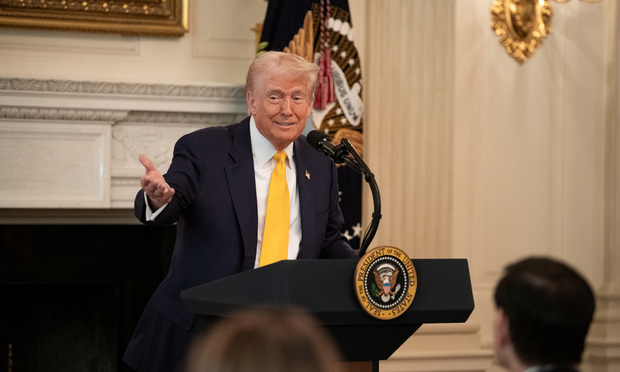
 The Trump administration has a “10-to-1” deregulatory initiative, which mandates the elimination of 10 existing regulations for every new regulation implemented. (Credit: The White House)
Financial services firms saw far fewer regulatory enforcement actions in the first half of this year, as violation volumes declined 37% compared to the previous six months, according to a new report from Wolters Kluwer.
The firm’s Regulatory Violations Intelligence Index found monetary penalties dropped 32% across key violation categories, and competition-related penalties, including anti-trust violations, fell 97% in dollar value.
Enforcement of consumer protection violations was down 22%, and monetary penalties were 21% lower. The violation volume for financial offenses also dropped 53%.
"We're witnessing a fundamental transformation in federal enforcement priorities," said Chuck Ross, vice president and segment leader at Wolters Kluwer, in a statement. "While deregulation was anticipated under the new administration, the velocity and magnitude of this enforcement pullback exceeds even the most aggressive predictions.”
The Trump Administration has been vocal about its support for deregulation. In addition to scaling back many government agencies, the administration also has a “10-to-1” deregulatory initiative, which mandates the elimination of 10 existing regulations for every new regulation implemented. The Consumer Financial Protection Bureau, which has been targeted for deep cuts by the administration, withdrew 67 guidance documents earlier this year, creating regulatory gaps that will have to be sorted out by state-level regulators.
Ross warned that a decline in federal enforcement will create a regulatory vacuum, and states — especially blue ones — will be moving to fill it. For organizations that operate in multiple jurisdictions, regulatory management will likely grow increasingly complicated.
“Financial institutions face a greater patchwork of state-level enforcement that could be even more complex and burdensome than the federal framework it's replacing,” he says.
Wolters Kluwer analysts have already noticed a surge in state regulatory activity, and organizations should be prepared to stay on their toes, Ross said.
"History shows us that enforcement pendulums swing," concludes Ross. "Organizations that maintain robust compliance frameworks during periods of light federal enforcement while adapting to the emerging state-level requirements are best positioned to weather future shifts. Those who mistake the current deregulatory regime as the new normal do so at their own peril—especially as states fill the enforcement void."
© Arc, All Rights Reserved. Request academic re-use from www.copyright.com. All other uses, submit a request to TMSalesOperations@arc-network.com. For more information visit Asset & Logo Licensing.