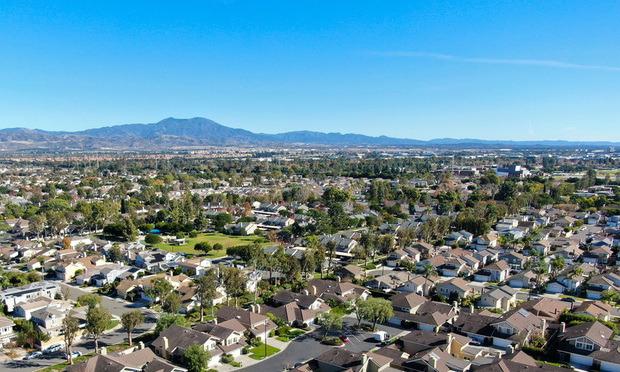
 The model change in California also comes with the requirement that insurers start writing at least 85% of their statewide market share in wildfire-distressed areas. (Credit: Unwind/Adobe Stock)
The California Department of Insurance has approved the Verisk Wildfire Model for use by insurers when assessing wildfire risk and setting rates in the state.
It’s the first catastrophe model to pass evaluation under the state’s new Sustainable Insurance Strategy, which requires insurers to write and maintain coverage in wildfire-prone areas.
The Verisk model uses wildfire science, climate data and engineering expertise to produce a forward-looking assessment of risk. It also accounts for property- and community-level mitigation efforts.
Insurers can now start using the model to write and maintain homeowners and commercial insurance policies.
“This is a transformative moment for the insurance industry and for California homeowners and businesses,” said Rob Newbold, president of Verisk Extreme Event Solutions, in a statement. “We’re proud to be the first catastrophe modeler to work with the California Department of Insurance to offer a modeled assessment of wildfire risk and contribute to efforts to bring stability to the insurance market. The latest version of the model, released in 2024, reflects decades of scientific research and engineering expertise, and we believe it will be a powerful tool for insurers navigating the complexities of wildfire risk in a changing climate.”
The CDI is also in the review process with models from Karen Clark and Company and Moody’s.
To date, insurers in California have been required to use historical data to set insurance rates. But as wildfires have intensified in the state, putting more areas at risk, that model has led to major losses for many insurers, with several carriers pulling back coverage or leaving the state altogether.
Premiums have spiked for those living in fire-prone areas, and many households have had to opt for coverage through the state’s insurer of last resort, the FAIR Plan, because traditional carriers won’t insure them.
By switching to a forward-looking wildfire catastrophe model, insurers will be able to set rates based on current and future fire conditions. Wildfire catastrophe models have existed for more than 20 years, and every other state in the country already allows insurers to use them.
However, the model change in California is unique in that it also comes with the requirement that insurers start writing at least 85% of their statewide market share in wildfire-distressed areas. This is meant to expand options for consumers and help them transition off the FAIR Plan.
“For the first time in California history, insurance companies will be required to write more policies in wildfire-distressed areas. This closes one of the biggest coverage gaps across the state,” said Commissioner Lara. “Under existing regulations, insurers have raised rates without guaranteeing coverage or committing to Californians, causing distress for homeowners. That ends now.”
The American Property Casualty Insurance Association applauded the approval of the forward-looking wildfire catastrophe model.
"We commend Commissioner Lara for his leadership in advancing catastrophe modeling in California—an important step toward stabilizing the state’s insurance market amid growing climate threats,” said Mark Sektnan, APCIA vice president of state government relations. “Catastrophe models are a proven tool used in every other state to better assess risk and ensure adequate coverage. We appreciate the Commissioner’s role in guiding two years of public input and collaboration to address this long-standing regulatory gap that left Californians increasingly vulnerable to climate-driven extreme weather. We look forward to working with the Department to remove remaining regulatory barriers and advance additional reforms needed to restore and protect access to insurance coverage for Californians.”
© Arc, All Rights Reserved. Request academic re-use from www.copyright.com. All other uses, submit a request to TMSalesOperations@arc-network.com. For more information visit Asset & Logo Licensing.