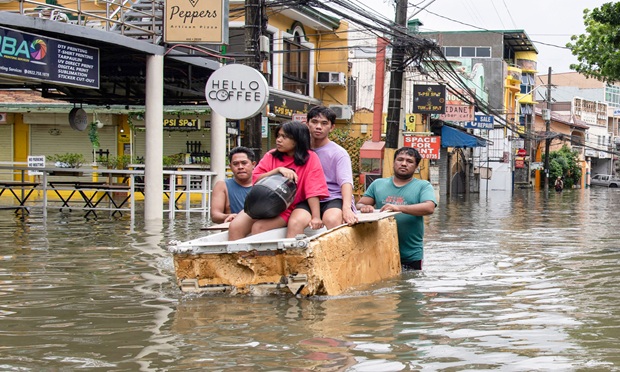
 A tropical storm and torrential rains drenched the Philippines in recent days, causing the government to suspend work and school. (Photo credit: Bloomberg)
(Bloomberg) — Severe storms are triggering flooding in parts of Europe following weeks of extreme heat, while temperatures on the Italian island of Sicily climb to 111 degrees.
A powerful low-pressure system delivered heavy precipitation as it moved east into central Europe on Tuesday, after dumping a month’s worth of rain across parts of England, according to Tom Morgan, a meteorologist with the UK Met Office.
Red alerts for rain and flooding have been issued across Denmark, threatening transport and homes. Orange storm warnings are in place along the Baltic Sea coasts of Germany and Poland.
Climate change is increasing the frequency and severity of extreme weather events from violent storms to wildfires on the world’s fastest-warming continent.
The low is set to expand and help collapse a dome of high pressure that’s fueling scorching temperatures in southeastern Europe. Before that change comes over the weekend, Greece and Italy are expected to reach highs well over 100 degrees.
The heat wave in Greece will peak later this week, with the night time low in Athens not expected to fall below 85 degrees. The capital and the surrounding Attica region have been added to a list of areas where outdoor labor is halted between noon and 5pm. Most of the Greek mainland is on high fire alert.
Greek Energy Minister Stavros Papastavrou said in an interview with Skai TV that the government has coordinated with power grid and distribution network operators to keep electricity supply stable amid soaring demand for cooling. Consumption is expected to surge 40% over the next week, according to Bloomberg models.
As the low-pressure moves south this week, it could spark even more powerful storms, supercharged by an unusually hot Mediterranean Sea, said Juan Jesús González Alemán, a meteorologist with Spanish national forecaster AEMET. — Joe Wertz
'Land of the Blue Dragon' blasted by tropical storm
Tropical Storm Wipha crossed Vietnam’s northern coast near the port city of Haiphong, bringing strong winds and heavy rain that led to flash floods and warnings in several provinces.
Wipha made landfall between Hung Yen and Ninh Binh provinces, according to Vietnam’s National Center for Hydro-Meteorological Forecasting, before gradually weakening as it tracked south of the capital Hanoi toward Laos. Wind speeds for the system were as high as 88 kilometers (55 miles) per hour, the bureau said.
The storm caused flooding and landslides in Thanh Hoa province, inundating traffic routes and residential areas, local news outlet Thanh Nien reported. Nearly 170,000 people living in coastal and estuary areas faced evacuation, while some 7,200 hectares of rice fields were under water, VnExpress reported.
Flash flooding and landslide warnings were in place Tuesday afternoon for six provinces including Phu Tho, Nghe An and Ha Tinh, according to Vietnam’s weather agency.
Vietnam’s government had warned of potential flooding at industrial zones in provinces where companies such as Samsung Electronics Co., Hon Hai Precision Industry Co. — known as Foxconn — and Luxshare Precision Industry Co. have factories. But the storm’s trajectory appears to have spared key production hubs from the most severe weather.
The Northern Delta area and parts of the north-central provinces are still expected to see heavy rain and thunderstorms into Wednesday, with some places getting more than 200 millimeters (8 inches), according to Vietnam’s weather bureau.
Van Don and Cat Bi International airports in Quang Ninh and Haiphong were temporarily shut late on Monday night, with operations resuming after Wipha made landfall. Authorities in Hanoi also evacuated residents from an apartment building deemed to be particularly vulnerable to the storm’s effects, VnExpress reported.
Wipha developed as an area of low pressure east of the Philippines last week, before lashing Hong Kong with gale-force winds on Sunday as it tracked to the south of the city at typhoon-strength. The system then skirted mainland China, temporarily moved inland, and headed west toward Vietnam. — Mary Hui, Francesca Stevens and Nguyen Xuan Quynh
Deluge in the Philippines
Philippine authorities suspended government work and classes in the capital region and dozens of provinces for a third day on Wednesday, warning of continued strong rains that killed at least six people and forced thousands in flooded areas to evacuate.
Monsoon rains and a tropical storm have combined to pour the equivalent of a month’s worth of rain in just four days, Manila’s weather bureau said Tuesday, submerging many cities and displacing more than 82,000 individuals.
The suspension covers the capital region, home to at least 14 million people, and 36 provinces, most of them in the main Luzon island, the office of President Ferdinand Marcos Jr. said in a circular.
The southwest monsoon “will bring moderate to intense rains” in the next few days in northern and central Philippines, the interior ministry said in a statement. “Flooding is expected in areas that are urbanized, low-lying and near rivers. Landslides may also occur in moderate to highly susceptible areas,” it said, adding that forced evacuation has started in some areas.
The weather bureau said it expects “widespread incidents of severe flooding” with landslides through Friday, with three low pressure areas east of the country likely to become tropical cyclones this week. — Neil Jerome Morales and Ditas Lopez
Pakistan's deadly flooding
Torrential rains that have lashed Pakistan since June, claiming more than 200 lives, are set to continue in the coming days, according to the country’s weather agency.
Swathes of Punjab province have seen above-normal precipitation in the past two weeks, with many places getting 150 millimeters (6 inches) above historical averages in that period, according to the US Climate Prediction Center. The country’s disaster management authorities have estimated this year’s monsoon to be 65% more intense than last year, and that future rainy seasons are likely to be more severe and start earlier.
Pakistan has been pummeled by a series of extreme effects of climate change in recent years, including heat waves and prolonged flooding in 2022 that killed more than 1,700 people and caused about $40 billion in damage.
“Pakistan contributes minimally to global greenhouse gas emissions but ranks among the top ten most climate-vulnerable countries,” Prime Minister Shehbaz Sharif said in a statement addressing disaster management last week. “It is a challenge, but also an opportunity to build a climate-resilient nation, especially in agriculture and infrastructure,” he said.
Collapsed buildings have been a leading cause of death in recent weeks, killing at least 136 people as of July 21, a sign that infrastructure resilience remains a major challenge for a country that sees heavy rains most years. This year’s death toll exposes a persistent lack of preparedness since 8 million people were displaced in the 2022 floods.
According to Germanwatch, an environmental NGO, Pakistan was the country most affected by climate impacts that year, with disasters taking off 4% from the country’s GDP.
More extreme events are likely to further strain the country’s fragile economy, plagued by debt, political instability and a chronic energy crisis. Climate change may dent the modest progress made in the past two years after fresh loans were granted by the International Monetary Fund. — Lou Del Bello, Faseeh Mangi and Mary Hui
See also:
- NOAA budget cuts: What insurance professionals need to know now
- Ending FEMA would create its own disaster
- Severe weather, natural catastrophes are ‘blind spots’ for P&C insurers
Copyright 2025 Bloomberg. All rights reserved. This material may not be published, broadcast, rewritten, or redistributed.
© Arc, All Rights Reserved. Request academic re-use from www.copyright.com. All other uses, submit a request to TMSalesOperations@arc-network.com. For more information visit Asset & Logo Licensing.