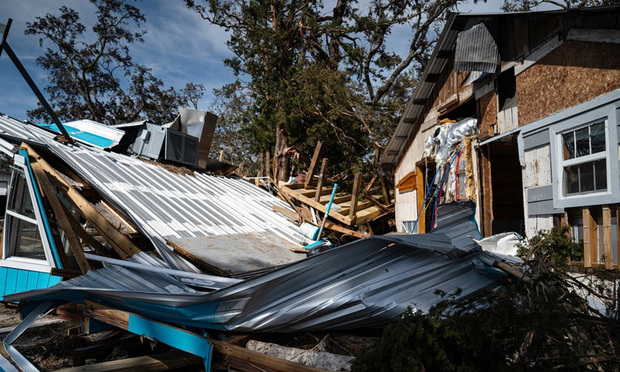
 FEMA runs the National Flood Insurance Program, which provides most flood insurance policies in the U.S. (Photo: Brigida Sanchez/U.S. Army Corps of Engineers, Jacksonville District)
The Trump Administration is working to eliminate or dramatically reduce the Federal Emergency Management Agency — a move that could have terrible consequences for the country.
Speaking in June, President Donald Trump said the agency could be eliminated as soon as this December. "We want to wean off of FEMA, and we want to bring it back to the state level," he said. He also said that the agency, starting immediately, would "give out less money" to states that are recovering from disasters.
He has appointed a FEMA Review Council of cabinet members, governors and emergency management professionals to recommend changes to FEMA by mid-November. At the council’s first meeting in May, Department of Homeland Security Secretary Kristi Noem, the council’s co-chair, said, “I want to be very clear. The president wants [FEMA] eliminated as it currently exists. He wants a new agency.”
But we received a preview of what life without FEMA might look like this spring in St. Louis. The city was struck by a devastating mile-wide tornado on May 16 that killed five people. President Trump didn’t approve the state’s request for a disaster declaration until June 9, which meant the disaster’s victims and first responders were on their own for nearly a month.
City residents set up makeshift donation centers, with thousands of volunteers distributing necessities like bottled water, food and diapers. Community members drove around tarping roofs and windows for those who couldn’t do it on their own. First responders worked without rest. And within a few weeks, money, resources and volunteers were nearly depleted, and recovery had barely begun.
When FEMA isn’t present, the burden of recovery shifts to disaster victims and their communities. Most Americans aren’t able to take on such a challenge. According to a recent survey by the American Institute of CPAs, one-third of Americans (32%) have taken no financial steps to prepare for a natural disaster.
States aren’t in a much better position to help either. Representative John Rutherford, a Republican from Florida, said in May that, in the event of a disaster, “we don’t need someone to come in and hand-hold us … I can tell you our governor does a fantastic job.”
But according to analysis from the Carnegie Endowment for International Peace, while states like Texas and Florida do have large emergency management agencies and rainy day funds, they still rely on FEMA for 75% of recovery costs when disasters hit. Since 2015, FEMA has sent $7.2 billion to Texas and $14.3 billion to Florida for disaster recovery.
The analysis also found that, among the 20 states that receive the most federal disaster recovery funds, most could run for fewer than 100 days on rainy day funds and leftover general funds if disaster struck.
It could be easy to say, “So what? I don’t live in Texas or Florida, so it’s not my problem.” But when hurricanes or other disasters strike major ports or oil and gas assets, that means price spikes for gasoline and consumer products and delays that impact the entire country’s economy. Less aid means a slower recovery process, which means more economic damage over the long term.
There’s potential for states to build up their emergency management resources over time, but it certainly wouldn’t happen in the short timeline — before the 2026 hurricane season — that the president has suggested for eliminating FEMA.
And even then, odds are good that many states will still be caught unprepared. Climate change is causing natural disasters to grow in number and severity. According to a recent study by MS Amlin, rising temperatures will likely cause hurricanes to become stronger and travel further, and they will start impacting states in the Mid-Atlantic and on the East Coast more frequently in coming years.
FEMA is far from perfect — most of us remember Hurricane Katrina well — and is due for continued reform. But stripping down or abolishing the agency altogether, at a time when natural disasters are surging, would be a decision with devastating, and lasting, impacts for our country.
Opinions are the author's own.
© Arc, All Rights Reserved. Request academic re-use from www.copyright.com. All other uses, submit a request to TMSalesOperations@arc-network.com. For more information visit Asset & Logo Licensing.