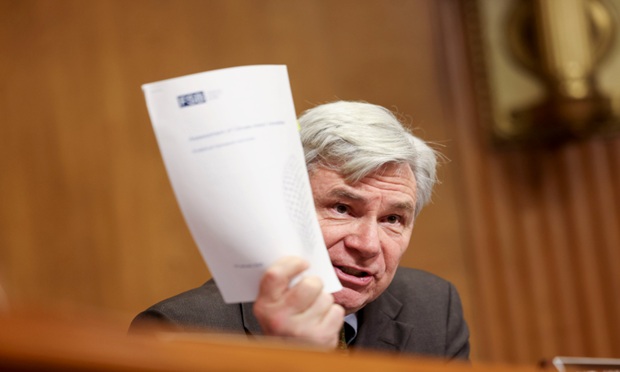
 Sen. Sheldon Whitehouse (D-R.I.) has one of the longest-running regular speaking spots in Congressional history. (Credit: Tierney L. Cross/Bloomberg)
(Bloomberg) — Senator Sheldon Whitehouse is imploring his colleagues to "wake up" and start addressing climate change.
The Rhode Island Democrat in April 2012 began one of the longest-running regular speaking spots in the legislature’s history. The biggest change since he began making climate floor speeches, he said recently in his Senate office, came after he realized he needed to dwell less on the facts of climate science and more on “calling out the fossil fuels [industry’s] massive climate denial operation.”
In a wide-ranging interview about lawmaking, politics, industry and science, Whitehouse expressed mild amusement about a section of President Donald Trump’s new tax and spending law that creates a climate safety net for an unlikely constituency: Chickens.
The Poultry Insurance Pilot Program updates the federal crop insurance program to provide a backstop for independent growers who raise livestock for companies. The new law has a provision allowing so-called contract growers of broilers and laying hens “to receive index-based insurance from extreme-weather related risk, resulting in increased utility costs” — such as natural gas, propane, power or water.
It’s a sharp departure from the law’s rollback of support for clean energy and other climate initiatives. Yet the program, just one of a vast constellation addressed in the law, eluded the attention of most commentators — including senators.
When asked about the provision, Whitehouse called it “a very telling part of the bill” about which he was not previously aware.
Whitehouse described the legislation broadly as executing “everything the fossil fuel industry wants.” At the same time, the bill tacitly acknowledged that the poultry industry has real concerns about the effects of heat and storms exacerbated by greenhouse gas pollution, and provides contract growers new insurance — something that the sector as well as many others increasingly need.
“Well, if the risk weren’t real, why would they be bothering? And if that risk is real, well, there goes your rhetorical platform that it isn’t,” he said, adding that “it kind of belies the whole operation, doesn’t it?”
Mike Sommers, president and chief executive officer of the American Petroleum Institute, lauded the overall legislation as “the most important energy bill in a generation,” in a statement after Trump signed it into law.
Whitehouse has for several years tried to focus attention on the brewing crisis extreme weather poses to insurers of human life and property, going back at least to a 2014 climate floor speech — his 81st on climate.
As chairman of the Senate Budget Committee in the previous Congress, Whitehouse in December released a staff report on disaster risk and the insurance industry, based on a year-long investigation that included requesting novel data from 41 insurers (23 provided information).
The results showed that insurers are not renewing policies in a growing number of counties highly exposed to emerging disaster risks. Texas, where relief operations continue after floods killed at least 115 people, isn’t in the top 10 states facing the highest non-renewal rates. What’s certain is Texas is likely to continue to see compounding disasters, and insurers will continue to do what they need to not lose money.
Leaping premium costs, disappearing coverage and the rising toll of disasters make the insurance crisis potentially as or more devastating than the 2008 financial crisis, Whitehouse said, citing former Freddie Mac chief economist Sean Becketti’s work on coastal risks.
The danger of a systemic insurance-then-mortgage crisis has become “far worse,” Whitehouse said, since Becketti wrote about it in a 2016 analysis because of a run of destructive wildfires in the western US, including the devastating Los Angeles fires in January.
“That 2008-style recession warning was based just on a coastal property values crash caused by the insurance crisis,” Whitehouse said. “You can see the twin crash happening out West from wildfire risk. So, yeah, it's 2008 or worse.”
More expensive disasters, retreating insurance and vanishing federal relief budgets will put more pressure on cities and counties — something that ratings agencies are already taking note of.
“It's a very real looming situation,” he said. “It's sort of the municipal version of what homeowners are seeing, only it relates to municipal bonds instead of home insurance.”
Whitehouse noted that rising insurance premiums are an “immediate punch that is coming to American families.” But projections that the new tax bill’s provisions undoing clean-energy support will make power more expensive are "the other economic punch that is coming their way.”
Almost but not all of the 575,000 words Whitehouse has read from the podium for his climate speeches are his own. Consider a quotation he shared in June 2016 from former Rhode Island Senator John Chafee from 30 years prior: “‘This is not a matter of Chicken Little telling us the sky is falling. The scientific evidence … is telling us that we have a problem; a serious problem.’”
See also:
- EPA rule rollbacks could cost money, lives
- The United States of Insurance in 2025
- Swiss Re: Insurers have new opportunity in secondary perils
Copyright 2025 Bloomberg. All rights reserved. This material may not be published, broadcast, rewritten, or redistributed.
© Arc, All Rights Reserved. Request academic re-use from www.copyright.com. All other uses, submit a request to TMSalesOperations@arc-network.com. For more information visit Asset & Logo Licensing.