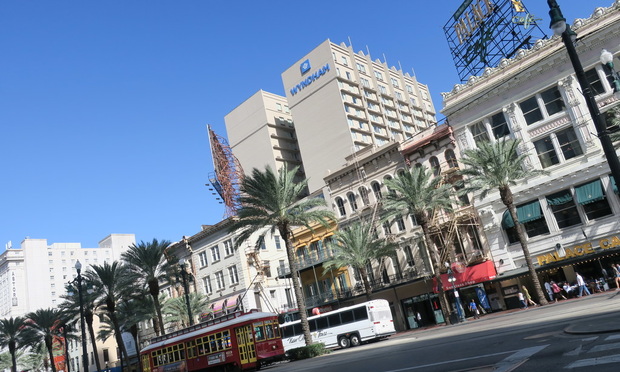
 Canal Street in New Orleans, Louisiana.
Heightened flood risk in New Orleans has many insurers pulling back on commercial coverage, leaving businesses vulnerable to disaster.
Flooding in New Orleans can stem from weather events like hurricanes, thunderstorms, storm surge and winter storms, according to the city’s hazard mitigation plan, with high rainfall totals at any time of day or year. In Louisiana, there are six specific flood types including riverine, flash, ponding, backwater, urban and coastal.
Bessie Schwarz is the CEO and Co-founder of Floodbase, and in 2024, was named to Bloomberg's list of the 13 Most Influential Climate Leaders to watch. Recently, PropertyCasualty360 spoke with Schwarz about insurance gaps in the city of New Orleans and what it means for businesses in high flood-risk areas.
PropertyCasualty360: Are there critical gaps in flood coverage for New Orleans businesses? If so, why?
Schwarz: Absolutely. Many insurers don’t offer commercial flood coverage in New Orleans due to its well-known flood risk.
The primary existing option, the National Flood Insurance Program (NFIP), only covers direct property damage and excludes significant flood-based drivers of economic loss, like business interruption, revenue loss, cleanups, temporary facilities, and more. These limitations leave businesses exposed and financially vulnerable.
PropertyCasualty360: Most New Orleans businesses are insured against flood loss through the federal National Flood Insurance Program (NFIP). Currently, the NFIP caps their commercial payouts at $500,000. Is this total insufficient? Why?
Schwarz: Not only is $500,000 an insufficient payout amount, it also assumes that businesses qualify for NFIP.
Currently, valid NFIP claims require on-site damage, leaving second-story or higher-elevation businesses totally uncovered when flooding disrupts foot traffic and tourism across the city, which is vital for NOLA’s iconic hospitality sector.
PropertyCasualty360: Why are businesses in New Orleans’ tourism sector, which are highly vulnerable to flood damage, largely overlooked by current flood insurance options?
Schwarz: Because of its low elevation, meaning much of the city is below sea level, New Orleans has famously been the site of historic devastation and financial loss during hurricane-season in particular.
The area’s high risk of flooding, amplified by rising sea levels, has led many insurers to exit this market altogether. Since the main option available, NFIP, only covers direct property damage, NOLA businesses are highly exposed to significant economic loss in the likely event of flooding.
PropertyCasualty360: Outside of flood damage to their structures, what other types of economic loss are New Orleans’ businesses susceptible to?
Schwarz: Businesses in flood-prone regions like New Orleans often experience revenue interruption due to the drop in tourism and visitor traffic after a major flooding event.
When a street is completely flooded and patrons can’t access a hotel or restaurant, for example, that business experiences an immediate interruption, and a drastic drop in revenue. Power outages caused by flooding are another major expense for businesses beyond direct structural damage; generators can cost businesses tens of thousands of dollars, and hundreds of dollars per day, to fuel.
PropertyCasualty360: Would parametric insurance provide better coverage for business owners in New Orleans and other U.S. cities prone to flooding? If so, why?
Schwarz: I believe that parametric insurance will undoubtedly provide more robust and holistic coverage options for business owners in New Orleans. The ability to purchase additional first-dollar coverage will also be a lifeline for those hospitality businesses looking to expand their property coverage.
Because this type of coverage isn’t limited to documented on-site property damage, covers any type of loss, and is paid out automatically once a predetermined threshold is met – it offers a quicker and holistic financial safety net than any currently available to New Orleans businesses.

These flood covers can also be a game-changer for any cities, municipalities, or local governments that face flood risk. This past fall, Fremont, California became the first municipality in the country to buy citywide parametric flood coverage, backed by Floodbase’s constant, real-time flood monitoring data.
Businesses or local governments like Fremont that purchase parametric flood insurance receive payouts any time a predetermined flooding threshold is triggered, which they can use flexibly for recovery or other areas where it's most needed.
© Arc, All Rights Reserved. Request academic re-use from www.copyright.com. All other uses, submit a request to TMSalesOperations@arc-network.com. For more information visit Asset & Logo Licensing.