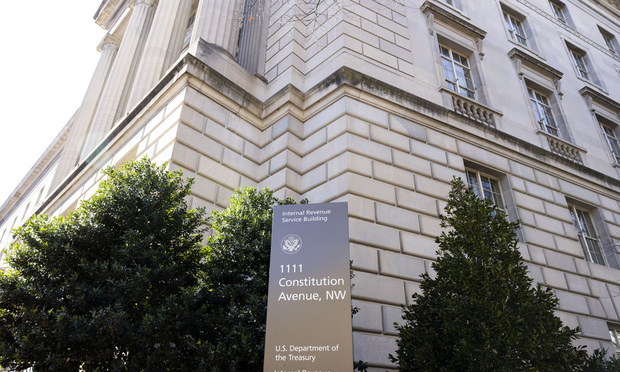
 Internal Revenue Service building in Washington, D.C., on January 12, 2022. (Credit: Diego M. Radzinschi/ALM)
Insurer SRA 831(b) Admin, along with Drake Insurance Company and Drake Plastics, has filed a lawsuit against the U.S. Internal Revenue Service targeting what they assert is a multi-year pattern of regulatory overreach targeting the 831(b) captive insurance industry.
“When a government agency exercises its power without accountability or clarity, businesses have not only the right but the responsibility to push back,” Dustin Carlson, president of SRA 831(b) Admin, said in a release about the suit. “This lawsuit isn’t just about our company — it’s about standing up for the thousands of business owners who deserve fairness, transparency, and the ability to manage risk without fear of regulatory overreach.”
These 831(b) captive insurers are often referred to as “micro-captives.” These are insurance entities owned by the people or entities it insures. In these cases, the owners have chosen to be taxed on the investment income generated rather than on the captive’s underwriting profits.
The lawsuit was filed in response to IRS regulations published in January 2025 that define the criteria that characterize certain micro-captive transactions as either listed transactions or transactions of interest. That means these transactions are now reportable and will require extensive additional tax return disclosure for 831(b)s.
The lawsuit argues that this regulation exceeds the authority of the IRS and that this blanket classification of arrangements as transactions of interest or listed transactions criminalizes legitimated insurance structures like micro-captives that are utilized by small businesses.
In a release announcing the suit, SRA cites three specific examples that it says are representative of this abuse from the IRS:
- “In 2022, the IRS initiated a promoter audit under IRC § 6700, demanding years of records, including every insurance policy, invoice, agreement, marketing piece, and client communication in SRA’s history. The company spent more than $200,000 on legal and compliance costs and delivered over 2,500 file boxes worth of digital records. Two years later, in July 2024, the IRS abruptly dropped the audit without comment, conclusion, or guidance, reserving the right to return at any time.”
- “In 2019, SRA and its advisors submitted a Private Letter Ruling request to clarify a specific client transaction. Despite consistent engagement and multiple data submissions over a five-year period, the IRS ultimately declined to rule, citing “pending guidance” on risk distribution; guidance that has not come. The process cost SRA over $50,000 and left a legitimate, good-faith request in limbo.”
- “Following IRS Notice 2016-66, SRA has filed thousands of Form 8886 disclosures on behalf of over 1,000 insureds and 2,000 participants, every year since 2017. These filings are not permitted electronically, forcing manual submissions to both the IRS and its Office of Tax Shelter Analysis. Despite this extraordinary transparency, not one of SRA’s clients has been audited due to these filings, nor has the IRS provided any feedback on the company’s practices.”
SRA claims that January’s finalized regulations codify a “pattern of abuse by reclassifying nearly all 831(b) activity as inherently suspect, regardless of substance, structure, or compliance history.”
“These regulations don’t differentiate between honest companies protecting themselves from real-world risks and bad actors looking for tax avoidance schemes,” Carlson said in the release. “The result is a chilling effect on responsible risk management at a time when commercial insurance markets are in crisis.”
The lawsuit seeks to vacate the IRS’s January rule and halt the enforcement of the new reporting system.
© Arc, All Rights Reserved. Request academic re-use from www.copyright.com. All other uses, submit a request to TMSalesOperations@arc-network.com. For more information visit Asset & Logo Licensing.