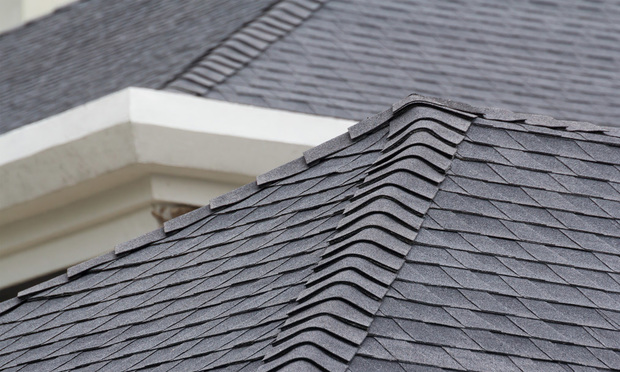
 Attempting to match replacement shingles to shingles undamaged by the reported loss event can be challenging and expensive. (Shutterstock)
The judges of the Eighth Circuit recently reversed a district court ruling that an insurer was obligated to replace the policyholder’s entire roof to ensure the shingles would match.
The roof on Thomas and Annette's Noonans’ Minnesota house was damaged in a severe thunderstorm. At the time of the damage, the Noonans had a “Gold Star Special Deluxe Form” policy with American Family. A “Gold Star Homeowners Amendatory Endorsement” was attached to the policy in 1999, which completely replaced the policy’s loss valuation clause.
In 2013, a second, Minnesota-specific endorsement was added to the policy. It stated American Family would not pay any increased costs associated with physically matching existing and replacement materials.
When the Noonans reported the damage, American Family sent out an adjuster. The adjuster returned an estimate of $12,000 to fix the damaged portion of the roof, excluding undamaged shingles.
The Noonans exercised their right to demand an appraisal to determine the cost to replace the whole roof. The appraiser's estimate, which did not differentiate between the amount to replace the damaged and undamaged shingles, was $141,000. A note on the appraisal form indicated there was a matching issue because an exact match for the existing shingles on the Noonans’ roof was unavailable.
The adjuster from American Family revised his estimate, stating that approximately $87,233 of the appraisers’ estimate represented the amount necessary to replace the undamaged shingles, which would leave a $53,767 potential payment for the Noonans.
Litigating the appraisal
The Noonans sued American Family for breach and requested a confirmation of the appraisal award. The court ordered the appraisers to apportion their estimate between the amount to fix the damaged shingles and the amount to fix the undamaged shingles. The appraisers informed the court that $74,381 of the award was needed to match the existing shingles to the new shingles, and the remaining $66,619 would cover only the damaged shingles. American Family paid the amount needed to fix the damaged shingles but would not budge on paying the amount needed to make the whole roof match, citing the 2013 endorsement on the Noonans’ policy.
The judges analyzed the policy and the two endorsements. There was no clarity regarding whether the 1999 endorsement or the 2013 endorsement should be applied to the policy first, and the order of application would be outcome-determinative. If the endorsements applied in the order they were added to the policy, the matching exclusion in the 2013 endorsement would prevail, and American Family would not have to pay to make the Noonans’ roof match.
However, if the 2013 endorsement applied first, then there should be matching coverage because the 1999 endorsement specifically stated it replaced the part of the policy where the matching exclusion was found. Also, while certain parts of the 2013 endorsement specifically applied to the 1999 endorsement, others did not reference the earlier endorsement. Therefore, the district judges reasoned, any omissions must be intentional. Given this lack of clarity, the district court ruled in favor of the Noonans and ordered American Family to pay the remaining balance of the appraisal award. American Family appealed.
What the appellate court said
In the Eighth Circuit Court of Appeals, American Family argued the two endorsements were not mutually exclusive. The matching exclusion in the 2013 endorsement applied to an entirely different subject than the 1999 endorsement, so it was unnecessary to give a specific statement on the applicability.
The appellate judges agreed with American Family. The very first page of the Noonans’ policy included a statement that the 2013 endorsement applied; a physical copy of that endorsement accompanied the policy. Even the portion of the 2013 endorsement that included the matching exclusion had “expressly said that revisions were being made to the [1999] Endorsement.”
However, the appellate judges acknowledged the district court’s confusion. The matching exclusion had, admittedly, been four paragraphs beneath the heading, “The following is added to Loss Value Determination.” Instead of confining the scope of the heading to the paragraph immediately following it, the district court had taken the heading a few paragraphs too far.
The standard fire policy
Nonetheless, the Noonans’ argued for policy reformation because they were owed “the statutory minimum coverage of a standard fire insurance policy” because their homeowners policy covered damage from a fire.
The appellate judges pointed out that the Noonans’ roof had suffered damage during a thunderstorm, not a fire. Since fire did not cause the loss, the provisions of the standard fire policy were inapplicable.
The Eighth Circuit reversed the verdict in favor of the Noonan’s and sent it back to the district court, with order to enter judgment in favor of American Family.
Coverage analysis
Many policies state they that pay for direct physical damage to covered property. This becomes an issue when the damaged property is no longer readily available, and replacement property does not match the remaining, undamaged property. This mismatch affects the aesthetics of the property and can possibly affect sale value as well.
Some states have gotten ahead of the issues by putting laws in place that require insurers to replace a certain amount of undamaged property around the damaged area so the appearance is reasonably uniform. In states where matching laws aren’t on the books, some state high courts have determined that matching is required in certain circumstances.
FC&S Expert Coverage Interpretation has published a Matching Statutes by State chart that goes through the matching laws for each state or, in case of states without a specific matching law, the existing case law.
© Arc, All Rights Reserved. Request academic re-use from www.copyright.com. All other uses, submit a request to TMSalesOperations@arc-network.com. For more information visit Asset & Logo Licensing.