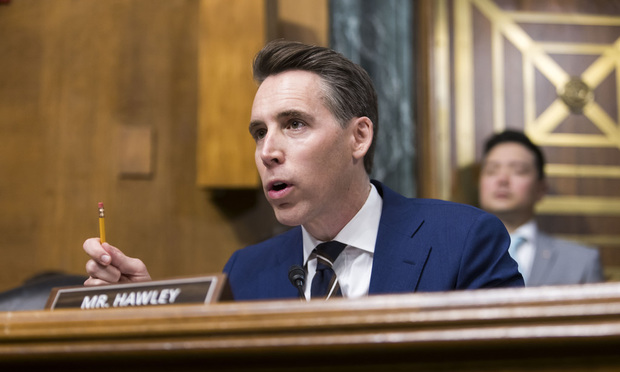
 Sen. Josh Hawley (R-MO) questioned executives from Allstate and State Farm about what he called "a system of institutionalized fraud." (Credit: Diego M. Radzinschi/ALM)
A U.S. Senate subcommittee questioned executives from State Farm and Allstate on Tuesday after hearing testimony from clients and adjusters alleging fraud and abuse in the system.
The disaster management subcommittee hearing of the U.S. Senate Committee on Homeland Security and Governmental Affairs was called to look at claims practices following natural disasters. Sen. Josh Hawley, the subcommittee’s chair, said devastating catastrophes were leaving families homeless and in debt because insurance companies wouldn’t pay out their claims.
“This isn’t charity that we’re talking about,” he said in his opening remarks. “[Americans] turn to their insurance companies because they pay premiums to those insurance companies. It’s a contract. And unfortunately, time after time, they find when disaster strikes — in their moment of utmost need — the insurance companies come back to them and they delay, and they deny, and they offer excuses, and they send out two adjusters and three adjusters and 15 adjusters and 25 adjusters, and they constantly change the estimates. And at the end of the day, they just won’t pay what is due. What is required. What is just.”
The committee heard testimony from policyholders and adjusters. Georgia homeowner Natalia Migal, an Allstate policyholder, said the company gave her the run-around after a 70-foot tree fell on her home and her roof collapsed.
After Allstate offered her $46,000 to repair the damage, she hired an independent inspector and engineer, who found the property had suffered closer to $400,000 in damage.
Ultimately, Migal received less than $100,000 to repair her home. Clifford Millikan, one of the adjusters assigned to the case, said he disagreed with that payout and was told by Allstate to revise his initial estimate, which was around $200,000.
Millikan, who has worked as an adjuster for Allstate through Pilot Catastrophe for several years, said adjusters are routinely asked to lower their estimates to reduce claims awards. Allstate has also started removing on-site adjusters from the process, he said, relying instead on third-party non-licensed inspectors to take pictures and then upload them to a portal for review. This increases the likelihood that damage will be missed, he said, which is to Allstate’s benefit.
“These new practices are wrong, and the people most affected by them are the ones who lack the resources to fight back, like the poor and the elderly,” he said.
The committee heard similar testimony from Jacob Vertel, a State Farm policyholder whose North Carolina ranch home had multiple trees fall on it during Hurricane Helene last October. State Farm deemed the home habitable and denied Vertel’s living expense claims, despite the county declaring the home unsafe to enter, he said.
Vertel, his wife, who was pregnant at the time and has since given birth, and their toddler are living in a rental that they’re paying for out of pocket. Their home has yet to receive any repairs.
Michael Keating, operations vice president for State Farm, and Mike Fiato, vice president and chief claims officer at Allstate said their companies are committed to paying out claims and helping policyholders recover.
Keating said State Farm received 129,600 claims from hurricanes Milton and Helene last year and has paid out $1.28 billion so far. Less than 1% of those claims have received one or more policyholder complaints, he said.
Fiato said he regretted that Migal was unhappy with how her claim was handled but disputed the testimony surrounding the case. He said much of the damage was cosmetic, not structural, which accounted for the discrepancy in repair estimates.
He said Allstate has robust internal oversight protocols and a separate quality department. He pointed out that insurers are also subject to state regulation.
“Fifty-one regulators oversee and regulate everything from pricing and underwriting to policies and claims, where we are routinely subject to market conduct exams including following large catastrophe events,” he said.
Hawley questioned whether Allstate’s commitment is to its policyholders or profit. The company made $4.6 billion in profit in 2024 and its CEO Tom Wilson make $26 million in executive compensation.
“Ms. Migal can’t get her claim paid out, but Tom Wilson, whoever the heck he is, gets $26 million,” Hawley said. “That’s really extraordinary.”
Doug Quinn, executive director of the American Policyholder Association, an insurance watchdog group, called on the subcommittee to start investigating insurers at the federal level. He said his organization had delivered “gift-wrapped” fraud cases to state regulators that went ignored.
A study from the Insurance Fairness Project found that 61% of voters think the federal government is doing too little to protect consumers and hold insurance companies accountable, and 52% of voters say the same about their state government.
“It’s time for federal enforcement,” Quinn said. “It’s time for federal prosecutions. It’s time for these criminal organizations to be brought to justice.”
© Arc, All Rights Reserved. Request academic re-use from www.copyright.com. All other uses, submit a request to TMSalesOperations@arc-network.com. For more information visit Asset & Logo Licensing.