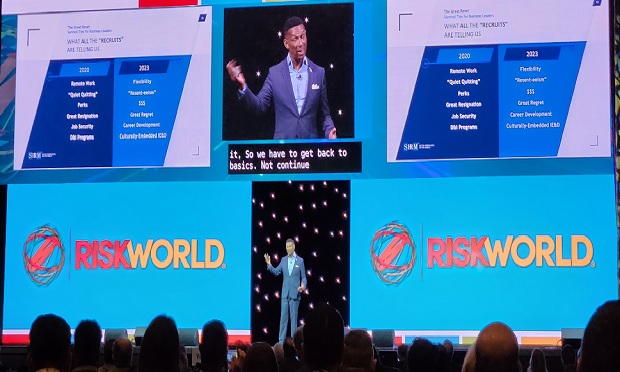
 Johnny C. Taylor, Jr., emphasized that today's employees expect empathy and flexibility from their employers. (Photo: P. Harman/PropertyCasualty360.com)
When the world first shut down for the pandemic, the expectation was that it would only be for a few weeks. The reality was very different. As weeks turned into months, employees' perceptions and expectations around work also changed.
During the opening keynote presentation at this year's RiskWorld in Atlanta, Ga, Society of Human Resource Management (SHRM) president and CEO, Johnny C. Taylor, Jr., shared some of the research his organization has conducted and what trends they are seeing ahead for employers and employees. "People in so many ways, are your biggest risk."
The world of work
Taylor shared that what many thought would be the 'great pause' as many offices closed and employees stayed home during the early days of the pandemic, turned into the 'great reset' as they evaluated their work-life balance and priorities.
Workers questioned whether or not they wanted to work, where did they want to work, how were they willing to work, and what did they expect to be paid?
Taylor said SHRM has been surveying employees for the last three years and shared the results of their research.
"The war for talent is real…and it's worsening," he said. "Despite companies announcing layoffs, the talent war is getting worse…Accessing and finding really talented people is the challenge of our day."
He shared that the top issue facing businesses is wage inflation as lower-wage jobs are becoming middle-class jobs as wage demands and the minimum wage increase. "It is becoming more expensive for you to thrive in this environment."
Part of this challenge stems from several issues including paying people not to work early in the pandemic. Now, Taylor says wage inflation is driving everything and many workers and employers are facing their first serious economic downturn in over 30 years. Wages are increasing at the fastest rate in decades, however, labor participation is dropping and no one wants to come to work and when they do, they don't want to work that hard.
"There are 9.9 million open jobs in America and we need those jobs filled," explained Taylor. "Forty percent of employees are looking for jobs, and of the 60% who aren't looking, they are being sought after. So, 40% of your workforce is at risk of leaving you."
Employers can expect a 25% turnover rate year after year because there is a new relationship with work. "People are not afraid of losing their jobs. They have not seen an economic downturn before," he stated.
"There are five generations in the workplace, and one in three people born today will live to be 100 years old." Taylor said employers should be as concerned about what their 27-year-old employees want as what their 67-year-olds want. "You must know that Gen X and Boomers think. We have to have people stay engaged in the workforce for a longer period of time. Everyone in that group matters and they all have different needs and desires."
What employees want
SHRM's study found that most people did not work remotely and those who did wanted flexibility and that carries over into what employees want in today's work environment.
"They don't want to work 9 to 5 Monday through Friday, but they do want flexibility," he advised. "We need to build a new world of work that focuses on flexibility and not remote work only."
Interestingly, 69% of remote workers in the study had a second job, and Taylor said some have full-time second jobs, not just part-time jobs. "This is affecting productivity in America," he said.
In addition, the phenomenon known as "quiet quitting" has evolved into resentment that Taylor described as a mindset of "I'm going to stay. I'm going to work hard, but I hate you."
With rising rents and mortgages, pressures from student loans and trying to pay for necessities like gas and food, employees expect employers to "show them the money" and not focus on perks like foosball tables and alcohol available throughout the day.
Today's workforce also expects career development opportunities as opposed to job security. They understand their jobs will change and they want employers to help prepare them for the next stage of their career.
Leaders who understand the pressures facing workers are vital in the workplace as well. Taylor emphasized that employees want empathetic leaders who are open to different viewpoints and genuinely care about their teams. This also encompasses making mental health a priority, even above physical well-being.
The Boomerang effect
The Great Resignation has in many cases turned into The Great Regret, with 80% of employees who quit their jobs now rethinking those decisions. Employers who lost good employees need to be willing to allow them to return if the experience wasn't as wonderful as expected. Taylor disclosed that he reaches out to employees who have left his organization 30 days after they've left to see how the new job is going. Then he contacts them at 60 days with the same question and finally at 90 days to ensure they are still happy with their decision.
Taylor implored the audience to focus on cultural clarity with new hires. "Articulate what it means to work in your shop. Tell them this is how we operate. Each of you has to have real clarity around your organization."
He also advised employers to look beyond hiring just for technical skills to consider a potential employee's cultural alignment. "If you do this, you will be 90% there."
Understanding risk amid uncertainty
CHUBB Chairman and CEO Evan Greenberg delivered the day two opening keynote and focused on some of the factors that will continue to drive risks for the insurance industry.
He forecasted that inflation is likely to remain high for longer than most people think and identified some of the markers that will create stress in the financial markets such as global trade issues, political polarization and the war in Ukraine.
Greenberg indicated that he believes the pricing for the current P&C market will continue on its current trajectory and that insurers will need to accept more exposure or tighten some of their exclusions going forward.
Some of the top risks affecting the insurance industry and the global economy are the increase in nuclear verdicts; U.S. trade agreements with other countries, particularly China; how insurers and their policyholders are using artificial intelligence; and the increased exposures from environmental, social and governance (ESG) investments.
"ESG doesn't maximize shareholder value," he said and predicted that insurers will see more climate-related litigation, which will affect directors and officers (D&O) liability. Greenberg also anticipates more litigation for oil and gas companies for carbon emissions related to energy expenditures, which will also affect D&O exposures.
"Companies will be held liable for any misstatements (related to ESG) and insurers will be seen as the deep pockets in this area," he admonished.
The closing keynote address was canceled out of an abundance of caution due to an active shooter situation in downtown Atlanta. All attendees were safe, but it highlighted the importance of risk management in every situation.
Related:
© Arc, All Rights Reserved. Request academic re-use from www.copyright.com. All other uses, submit a request to TMSalesOperations@arc-network.com. For more information visit Asset & Logo Licensing.