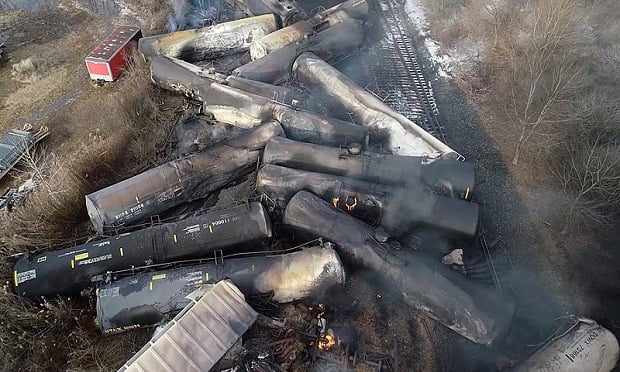
 Drone footage shows the freight train derailment in East Palestine, Ohio, U.S., February 6, 2023 in this screengrab obtained from a handout video released by the National Transportation Safety Board. (Wikipedia Commons)
In the month since 38 railcars carrying hazardous material came to a grinding, fiery halt in East Palestine, Ohio, interest has swelled around cleanup and liability concerns related to the dangerous derailment.
The crash caused nearby towns to evacuate residents, and the Environmental Protection Agency (EPA) ordered freight train operator Norfolk Southern to follow an approved toxic-waste remediation plan. Had the company failed to satisfy EPA requirements, the agency would have performed the remediation work itself and charged Norfolk Southern triple damages. However, roughly a week after the accident, the EPA reported that air quality around the crash site had returned to normal levels.
Train derailments often result in catastrophic losses to the railway company, its employees, the neighborhood, the environment and the country overall. For this reason, it's a good idea for insurance and risk management professionals to have at least a general understanding of what is and isn't covered.
ISO forms
Looking at potential third-party claims that might arise out of a train derailment, there could be physical damage to nearby buildings, residences, vehicles, persons or animals. This damage could be caused by an explosion, smoke, fumes or pollutants. And there could be resulting injury, illness or death. In some cases, there may be environmental damage from pollutants.
Here's how an insurance claims response would take shape based on standard ISO forms.
 A homeowners in East Palestine, Ohio captured this image of the Feb. 3rd Norfolk Southern train derailment from his front lawn. (Wikipedia Commons)
 Homeowners coverage: The physical damage from a train damaging the house would be covered, even if from an explosion.
However, if there is smoke damage to the interior of the house as a result of burning rail cars, that smoke damage would be excluded since it is not from a boiler, furnace or related equipment.
If the pollution is caused by a named peril, then there is coverage. As for vehicles, explosion and smoke are all included as named perils. A train is a vehicle, so the train derailing and leaking pollutants and causing damage would be covered.
However, the form does not cover pets. So if Fido died or Tweety Bird could no longer tweet, there would be no coverage for their injury or loss. The homeowners form also does not provide coverage should residents become hurt or ill as a result of the accident. but if cousin Bill was visiting and he sustained an injury from the event, there could be coverage under the homeowners medical payments section.
Coverage is provided for necessary medical expenses for "bodily injury" to a person on the "insured location" with the permission of an "insured." There are no qualifications as to how an injury must occur, just that someone is injured on the premises. Therefore, if the chemicals from the spill made their way into the insured's well in the yard and a visitor was made ill, there could be coverage.
Commercial property insurance: Physical damage from the train, its fire, explosion or smoke are all specified causes of loss covered by the form. While trains are not specifically listed, vehicles are, and a train is a vehicle. Damage from pollutants dispersed from the train accident would also be covered, or any resulting specified causes of loss caused by the pollutants themselves. Animals are only covered if they are stock and inside a building, so if the business has outdoor guard dogs, they would not be covered.
General liability insurance: The general liability form will provide medical expense coverage for any third party injured on the insured's premises. Medical expenses coverage is provided regardless of fault.
Commercial and personal auto coverage: Under either the personal auto or the business auto forms, bodily injury from a train accident would be covered, and physical loss or damage to a covered auto will be covered if insured for comprehensive / collision coverage. If the vehicles are hit by or hit a train and an injury occurs there is coverage under the liability or med pay sections, depending. If the vehicles drive into a puddle of chemicals from the spill and is damaged, then collision coverage would apply.
ISO standard coverage forms are not designed to cover the unique nature and exposures of railroads; as such coverage for the train and liability from the incident must be sought in the specialty marketplace.
Trains and freight
Trains are often used to haul freight, and in fact most of us not directly affiliated with their operations would likely be surprised by what gets shipped by freight, from household goods, to heavy equipment, vehicles, oil and other hazardous/flammable products, lions and other large and dangerous or exotic animals, and numerous other goods. Annually 1.7 billion tons of goods are transported by train across the country.
Most large freight shipments involve a sizeable number of companies with coordinating arrangements. The rail operator typically owns the engine and the track. It may own some of the transport cars, or it may be transporting cars owned by other rail operators. The freight, of course, is owned by the shipper or the company receiving it. Sometimes shippers own the cars that carry their goods.
There are roughly 1,000 derailments across the country in any given year. While most accidents are minor and rarely lead to injury or death, environmental problems are more common. Spills have in the past been rare, but as with any increase in frequency of operations the risk of accidents also increases. So, as more companies look to rail shipments vs other methods, this increases not only the risk of accident frequency, but also accident severity, based on the adage of 'frequency breeds severity'. Looking at this in terms of railway accidents, basically – the more accidents you have, the better chance that one will be severe in nature.
Rail liability
According to information available on III's website, railroads are not required to purchase insurance, but most do. Rail liability is sold primarily in excess and surplus lines and has five main coverages:
- Bodily injury and property damage liability, which covers injuries and destruction in case of derailment.
- Bill of lading (cargo) coverage, which reimburses the shipper for lost or damaged cargo, usually receiving a set amount following a loss schedule. Often shippers buy their own cargo insurance separately.
- Foreign rolling stock coverage, which pays for losses to the rail cars the operator does not own.
- Evacuation expense coverage, which handles cleanup after spills of hazardous materials like oil or other toxic or polluting substances.
- Federal Employees Liability Act coverage, which — a bit like workers compensation in other industries — protects and compensates railroad employees on the job.
Two major perils with catastrophic potential are typically covered by insurance – pollution and terrorism.
It is common for the largest railroad companies to retain much of their risk, through self-insurance or other alternative methods. The capacity limits offered to railroads are high to encompass the size and geographical operations of the railroads, allocated into Class I (larger railroads), Class II (regional), and Class III (short line, few tracks).
The railroad operator must carry any cargo brought to it, provided it is packaged and labeled according to federal regulations If there is a derailment, the operator is typically responsible for damages, both to the freight and to any injuries or property damage.
Railroad safety
The derailment in East Palestine, Ohio has highlighted questions about railroad safety, though federal data show accidents involving hazardous materials of that scale are very rare. The American Association of Railroads reports that between 2000 and 2021, train accident rate was down 33%, and the hazmat accident rate is down 55% since 2012.
No matter how safe something is, accidents happen, as do injuries and damages. Where there is risk there is a need for a way to compensate those affected. Insurance is one way to ensure that people are fairly compensated for their injuries or damages.
Superfund
In 1980, Congress established the Comprehensive Environmental Response, Compensation and Liability Act (CERCLA), which is commonly known as Superfund. The Act allows the EPA to step in and either force the company that caused the spill or accumulation of toxic waste to clean up the site, or for the EPA to clean it up and pay for those costs.
With respect to the East Palestine, Ohio train derailment, Norfolk Southern will be required to remediate the area under a plan approved by the federal agency, rather than doing the voluntary cleanup its CEO had previously pledged. As part of the EPA requirements, Norfolk Southern will have to pay for the remediation, under penalty of fines for violations. The company must also pay for cleaning services that the agency will offer to residents and businesses, participate in public meetings and publicly share information.
The article includes copyrighted material of Insurance Service Office, Inc., which is published with its permission.
© Arc, All Rights Reserved. Request academic re-use from www.copyright.com. All other uses, submit a request to TMSalesOperations@arc-network.com. For more information visit Asset & Logo Licensing.