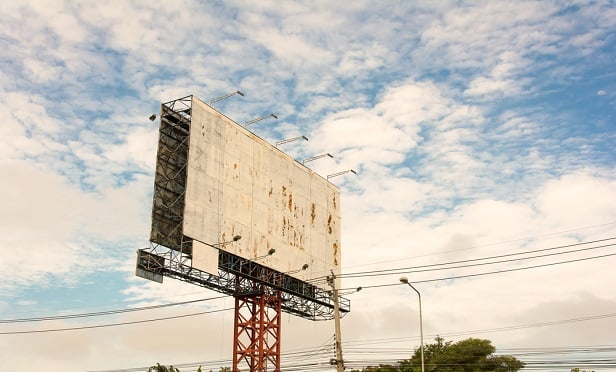
 Weak welds can cause signs to blow over in high winds, causing property damage. (Photo: Shutterstock)
Large road signs are subject to failure from a variety of causes. A typical scenario is a failure during severe wind conditions. High velocity winds can cause sign poles to break and fall, snarling traffic and creating headaches for commuters. Replacing these damaged structures can also be costly for businesses and municipalities.
Figure 1
 Figure 1 is a view of a typical large sign advertising the location of a motel off an interstate highway. (Photo: C. Roberts)
Figure 2
 Figure 2 shows a sign that failed during a windstorm where wind speeds approached 70 MPH. The sign was designed to withstand winds on the order of 90 MPH. (Photo: C. Roberts)
Figure 3
 A base plate that failed at the weld. (Photo: C. Roberts)
 Figure 3 shows the sign base plate, which is one-inch thick steel bolted to a concrete pier. The sign column tube has failed at a weld at the base plate. Wind-induced vibration has caused the weld to be overstressed, resulting in a dynamic fracture of the weld. Essentially the weld unzipped. A close-up inspection of the weld showed the existence of several imperfections in the weld.
Figure 4
 A degraded weld with severe undercutting. (Photo: C. Roberts)
 Figure 4 is a close-up of a portion of the weld showing severe undercutting and lack of penetration in the weld. Lack of penetration or fusion in a weld forms small cavities and crevices in the weld, reducing weld cross-section and strength. Over time, pitting in the cavities and crevices is subject to further degradation from crevice corrosion.
The formation of cavities is a result of poor welding procedure including improper electric current setting, improper electric arc length, improper electrode angle and lack of skill in movement of the electrode over the weld. An undercut results from excessive current and improper technique when welding, causing loss of base metal, a reduction in cross-section and weld strength. Although the wind speed was reportedly near 70 MPH, the sign should have survived without failure. The likely cause of this failure is a deficient weld that was over stressed by the wind conditions.
Charles C. Roberts, Jr., Ph.D., P.E., (ccr@croberts.com) is president of C. Roberts Consulting Engineers, Inc., which provides professional engineering services in accident reconstruction, failure analysis, fire causation, explosion analysis, and biomechanics.
© Arc, All Rights Reserved. Request academic re-use from www.copyright.com. All other uses, submit a request to TMSalesOperations@arc-network.com. For more information visit Asset & Logo Licensing.