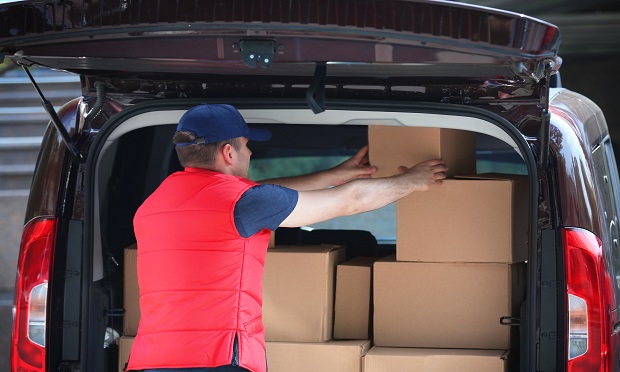
 Same-day delivery is seen as the holy grail of the e-commerce customer experience. (Photo: Shutterstock)
Online shopping is more than an option for consumers; it's a preference.
Consider that 80% of Americans have likely made an online purchase in the past month. The influence and impact of e-commerce is growing quickly, with estimated sales for Q2 2017 up more than 16% year-over-year, representing $111.5 billion according to the U.S. Census Bureau of the Department of Commerce.
As e-commerce demand grows, retailers are actively seeking ways to be better and faster than their competitors — particularly when it comes to the delivery experience.
"Now, it's all about speed," says Jay Masterson, division underwriting manager of National Insurance Casualty with Liberty Mutual Insurance. "Shoppers no longer consider three to four days to be fast. It needs to be two days or less."
"Or less" is increasingly is the goal, with same-day delivery seen as the holy grail of the e-commerce customer experience. Traditional retailers — many of whom have struggled with bankruptcies and store closings as they contend with the growing shift online — are treating this as an opportunity.
"Brick-and-mortar businesses are potentially better positioned to provide same-day delivery than online retailers as they already have established inventory hubs: their stores," says Masterson.
The challenge is that final leg of getting the product to the customer: transporting purchased goods from store to doorstep. Traditional shipping partners certainly continue to play a role. And as those companies enhance technology to improve delivery speed, retailers will happily take advantage of that.
But most retailers are not waiting around for the perfect shipping solution — they're exploring options like hiring sharing-economy service providers or even asking their own employees to make deliveries. While these options can certainly help retailers fulfill the promise of same-day delivery, they also present new business risks.
Connecting with sharing/on-demand economy service providers
Ride- and delivery-sharing service providers allow retailers to not only offer same-day delivery, but also use app services to track deliveries in real time. Retailers may also be able to save on the direct costs of delivery, potentially as much as 44% compared with traditional partners, according to L2.
However, a retailer could be taking on new risks and costs in other areas. When using a traditional shipper, the retailer knows it's using an established brand with well-known capabilities and quality standards, as well as a permanent workforce and its own fleet. Ride- and delivery-sharing service providers are a much more recent development and may require the retailer to work harder to evaluate capabilities and meet expectations. For example, sharing economy drivers are freelancers, which may make it difficult to ensure consistency in driver quality and vehicle type.
Retailers should also consider the potential reputational risks of using a third party.
"If folks aren't going to the store, their interactions with delivery people might be their only face-to-face contact with the retailer," Masterson says. If that experience does not go as expected — the product or property is damaged, the delivery is late, or someone is injured — the retailer's brand will suffer most.
For retailers choosing the sharing economy, the most important step is drafting contracts with ride- and delivery-sharing companies that make clear the retailer's expectations and spell out each party's responsibilities and risks. Critically, these contracts should ensure that liability is placed where it belongs.
During the contract process, retailers can also gain a better understanding of how service providers screen, manage, train and assess the quality of their drivers — and any geographical or package size limitations they might have.
And retailers should review their delivery plans with their brokers and insurers. There, they can discuss the coverages and limits of a ride- or delivery-service company and determine if the retailer has any coverage gaps.
Having employees deliver from store to doorstep
While not as common, some retailers are leveraging their existing employees, like those manning cash registers and stocking shelves, for same-day deliveries. The most obvious advantage is financial: Rather than paying a third party, the company can have an employee, already on the payroll and at the store, deliver packages — perhaps on his or her way home from work.
But retailers should take caution if they choose this method: While it may appear to be the simpler option, it also poses challenges.
First, employees might use their own vehicles. Managers will need to consider factors like driving eligibility and vehicle size and condition when deciding who is eligible to drive. Employers should also carefully monitor how many hours the employees work in order to minimize the risk of fatigue-related accidents.
As with ride- or delivery-sharing services, any retailer that is considering using their own employees should first discuss plans with its broker and insurer, as coverage and limits may need to be adjusted. And there is a significant change in risk exposures when a retailer's employees take to the road for deliveries.
"When you take employees out of the contained environment of a retail store and put them into other settings like their cars, a customer's property or a parking lot, retailers definitely lose substantial control," Masterson says.
Retailers should also set fleet safety guidelines, similar to companies with commercial vehicle operations. This starts with reviewing motor vehicle records and assessing which employees can make deliveries.
"Just because an employee passed a background check doesn't mean he or she is a good driver or has a well-maintained vehicle," Masterson notes.
Other recommended steps include communicating safe driving practices, documenting expectations, and crafting distracted driving policies. For more on fleet safety guidelines, see our article Controlling Your Commercial Auto Costs.
Monitoring same-day delivery: Is it working?
Regardless of how a retailer delivers goods, it should track the program to ensure packages are being delivered on time and monitor customer feedback. Retailers should understand their capabilities — especially around holidays and the high-volume periods — to avoid overpromising or cutting corners to meet unreasonable deadlines.
"Whatever options you choose, program oversight and internal/external communication are critical and can help you maintain quality levels and meet customer expectations," says Masterson.
Customer expectations are changing as e-commerce competition intensifies and alters the retail landscape. Retailers today are being pressured to effectively execute same-day delivery. Tomorrow, they will have to meet another demand. In the end, they will be expected to evolve and adapt quickly — but they must remember to implement quality and safety controls, and adhere to them, as they venture into unfamiliar territories.
To learn more about Liberty Mutual's commercial insurance coverages and services, visit https://business.libertymutualgroup.com.
© Arc, All Rights Reserved. Request academic re-use from www.copyright.com. All other uses, submit a request to TMSalesOperations@arc-network.com. For more information visit Asset & Logo Licensing.