 I don't drink coffee.
This is primarily due to the fact that I once had a boss who sat directly next to me, whose terrible coffee breath turned me off to the scent of it. But I digress; the point is, I get my morning caffeine from iced tea. Arizona and Snapple are my two drinks of choice, both at home and in the office. So when those 12-packs of Raspberry Snapple that you see in the supermarket drop below six bucks, I'm all over it.
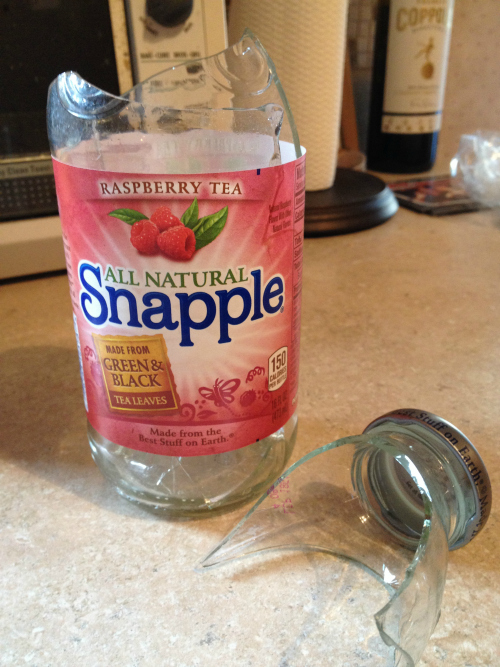
Recently, I was removing the bottles from one such 12-pack I'd purchased and putting them into my refrigerator when I heard the clink of shifting broken glass. I was halfway into the bottles when I realized one was broken off at about a third of the way down, its top now a jagged edge just ideal for hand-slicing—which is what would have happened, had I not been paying attention and just absentmindedly been pulling the bottles out. How often do we let our attention drift when performing a task like that, or worse, let one of our kids do it?
When I was a teenager, I worked at an ACME supermarket for two years. I unloaded pallets of goods from trucks, in all kinds of weather. I know how things get broken. But this was not your typical mishap by a clerk; this was a broken bottle that was empty (as in, it had never been filled), placed inside a 12-pack. Where it sat, wasn't even on an outer row adjacent to the cardboard.
I've always felt a certain brand loyalty to Snapple, whose slogan remains the same as it has for years, "Made from the Best Stuff on Earth." Originally based on Long Island, Snapple came from humble beginnings and gained national notoriety in the early '90s via live radio commercials on Howard Stern and its quirky, homegrown TV commercials featuring Wendy Kaufman, "the Snapple Lady," who would answer questions from fans. As such, it always felt like a hometown product to me, and that personal connection has always weighed into my purchase decisions.
There's always been an unspoken promise there, as I'm sure it exists for many of us in our lives: Don't do anything dumb that makes me question your integrity, and I'll keep buying your product. The company has changed hands several times since, and is now owned by the Dr. Pepper Snapple Group.
Naturally, I assumed that this drink company of which I've been a longtime consumer and which I've long held in high personal regard for its humble roots would be very concerned to hear about such a thing happening, but at least would be glad that it was brought to their attention. Part of effective risk management, especially at the corporate level, is about listening to the boots on the ground, staying in touch with your constituents—especially in cases where things go wrong. And any agent or broker worth his salt will tell you that dealing with clients is all about managing relationships, regardless of client size.
Deliver on your promise, they'll tell you, and don't forget where you came from. Manage those personal relationships.
The Snapple folks took my call the following week and asked for the appropriate codes on the bottle, which I was told might help discover where the accident took place. But even during two separate conversations, there was never a single word said by their company folks that indicated they were sorry it happened.
Now, understand—I'm a realist. This is a corporate entity now, not the little, local company whose product I grew so fond of. But it was telling that all this was done by the book, with not a single acknowledgement of fault. Such is the litigious environment we live in, where no one can say they're sorry for anything anymore, lest they open the door to a clear admission of blame.
I asked the rep what I should do with this 12-pack box, which had plenty of little shards of glass in it. I thought they'd at least replace the 12-pack I'd bought, which would have been a nice gesture that would have gone a long way.
"Do what you want," they said.
About two weeks later, I received a form letter from the Dr. Pepper Snapple Group saying that what happened was unfortunate, yadda yadda yadda, but that they were supplying me with a coupon good for one—one—single-serve bottle of Snapple.
Did I expect the Snapple Lady to show up at my house with a truckload of free Snapple? Of course not. But it's the principle. And when things go wrong with a longtime customer, you have only one chance to get it right. And in my mind, they blew that chance.
Hey, that's too bad you could have sliced your hand open, pal. Buy hey, have one Snapple on us, guy! Cheers!
I'll be returning their generous coupon, thanks. With a strongly worded letter letting Snapple know exactly what they can do with their one bottle.
The lesson here is simple. When an insured has a claim, or an issue, you have one opportunity to do right by them. When that call comes, they're depending on you to make the right decision. Make it.
Otherwise, you may end up like the company whose logo arguably should be, "Made from the Most Careless, Stingy Stuff on Earth."
© Arc, All Rights Reserved. Request academic re-use from www.copyright.com. All other uses, submit a request to TMSalesOperations@arc-network.com. For more information visit Asset & Logo Licensing.